News: Short & sweet / archive |
|---|

|
|

Song Thrush freed from mist net © Committee Against Bird Slaughter (CABS)
Cyprus: Once again this year, the winter culling of song thrushes has cost the lives of thousands of birds seeking rest and nourishment
The relatively sparse illegal bird trapping and hunting activities at the beginning of 2026 received a massive boost on 27 January 2024, triggered by thousands of Song Thrushes flying into Cyprus. They stopped over on Cyprus to rest and forage during their spring migration back north.
Our bird conservationists were well prepared for the surge in illegal hunting and trapping, and in the first week after the thrushes arrived, three illegal hunters and one bird trapper were caught in the act and reported to the authorities.
With the support of the Cypriot police and the Game Service, five illegal mistnets were dismantled and confiscated in a single night.
Results so far from the Cyprus Winter Bird Protection Camp (5 weeks):
Illegal bird trapping
Shot song thrushes – victims of illegal hunting © Committee Against Bird Slaughter (CABS)
Night-time dismantling of an illegal mist net © Committee Against Bird Slaughter (CABS)

A Little Owl in its apple tree cavity © H. Glader
Cutting (pollarding) old willow trees to secure and protect natural Little Owl nesting and breeding sites is not a job for the faint-hearted
The persistent cold winter weather, with light frost at night, this January in East Westphalia, in the districts of Paderborn, Gütersloh and Soest, has allowed our volunteer Little Owl conservationists and the tree care company we employ to rapidly pollard the willow trees that were selected by our colleague Herbert in summer 2025 and contractually agreed for maintenance.
Of the 780 willow trees we planned to prune this winter, from early November 2025 to late February 2026, more than 550 trees have already been professionally ‘topped’, putting us ahead of schedule.
We therefore want to continue to take advantage of the frosty weather, which is ideal for this hard work, and, if the weather remains cold, create up to 900 pollarded willow trees this winter... that would be a record number of well-maintained willow trees. See also the chart below.
Chart: Pollarded Willow Care – Little Owl Protection Project © SPA
Avenue of pollarded willows maintained by us in 2022 © SPA

Kingfisher in driving snow © A. Kneifel
We extend our heartfelt Christmas and New Year wishes, along with our sincere thanks, to all who have supported our Foundation's work for the benefit of nature and biodiversity with such dedication and commitment throughout 2025.
Despite political and economic changes in Germany and around the world, our 23rd year of work in species conservation was positive and successful for our nature and species protection projects. Thanks to the continued financial support of many long-standing, loyal donors and sponsors, as well as new donors and sponsors, we were able to consistently conduct our statutory project work in 2025. Once again, you deserve our heartfelt thanks.
We would also like to express our heartfelt thanks to the tenants and area managers of our Foundation's nature conservation areas for implementing our statutory objectives, and the species protection land use guidelines designed for this purpose, with great competence and passionate conviction for the benefit and consolidation of our biotope habitats and the diversity of wildlife species that is found there.
We are well prepared and optimistic as we enter our 24th year of work in species protection, and we will continue to develop our existing nature and species conservation projects with great passion. We are particularly looking forward to working with you to successfully address the challenges ahead for new nature and species conservation projects in Germany and Italy.
The teams at the Foundation Pro Biodiversity in Bielefeld and Sicily wish you and your families a peaceful and joyous Christmas and a happy and healthy New Year in 2026!
Thank you for your loyalty and your continued support.
Our wintry Finowtal lowland moor conservation area © SPA
Our Little Owl Conservation Project – Pollarded Willow maintenance in the Paderborn Region © SPA

Dismantled limesticks and songbird victims © Committee Against Bird Slaughter (CABS)
Cyprus Bird Protection Camp / Final Report Autumn 2025
The Autumn Bird Protection Camp special operations ‘Occupy Akas’ and ‘Dead Air’ required our bird protection teams to carry out extensive and time-consuming on-site preparations for the missions and a variety of media activities. However, the results were well worth the effort.
The Autumn Bird Protection Camp, which has now come to an end, will be remembered as a milestone in our bird protection efforts against the ‘big players’ in the bird slaughter business in Cyprus. For many years, we have fought in vain against the mass industrialised illegal trapping of migratory birds by ‘Akas’ and ‘Trikkis’ (our code names). Their social status and influence, as well as their extensive network in the bird slaughter scene, have regularly prevented even politicians and the police from consistently enforcing the applicable laws.
The previous ‘cheap’ fines did not prevent their bird slaughter activities for even a single day. With our actions this year and the extensive publications and professional media work, the police could no longer ignore these serious violations of the applicable EU Birds Directive and Cypriot nature conservation laws. As a result, an anti-terrorism police unit was also deployed during police operations on the properties of ‘Akas’ and ‘Trikkis’. ‘Akas’ was caught three times engaging in illegal bird trapping with nets, and ‘Trikkis’ five times!
The result was that these bird slaughter professionals finally received hefty fines totalling almost €150,000! In bird-slaughter currency, this corresponds to the proceeds from 40,000 to 50,000 illegally killed songbirds, which small-time bird poachers can obtain from black-market bird dealers.
The successes against the ‘big players’ did not dissuade our bird protection teams from investing another eight weeks of work in searching for trapping and hunting sites, monitoring and documenting illegal bird trapping and hunting activities in a manner admissible in court, dismantling illegal trapping equipment and filing further criminal charges.
The overall results of this year's autumn bird protection camp in Cyprus are equally impressive.
Overall results of the CABS & SPA Autumn Bird Protection Camp 2025 on Cyprus
(10 September – 25 November):
Bird trappers / illegal bird hunters
The good news for migratory birds that have chosen Cyprus as their wintering ground is also bad news for Cyprus's bird poachers and hunters: Cyprus, we'll be back. Our bird conservationists will soon return for the Winter Bird Protection Camp on Cyprus... That's a promise!
Willow Warbler caught on an illegal limestick © Committee Against Bird Slaughter (CABS)
Spot the birds: how many Eurasian Blackcaps are trapped on the limesticks? © Committee Against Bird Slaughter (CABS)

Bird conservationist removing illegal limesticks © Committee Against Bird Slaughter (CABS)
2nd Cyprus Bird Protection Camp Report 2025
The special operations “Occupy Akas” and “Dead Air” have also brought very positive results. Although both operations ran only for several days and ended around 2 weeks ago, they achieved results that had never been accomplished before. The Cyprus Police finally recognised professional trapping as a serious issue that needs to be dealt with.
They carried out several well-organised anti-poaching operations against the two biggest trappers in Cyprus: Akas and Trikkis. In total, the Cyprus Police seized 15 nets from Akas and 16 nets from Trikkis. During one particularly successful operation at the Akas site, police found seven nets set and freed 350 migrating birds from the nets. At Trikkis' site, police found 11 nets set and freed 150 birds. A further 150 birds were already dead when police officers arrived at the trapping location.
As a result of police operations, Akas has been issued a fine totalling 30,000 euros. Trikkis was fined the same amount. It is the first time in the history of our Cyprus Bird Protection Camps that the big trappers were confronted with such hefty fines.
Overall results of the CABS & SPA Autumn Bird Protection Camp 2025 in Cyprus from 10 September to 10. October:
Bird trappers
Bird hunters
We hope very much that the Cyprus Police will continue such consequent operations against big trappers until the end of the autumn bird migration period and the corresponding trapping season. This is the only way to put a stop to professional bird poaching, which makes a lot of money from illegally killed songbirds.
Eurasian Wryneck cut out of a mist net © Committee Against Bird Slaughter (CABS)
Male Eurasian Blackcap freed from a mist net © Committee Against Bird Slaughter (CABS)

State game warden with confiscated songbird victims © Committee Against Bird Slaughter (CABS)
1st Cyprus Autumn Bird Camp Report
This autumn bird protection camp mission will be something that Cyprus's biggest professional bird poacher, known under the pseudonym Akas, will never forget for the rest of his life!
For days, bird conservation teams demonstrated in front of his massive trapping facility with posters and live video broadcasts on social media, and unlike in previous years, the police finally showed up at his property and confiscated two huge mist nets. Caught red-handed in the act of illegal bird trapping, Akas also received a hefty fine.
Our bird conservationists received media support for this ‘STOP Bird Slaughter’ protest campaign from Chris Packham, a well-known BBC reporter and active bird conservationist in England, who reported live to England via the BBC and lent a hand himself in dismantling illegal limesticks and nets. His report can be found at the link at the end of this report.
In addition to these ‘special bird protection operations’, the other results of the bird protection camp are also noteworthy. In addition to Akas, a team of bird conservationists caught another large-scale professional bird poacher. He had set up a total of 270 limesticks on his property, along with an electronic bird call device, and was illegally catching up to 100 songbirds daily.
.
Results of the Cyprus Autumn Bird Protection Camp (2 weeks in September 2025)
Bird trappers
Male Eurasian Blackcap caught on a limestick © Committee Against Bird Slaughter (CABS)
Bush with 15 prohibited limesticks installed © Committee Against Bird Slaughter (CABS)

Voracious goats carrying out biotope maintenance work © M. Pfeifer
The preliminary work was lengthy and sometimes very difficult, but a milestone has now been reached at the "Schimmels Teiche" near Limbach-Oberfrohna in Saxony …
After completing approximately one and a half kilometres of sturdy electric pasture fencing, two water buffaloes have now joined the three hungry billy goats in our unique biotope with nine former fish ponds. And with a Scottish Highland cow arriving soon, we will have further reinforcement for biotope maintenance!
With their almost limitless appetite, these animals not only ensure that blackberries, shrubs and invasive Japanese knotweed are kept at bay on the pond banks, but also reduce the excessive growth of bullrushes in the ponds. These still benefit from the mud at the bottom of the ponds, which is heavily fertilised by fish excrement.
Only by reducing the biomass in and around the ponds will the water bodies and pond banks be able to develop in a variety of ways and, following the end of intensive fish farming four years ago, become species-rich biotopes.
Building the pasture fence was not the only challenge on the approximately 12-hectare pond area, which has been owned by our foundation since 2023. The extensive renovation of the pond drains, repairs to the stream inlets and careful reed cutting in an overgrown pond required a lot of work and also cost a considerable amount of donated money. Further biotope work is planned for the coming winter half-year 25/26.
The presence of the semi-wild grazing animals and the sturdy, electrified fence will also ensure that, after years of unauthorised trespassing and recreational use of our property, peace and tranquillity will finally return to this ecologically sensitive pond area.
From now on, the focus here is no longer about human activities, but about protecting the habitat of endangered bird species such as Marsh Harriers, Bluethroats and Reed Warblers, and endangered amphibians such as the Common Spadefoot Toad and the Smooth Newt.
Conservationists from the Limbach-Oberfrohna region, including well-known ornithologists, are already enthusiastic about our pond project, which will certainly bring many positive benefits for biodiversity, which is under threat in many places, over the next few years!
Young water buffaloes are not fussy eaters © M. Pfeifer
Water buffaloes enjoy the cooling ponds and shelter © M. Pfeifer
Seed heads of the invasive amaranth plant © SPA_IT
After extensive biotope restoration work for our migratory bird sanctuary Pantani Cuba & Longarini, biotope maintenance work is now increasingly on the agenda
Just as nature in Germany is confronted with invasive wild plants such as Siberian hogweed, Canadian goldenrod and Japanese knotweed, and wildlife such as raccoons, raccoon dogs and Asian hornets, which have no natural enemies here, invasive wild animals and plants from Africa and South America are increasingly colonising Mediterranean countries.
Since 2013, we have been quite successful in halting, limiting or, ideally, ending this development in our Pantani Cuba & Longarini migratory bird sanctuary. Since the extremely dry years of 2023–2024, the invasive plant amaranth, which is native to Central America and is highly prolific in terms of growth and reproduction, has begun to colonise the edges of the reed belt in our sanctuary in Pantano Cuba and Longarini, where it is already forming dominant populations in some areas.
Once again, we owe a debt of gratitude to the tireless efforts of the members of the local nature conservation group "Pirati della Marza" (Pirates of Marza), who have been helping for years with hundreds of hours of voluntary work to make our Pantani nature reserve a paradise for Mediterranean flora and fauna.
In July, despite the high temperatures, a group of loyal Pirati volunteers worked in our Pantani reserve to suppress amaranth, one of the oldest crops in South and Central America. Before hundreds of ripe ears could scatter millions of seeds, the amaranth plants were cut down individually by hand at the base, their ears collected and stored in plastic bags to be composted.
Through the targeted collection of the ears, this invasive plant species was removed from our nature reserve's reed and meadow habitats. The 'seed harvest' filled 12 sacks, each with a capacity of 100 litres.
Pirati volunteers during the amaranth seed collection campaign © SPA_IT
After completing the biotope maintenance, just about enough energy is left for a smile. © SPA_IT

Tour of the Winningen conservation tower at its inauguration © SPA
Inauguration of our 38th species protection tower, this time in the Rural District of Salzland, Saxony-Anhalt
Under the watchful eyes of the first residents to move in – a Starling, a Great Tit and a Blue Tit – we were able to inaugurate our 38th species protection tower on 24 June 2025 with a small celebration in Winningen suburb of Aschersleben. The craftsmen involved in the construction, the district mayor, and the mayor of Aschersleben joined the numerous children from the nearby Winningen daycare centre in celebrating ‘their new species protection tower’. The children proudly presented their large banner with pictures they had painted themselves of the animal and bird residents they expect to see in the tower in the future.
The idyllically located transformer station supplied the small village of Winningen with electricity for more than 100 years before it was decommissioned in 2023. Discovered during one of our regular work assignments in our nearby nature reserve ‘Seeländereien bei Frose’, we quickly agreed with the regional energy supplier and the town of Aschersleben in April 2024 to take ownership of the listed industrial monument and convert it into a species protection tower adapted to its location.
Renovation work on the species protection tower began in autumn 2024 and, following a break during the winter, was completed in time for the 2025 breeding season. The old transformer tower station now serves a new and meaningful purpose as a species protection tower in Winningen, providing a future-proof roof over the heads of Barn Owls, Jackdaws, Swifts, House Martins, Starlings, Tree Sparrows, House Sparrows, White Wagtails and several bat species.
We hope the children's enthusiasm in Winningen for their new species protection tower will rub off on their parents, inspiring them to create suitable habitats for the wild animals inhabiting their property and gardens. It doesn't take much effort!
The conversion costs for the new species protection tower in Winningen, amounting to just under €30,000, were financed by our Pro Biodiversity Foundation from private donations earmarked for this purpose.
Kindergarten children from Winningen present their conservation tower wall poster © SPA
Winningen kindergarten artists at their wall poster presentation © SPA

Greater Flamingo breeding colonies in our Pantano Longarini lagoon © SPA_IT
Unlike this spring, the extremely dry year of 2024 in Sicily offered little chance for the successful breeding and rearing of young ground-nesting birds in wetlands and lagoons.
In the sweltering heat of summer 2024, with temperatures reaching +45°C, up to 50 schoolchildren took the opportunity to tirelessly clear the bird breeding islands we had created in the Pantano Longarini lagoon of vegetation that had grown up, thereby creating perfect breeding habitat conditions for ground-nesting bird species such as the Greater Flamingo, the Stone Curlew, Black-winged Stilt, Little Tern and the Collared Pratincole, which is breeding in the lagoon area for the first time this year.
And, to our great delight, this spring seven species of birds are using them, some of which have become rare, including those that only breed in colonies, such as Greater Flamingos and Little Terns!
In the coming weeks, we will be able to show schoolchildren the fruits of their hard work last summer, which is perfect for ground-nesting birds, and give them a personal sense of achievement in nature.
August 2024 - Schoolchildren remove vegetation from the breeding islands © SPA_IT
May 2025 - Breeding pairs of birds on islands in the Pantano Longarini lagoon © SPA_IT

Bird hunting hide on the island of Zakynthos © Commitee Against Bird Slaughter (CABS)
Zakynthos (Ionian Islands / Greece) Spring Bird Protection Camp Report
The 3rd year of our Spring Bird Protection Camp on the island of Zakynthos (Greece), organised jointly with the Committee Against Bird Slaughter, will also be remembered as the most painful for the bird conservationists who participated.
From their experience over the past two years, our activists were well prepared for insults and aggressive hostility from angry hunters, but a physical attack by up to 15 hunters, some of them masked, was a new and not exactly longed-for, and at times bloody, experience. Three of our bird conservationists had to visit the hospital on Zakynthos to have their injuries treated, but were able to leave the same evening.
During the assault by hunters, our bird conservationists were able to capture video evidence with their bodycams which, despite the hunters fleeing the scene of the attack, led to the arrest and temporary three-day detention of four hunters for assault and destruction and theft of equipment. After the first court hearing, all four hunters had to post 3,000 € bail and are not permitted to leave the island until the second court hearing in approximately six months time!
Apart from the unpleasantness, it was gratifying that the news of this incident, and the consequences for the hunters involved, spread like wildfire across the island and thus thoroughly ruined illegal and criminal bird hunting for many hunters, at least for this spring.
Results of the Zakynthos Spring Bird Protection Camp (18.04 – 02.05.2025)
Although illegal bird hunting on Zakynthos has been noticeably and measurably curbed this year thanks to our 3rd Bird Protection Camp, there is still a lot of courageous migratory bird rescue and protection work to be done by our bird conservationists in the coming years. This applies in particular to a key region of illegal spring migratory bird hunting on Zakynthos, the Keri peninsula
Illegally shot strictly protected European Bee-eater © Commitee Against Bird Slaughter (CABS)
Island of Zakynthos - View of the Ionian Sea © Commitee Against Bird Slaughter (CABS)

A female Eurasian Blackcap trapped on a limestick in a mulberry tree © Committee Against Bird Slaughter (CABS)
1. Cyprus Spring Bird Protection Camp Report
Unlike the previous two springs, our hopes for continued low levels of illegal migratory bird hunting in Cyprus were not entirely fulfilled in 2025. There was a flurry of illegal activity at several active migratory bird hunting sites. For the first time in many spring seasons, illegal nets were set up and electronic bird call devices were used to maximise the number of birds caught. This took place not only during the day, but also in the early hours of the morning before sunrise.
But even the petty bird catchers were not entirely idle, and so our bird conservationists had to dismantle illegal limesticks in berry-bearing bushes and trees at several trapping sites or ask the state game warden service for assistance.
It was gratifying that bird poachers were caught red-handed at the three most active bird trapping sites and reported to the authorities.
Results of the Cyprus Spring Bird Protection Camp (18.03 – 11.04.2025):
Bird trappers
A female Eurasian Blackcap is freed from a limestick © Committee Against Bird Slaughter (CABS)
A Lesser Whitethroat trapped on a limestick © Committee Against Bird Slaughter (CABS)
Wild Mallow, Poppy and Corn Marigold on dry stone wall near Modica © SPA
Our revegetation project aims to create new wildflower meadow biotopes on the arable land purchased by our Foundation to expand our Pantani Migratory Bird Sanctuary north of our Pantano Longarini lagoon
Despite our best efforts, we have been unable to purchase certified wildflower seeds in Sicily in recent years that would have enabled us to convert the formerly intensively used arable land north of our Pantano Longarini lagoon into permanent, species-rich wildflower meadows.
The time is now ripe, following our acquisition of more than 12 hectares of arable land in 2023. After intensive waste disposal work and several ploughing sessions, we planted French sweet clover to rehabilitate the soil.
No sooner had the idea been born among our on-site Bird Guards to collect wildflower seeds at suitable locations in the region between Ispica and Granelli on the south-eastern coast of Sicily, numerous members of the local environmental protection group "Pirati della Marza" from Ispica (province of Ragusa), which has been extremely helpful to us for years, volunteered to collect wildflower seeds.
It was admirable to see the great motivation and perseverance with which the women and men of the Pirati environmental protection group completed the wildflower seed collection work, which was hard on their backs and knees. They not only searched the flower meadows of our Pantani migratory bird sanctuary, but also fallow land along country roads and field paths, as well as in olive and almond groves.
The impressive result of the seed collection campaign will enable us to sow more than 7 hectares (70,000 m²) of sloping land with genetically appropriate wildflower seeds. This will benefit the Mediterranean insect and bird population, including migratory birds such as the Common Linnet, European Goldfinch, Eurasian Skylark and Crested Lark, for whom we can thus create a species-rich and nutrient-rich meadow biotope of the highest quality.
SPA Pantani Re-Flowering Project Poster © SPA_IT_PG
Members of the Pirati nature conservation group collect wildflower seeds © SPA_IT

Great Egret (right) and Grey Heron (left) in the Seeländereien © U. Nielitz
The Salzlandkreis district, situated east of the Harz in Saxony-Anhalt, is not exactly known for its abundant water and high precipitation levels. However, the 75-hectare lake district near Frose is a true paradise for wetland birds and those inhabiting inland waters and reed beds
Many reed-lined shallow waters have emerged and are still emerging after the cessation of the use of the nearby open-cast lignite mines and the shutdown of the open-cast mining pumps that followed German reunification. In this intensively farmed landscape, this relatively small wetland has a magical attraction for migratory birds from the North Sea and Baltic Sea coasts on their journey south and return to their breeding grounds - waterfowl from inland and shallow waters, bird species from wet meadows and songbirds from the reedbeds.
They all benefit from our land purchases, which have been ongoing here for more than 12 years, and our efforts to have the area designated and protected as a nature reserve. And that, we hope, will finally become a reality in 2025.
View to the east over the Seeländereien near Frose © SPA
View to the south over the Seeländereien near Frose © SPA
A Dartford Warbler in the maquis near our Pantano Longarini lagoon © SPA_IT
After almost 12 months of drought in Sicily, the diversity of bird species resting and foraging in our Pantani Migratory Bird Sanctuary is breathtaking.
The re-filling of our lagoons and riparian wetlands with water after the heavy precipitation in January 2025 was as astonishing as the speed with which the migratory bird species of the North and Central European seacoasts, inland waters and wetlands returned!
What was still utopian in mid-January has been a gratifying certainty since the beginning of February: the Pantano Longarini lagoon has broken through the flat sand dune on the beach with immense water pressure and created a connection to the Mediterranean Sea, only 100 metres away. This means that saltwater fish, crabs and small crustaceans can now swim into the lagoon, significantly improving the food supply for waterbirds, waders and birds of prey.
At the same time, our Bird Guards were able to document two new bird species in our sanctuary. It was with slightly clouded joy that the first Sacred Ibises were observed. This invasive bird species that escaped from private aviaries, have settled in the Po Valley in northern Italy and have been observed for the first time in Sicily.
There is, therefore, all the more reason to be delighted about the sighting of a Dartford Warbler in our coastal Pantani dwarf shrubland (maquis) areas. This Mediterranean songbird species has become extremely rare and now only occurs in the mountainous regions and rocky hills of Sicily.
With the two new bird observations, we are now at 254 documented bird species in the Pantani Nature Reserve!
A Dartford Warbler in the riparian maquis of our Pantano Longarini lagoon © SPA_IT
The mouth of the Pantano Longarini lagoon opening onto the Mediterranean Sea © SPA_IT
Northern Lapwings fly over the Pantano Cuba lagoon © SPA_IT
Sporadic summer drying out of the Pantani Cuba & Pantano lagoons is a natural dynamic, but what was new was the months-long drought, which has finally come to an end with more than 150 litres of precipitation per m² in only five days …
The sporadic drying out is crucial for the freshwater lagoons and wet meadows and future water quality in particular, as harmful germs, bacteria and non-native introduced animal species lose their basis for existence and thus their adverse effects on the diverse migratory birdlife.
And as fast as our lagoons and the wet meadows near the shore filled up with water again thanks to the heavy rainfall, so rapid was the return of the migratory bird species of the northern and central European coasts, waters and wet meadows! Finally, we are glad to say! Our Bird Guards and we, too, were already showing signs of withdrawal due to the absence of migratory birdlife and biodiversity.
If we experience further precipitation by spring 2025, the mouth of the Pantano Longarini lagoon will be able to open up to the Mediterranean Sea, allowing salt-water fish, crabs and small crustaceans to enter the lagoon. This will increase the food supply for waterfowl, wader species, and birds of prey while creating new aquatic life!
Common Shelducks in flight over the Pantano Longarini lagoon © SPA_IT
The estuary of the Pantano Longarini lagoon where it meets the Mediterranean coast © SPA_IT

Yellowhammer in the snowy Hirschgrund near Oberlungwitz © M. Pfeifer
As 2024 draws to a close, our heartfelt best wishes for Christmas and the New Year, together with a huge thank you, go to all who have again shown such commitment and support for our foundation's work for the benefit of nature and its incredible biodiversity this year.
Despite many worrying economic and political developments in Germany and the world, the 22nd year of our nature and species conservation project work was a good and successful one to the benefit of flora and fauna biodiversity. As in the past 21 years, we could only conduct our statutory project work this year thanks to the ongoing financial support of many loyal and first-time donors and sponsors. Once again, our heartfelt thanks.
We would also like to sincerely thank the tenants of our foundation-owned nature conservation areas for fulfilling our species-protecting land use requirements for the benefit and strengthening of our biotope areas and the diversity of wildlife species found there with great expertise and passionate conviction.
We are well prepared and full of optimism as we enter our 23rd year of working to protect endangered species. We will continue to pursue and develop our existing nature and species conservation projects with great passion and, together with you, are particularly looking forward to successfully tackling the challenges ahead of us in new nature and species conservation land purchase projects in Germany and Italy.
Thank you for your loyalty and your continued sponsorship support.
Winter landscape with pollarded willows in the Sieker district of Bielefeld © SPA
Highland cattle herd in the snowy Hirschgrund © M. Pfeifer

Song Thrush trapped on an illegal limestick © Committee Against Bird Slaughter (CABS)
Republic of Cyprus: Report # 5 from the Autumn Bird Protection Camp
Since the end of October, an increasing number of bird hunters have been operating illegally on Cyprus, ruthlessly optimising the hunting of the song thrushes and skylarks on stopover with the massive support of illegal electronic bird call decoy devices. The high number of migratory birds killed in this way still tempts many bird hunters to use this illegal hunting method despite the risk of heavy fines.
With the operational focus of our bird conservationists' nocturnal rescue missions on the actively used hunting sites, the number of bird hunters caught in the act and reported to the police rose continuously.
In the last two weeks of the bird protection camp's deployment in November alone, two bird poachers were caught trapping birds with limesticks, and ten bird hunters were caught using bird call decoys to support bird hunting illegally.
In almost 12 weeks of operations, 14 bird conservationists from six European countries once again demonstrated remarkable stamina, great civil courage and passion in the fight against the appalling murder of migratory birds.
The most important result of the bird protection camp work is the high number of charges preferred against bird trappers and bird hunters caught red-handed. Hefty fines demonstrably have a lasting effect on other active bird poachers and bird hunters in the region, as the penalties range from €600.00 to €8,000.00.!
Results of the Cyprus Autumn Bird Protection Camp 09.09.2024 – 28.11.2024
(Previous year's results 2023 in brackets)
Bird trappers
Illegal mist net facility erected by professional trappers © Committee Against Bird Slaughter (CABS)
Male Eurasian Blackcap freed from an illegal mist net © Committee Against Bird Slaughter (CABS)

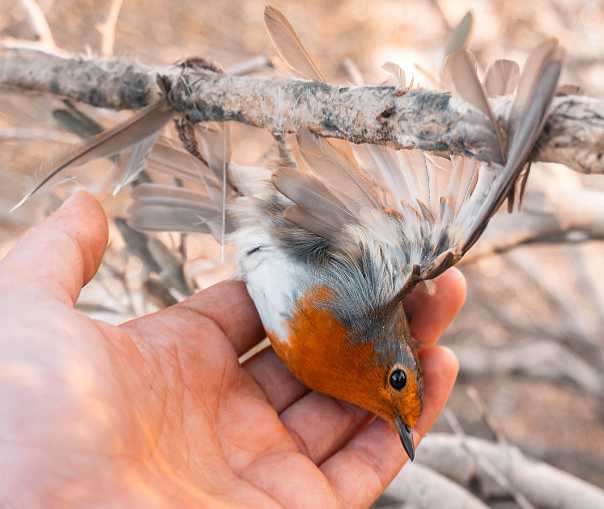
A European Robin male trapped on a limestick © Committee Against Bird Slaughter (CABS)
Republic of Cyprus: Report # 4 from the Autumn Bird Protection Camp
Not unexpectedly, our bird protection activists also experienced extremely active bird poachers and a sharp increase in illegal bird hunters during the 4th and 5th bird protection camp weeks this autumn. With the departure of the Eurasian Blackcaps from Cyprus towards the south since the end of October, the poaching of migratory birds with illegal limesticks and nets is gradually decreasing. However, hardcore bird poachers are switching to capturing Song Thrushes, European Robins and European Stonechats using illegal electronic bird callers.
Since the end of October, hunters have also been increasingly active, ruthlessly optimising their hunting instinct for the arriving Song Thrushes and Eurasian Skylarks with the help of illegal bird callers. The use of these prohibited decoy systems means that up to ten times more thrushes are shot at the hunting sites.
Fortunately, the number of bird hunters caught in the act and reported to the police increased in line with the number of nocturnal bird rescue operations carried out by our bird conservationists at the hunting sites.
Since the end of October, nine bird poachers and seven hunters have been caught and reported. One hunter was caught red-handed by our bird conservationists, shooting thrushes and larks directly behind his house. He will receive a hefty fine because hunting in residential areas is strictly prohibited. Whether he will learn from the expected heavy fine remains to be seen next year.
Results of the Autumn Cyprus Bird Protection Camp 09.09.2024. – 11.11.2024 (nine weeks)
Bird trappers
A male Eurasian Blackcap female trapped on a limestick © Committee Against Bird Slaughter (CABS)
An Eurasian Blackcap male is freed from a mist net © Committee Against Bird Slaughter (CABS)

Bird conservationist frees a female warbler from a limestick © Committee Against Bird Slaughter (CABS)
Republic of Cyprus: Report # 2 from the Autumn Bird Protection Camp
As expected, our bird protection activists also observed considerable activity by bird poachers and hunters during the 2nd and 3rd weeks of this autumn's bird protection camp. Following the widespread absence of bird poachers and hunters during spring bird migration in Cyprus, it goes without saying that the ‘big players’ in the bird slaughter industry are already taking advantage of the current very strong influx of migratory birds to Cyprus to maximise their profits from this bloody business.
The greed for tax-free profit is so great among some poachers and hunters that we are currently recatching bird poachers whom we had already caught and reported years ago and who paid heavy fines at the time.
Clearly, fines need to be substantially more severe before they wise up!
Results of the Cyprus Autumn Bird Protection Camp 09.09.2024 – 28.09.2024 (3 weeks)
(Results of the Autumn Bird Protection Camp 03.09. – 02.10.2023 (4 weeks))
Bird poachers
Bloody songbird catch of a bird poacher caught in the act © Committee Against Bird Slaughter (CABS)
Dismantling a huge illegal mist net complex for migratory birds © Committee Against Bird Slaughter (CABS)
Ortolan Bunting in an illegal mist net © Committee Against Bird Slaughter (CABS)
Republic of Cyprus: Report # 1 from the Autumn Bird Protection Camp
As expected, our bird protection activists are unfortunately experiencing much more active bird poaching and hunting this autumn. After the marked absence of bird poachers and hunters during the spring bird migration on Cyprus, the "big players" in the bird slaughter business, in particular, are counting on an autumn full of birds to bring them the long-planned-for tax-free profits from this bloody business.
Our bird protection activists found what they were looking for in the first few days of operations and, in addition to several small bird trapping sites, discovered a large professionally operated bird trapping site with seven illegal nets and two illegal electronic bird call decoys. Unfortunately, despite a lot of time and effort, we were unable to catch the bird trappers(s) red-handed.
Nevertheless, 67 songbirds, some rare migratory species, were released from the nets alive and reasonably unharmed. These included Ortolan Bunting, Willow Warbler, Garden Warbler, Northern Wheatear, Spotted Flycatcher and even a Masked Shrike.
Results of the Cyprus Autumn Bird Protection Camp (09.09.2024 – 14.09.2024):
Bird trappers
Willow Warblers trapped on an illegal limestick © Committee Against Bird Slaughter (CABS)
A mist net facility erected by professional illegal bird trappers © Committee Against Bird Slaughter (CABS)

After the German TV programme of SWR has broadcasted the TV film "Sicily - Italy's Sunshine Island in the Mediterranean" incl. our 2 Sicily nature and biodiversity projects on Sunday, 15th, September 2024 at 8.15 hours CET, for all of you who have missed the film or could not receive it, below the link to the mediathek:
Sicily - Pantani migratory bird sanctuary: TV film shooting in extreme heat © SPA
Sicily – The TV crew enthusiastically filmed the Great Flamingos © SPA_IT_PG

Sicily – TV film shooting in our Pantani migratory bird sanctuary © SPA
Following the showing of a short-form film version (45 minutes) on the French/German TV programme ARTE in May 2024, the full Sicily documentary film version (90 minutes) will now be shown on the German TV programme of SWR in the framework of their series "Dream Destinations" in the TV film "Sicily - Italy's Sunshine Island in the Mediterranean". The Foundation Pro Biodiversity’s migratory bird protection project and the wildlife rescue project are well represented in this film.
The SWR will broadcast the film "Sicily - Italy's Sunshine Island in the Mediterranean" in its TV film series "Dream Destinations" (90 min) on Sunday, 15 September 2024, from 8:15 pm, which will also include comprehensive reports on our two migratory bird and wildlife conservation projects in Sicily, the Pantani Cuba & Longarini Migratory Bird Sanctuary on the southeast coast and the Messina Wildlife Rescue Station on the Strait of Messina.
If you missed the Arte documentary in May, be sure to tune in this time. It will be well worth your while!
Sicily - Pantani migratory bird sanctuary: TV film shooting in extreme heat © SPA
Sicily - The TV crew enthusiastically filmed the Great Flamingos © SPA_IT_PG
Voluntary biotope maintenance work to remove vegetation on the bird islands © SPA_IT
Effective biotope maintenance work by male and female volunteers for ground-nesting bird species in hot Mediterranean temperatures
We would like to thank the regional groups of the Italian non-profit organisations "Legambiente Sikelion - Ispica" and "Libera - Coordinamento Ragusa" for their recommendation and coordination of an immensely important and valuable biotope maintenance project for the conservation of ground-nesting bird species on the new islands we created in 2023 in our Pantano Longarini lagoon, which is currently dried up.
While weather stations and the media in Germany categorised the three-day midsummer heat of up to +35° C in the shade over the last few days as dangerous and quite unbearable, 26 men and women from all over Italy worked voluntarily at +40° C in the blazing sun with dedication and a great deal of motivation in sweat-inducing biotope maintenance for the benefit of ground-nesting bird species such as the Little Tern, Little Ringed Plover, Kentish Plover and the Eurasian Stone-curlew.
The aim of the biotope maintenance work was to systematically remove the densely grown ground vegetation on the new bird islands we created in 2023. In particular, the bird species that breed in colonies on the ground prefer largely vegetation-free sand and rubble areas, which offer them a clear view of the ground nest environment and thus early detection of potential predators.
Under the expert guidance of our Sicilian Bird Guards, the volunteers, despite the sweltering heat, only needed just under three hours to remove as much vegetation as possible from the five most important bird islands. As a result, almost 15 m³ of plant material was removed, which we dried within twelve hours and are now using as mulch material for our newly planted olive and carob trees on the banks of the Pantano Cuba lagoon.
Voluntary biotope maintenance work on the bird islands in the Pantano Longarini lagoon © SPA_IT
Final result of vegetation removal on one of the bird islands in the lagoon © SPA_IT
A fire on 01.08.2024 on the south side of our Pantano Longarini lagoon © SPA_IT
In addition to the months of drought in Sicily, thousands of fires and conflagrations have now occurred, some of which are the result of negligence, others have been set with criminal energy
Three so far unidentified persons have deliberately set fires on 30 July and 1 August 2024 on the north, west and south sides of our Pantano Longarini lagoon in our migratory bird sanctuary. This is the first criminal attack against our protected area in almost five years! The media and carabinieri have been informed.
The fires burnt down almost 21 hectares (210,000 m²) of dry reeds, grassland and scrubland. Fortunately, our painstakingly maintained firebreaks and the extensive mowing of vegetation before the start of each dry season prevented anything worse. An initial thorough inspection of the burnt areas by our Bird Guards, the fires showed that, fortunately, only minor damage to wildlife had been caused.
The burnt vegetation will recover six weeks after the first winter rains, and wildlife will recolonise the revitalised habitat.
After a wildfire on our waterfront properties on the north side of the Pantano Longarini lagoon © SPA_IT
The firebreaks along the safety fences have held ... the fences are still standing © SPA_IT
The dried-up Pantano Longarini lagoon at the end of July 2024 © SPA_IT
The sporadic summer drying out of the Pantani Cuba & Pantano lagoons is not a new phenomenon. Nevertheless, the fact that the drought began up to six weeks earlier than usual is a new phenomenon …
For the Greater Flamingo breeding colony with almost 500 chicks, the water level in the Pantano Longarini lagoon was just enough for the adults to rear their young safely. Now, in the renaturised canals, which are gradually drying up, very little food is left for the young flamingos. The Pantano Longarini lagoon is now completely dry, and the Pantano Cuba lagoon has hardly any water left.
When we began purchasing land to establish our migratory bird sanctuary in the Pantani Cuba & Pantano Longarini wetland complex in 2013, we were very irritated to experience the sporadic drying up of the two lagoons. Today, we know that this drying out is an integral part of the natural cycle for the lagoons and wetlands and future water quality.
Otherwise, this wetland complex would often be liable to outbreaks of bird influenza due to the extremely high concentration of thousands of waterfowl and their droppings over months. However, bacteria and germs die in the sweltering heat of the blazing sun and the correspondingly hot, dried-out mud of the lagoon bed.
The drying up of the lagoons, which refill with rainwater in the winter months, is part of the dynamism of this wetland complex, but this year the natural cycle has been severely disrupted. Sicilians reported a similarly severe dry period some 25 years ago!
So, we and the migratory bird world can only hope for more abundant winter rainfall so that our Pantani nature reserve can once again become an undisturbed, food-rich resting place for the autumn migration of tens of thousands of migratory birds seeking food and wintering here. We have transformed the wetland complex into an important natural habitat, and we will continue to develop it further in the future.
Young Greater Flamingos in the dried-up Pantano Longarini channel © SPA_IT
Dried-up channels and, in the background, the dried-up Pantano Longarini lagoon © SPA_IT
Freshly hatched Jackdaw chicks in the Dörtendorf species conservation station (Thuringia) © SPA
After a slow start to the breeding season in the cool, wet spring, our conservation buildings are now full of young birds
In our 37 species conservation towers and buildings across Germany, the breeding business got off to a slow start due to this year’s rather wet and cool spring. But now, at the beginning of summer, our species conservation structures are full of bird life, and the nurseries are well-populated.
It gives us great pleasure to report that, for the first time in years, almost all our species conservation towers are occupied by broods of Common Kestrels and Barn Owls.
House Sparrows are highly flexible and creative occupants of nesting cavities. They also use House Martin nests and niche nestboxes as stylish Sparrow residences.
Starlings will stop at nothing to build nests. They even crawl through the narrow oval flight holes of the Common Swift nestboxes and fill the extensive space inside completely with nesting material.
Unfortunately, this year, we are experiencing a massive decline and the absence of Tree Sparrows, which still bred regularly in our species conservation towers last year. At present, we can only speculate about the causes. Was it the wet spring, the increasing lack of insects to forage or the accumulation of pesticides used in intensive agriculture?
Increasingly, Coal Tits, Blue Tits and Nuthatches are also finding favour with our cat-, marten- and raccoon-proof buildings and breed here undisturbed and well-protected.
Unfortunately, the increasingly unused nest boxes and artificial swallow nests by Common Swifts and House Martins reflect the creeping decline in the populations of these species.
The breeding bird surveys in our conservation buildings will continue in June! Subsequently, you will find the data of the recorded bird broods on the pages of the respective species protection towers on our homepage, immediately following the bird photographs, by clicking on the button for species documentation.
Common Kestrel chicks in the Brilon (NRW) species conservation tower © SPA
Barn Owl chicks in the Radepohl (M-WP) species conservation tower © SPA

Sicily – TV film shooting in our Pantani migratory bird sanctuary © SPA
This year, the French/German TV programme ARTE and the German regional station SWR will also present our dedicated migratory bird conservation and wildlife rescue projects in Sicily in two separate documentary films.
ARTE will broadcast the TV documentary (42 min) "Sicily - Italy's sunny island in the Mediterranean" on Friday 17 May 2024 from 6:30 pm and again on Saturday 25 May 2024 from 10:30 am.
SWR will also be featuring two of our migratory bird and wildlife conservation projects in Sicily in its TV film series "Dream Destinations" (90 min) on Sunday, 15 September 2024 at 8:15 pm. Your support and viewership are crucial in spreading awareness about these important initiatives.
Sicily - Pantani migratory bird sanctuary: TV film shooting in extreme heat © SPA
Sicily – The TV crew enthusiastically film the Great Flamingos © SPA_IT_PG

Whinchat © SPA_IT_PG
In April of this year alone, our Bird Guards counted more than 110 migratory bird species during their weekly bird counts in our Pantani Cuba & Longarini Migratory Bird Sanctuary
Among the migratory bird species observed and scientifically documented were four new bird species that have not been observed in our Pantani Migratory Bird Sanctuary since 2013: Lesser Flamingo, Corncrake, Rufous-tailed Scrub Robin and Collared Flycatcher.
Since the start of our survey work in 2013, our bird species checklist has grown to 253 species. This is the best reward for our 11-year migratory bird conservation project commitment here on the southeast coast of Sicily, which involved extensive land purchases and habitat restoration and renaturation work.
The most common migratory birds in April were the Whinchat with almost 100 individuals in one day and an unusually high number of Pied, Collared, Spotted Flycatchers and Wood Warblers.
All observations of these migratory bird species were made in our protected areas, where we had planted hundreds of olive, almond and carob trees and Mediterranean wild shrubs in recent years. This again emphasises the importance of our biotope structure improvement measures, particularly in the hillside slopes bordering the Pantano Cuba lagoon to the east, where intensively cultivated greenhouses stood just a few years ago.
Rufous-tailed Scrub Robin © SPA_IT_PG
Spotted Flycatcher © SPA_IT_PG

Our conservationists are equipped with body cams for the first time © Committee Against Bird Slaughter (CABS)
2nd Cyprus Spring Bird Protection Camp Report
Fortunately, the bird poaching and hunting front on Cyprus remains relatively calm this spring, and millions of migratory birds have so far been able to continue their onward flight from Cyprus to Central and Northern Europe largely unscathed after resting and foraging here.
Our bird conservationists have not remained idle due to the reduced bird-trapping activity but have used the time to systematically locate and remove ground nets, which are increasingly being set up in orchards and other plantations. These ground nets are principally intended to keep snakes out of the properties!
Sadly, these ground nets are also death traps for songbirds, hedgehogs, and other smaller wild animals. Our bird conservationists have freed not only songbirds but also hedgehogs from the ground nets and have dismantled several hundred metres of nets that bring suffering and death to wildlife.
Results of the Cyprus Spring Bird Protection Camp (26.03 – 17.04.2024)
Bird trappers
A Eurasian Wryneck is cut out of a ground net © Committee Against Bird Slaughter (CABS)
Releasing a female Eurasian Blackcap from a limestick © Committee Against Bird Slaughter (CABS)

The first visible Bonelli’s Eagle offspring 2024 © E. Sabbioni
Second report from the Bonelli’s Eagle and Lanner Falcon Raptor Protection Camp 2024
In mid-April 2024, after a wide-ranging search, we identified just under 60 occupied eagle eyries and are systematically expanding our protection work accordingly. The provisional eagle protection camp centre now receives almost daily reports of Bonelli’s Eagle and Lanner Falcon offspring in the monitored eyries and nests.
As the eaglets grow up, and due to the already high temperatures, the parents are already beginning to hunt for food in pairs in flight for short periods of time. This is beneficial for the young eagles' food supply.
The first Lanner Falcon chicks have also begun to hatch, but the number of actively occupied falcon nests is alarmingly low. Of the more than 100 Lanner Falcon nest sites known to our conservationists - some of which are historical - only 15 nests appear to be occupied by breeding pairs. However, we can only determine this more reliably when the young falcons begin to sit up in the nests in the coming weeks.
A Bonneli’s Eagle breeding pair in flight above the eyrie © A. Micalizzi
Pair of Lanner falcons on hunt lookouts © A. Scuderi
Our 37th species conservation tower is located in the Hesseln suburb of Halle (Westphalia) © SPA
On the 15th of April 2024, in the Hesseln suburb of Halle, North-Rhine Westphalia, we officially opened our 37th species conservation tower for the commencement of its new and significant purpose
Many species of wildlife that inhabit buildings, such as the Common Kestrel, Barn Owl, Eurasian Jackdaw, House Martin and Barn Swallow, Common Swift, House and Tree Sparrow, Black Redstart, White Wagtail and bat species, which used to co-exist happily with humans, are now increasingly missing a roof over their heads. House renovation and energy-saving measures destroy thousands of nesting, breeding and hiding places for structure-dwelling wildlife species every year, often out of ignorance but also due to a misunderstood sense of orderliness.
Sterile gravel 'gardens', hostile to nature and the climate, are turning residential areas into a hell on earth for wildlife diversity. An increasing and unnatural quietness now surrounds our homes and yards, and, with the loss of indigenous wildlife, we rob our children of valuable nature experience and, simultaneously, a significant part of their quality of life.
The sad result is that many of the bird species that were previously welcomed as heralds of spring are now on the Red List of breeding birds in Germany. The Common Starling and the House Martins are already considered endangered, and even the Tree Sparrow is now on the 'early warning list' of endangered breeding bird species!
Since 2005, we have consistently implemented our species conservation strategy for structure-dwelling bird species, bats, and insect species such as hornets and butterflies, creating sustainable, secure, and undisturbed building refuges. This has been achieved through the conversion of disused or decommissioned transformer tower stations, deep well buildings and pumping stations into species-appropriate conservation structures. These have established themselves as regional biodiversity survival islands.
The Hesseln transformer tower was built in 1963 for local electricity distribution and decommissioned in 2022. After its energy supply function ended, it was scheduled for demolition.
Our conversion of the disused transformer tower into a species conservation tower gives it a new, meaningful, and progressive function for practical species conservation in urban areas. The conversion began in late autumn 2023 and, after a break due to bad weather, was completed just in time for the start of the 2024 breeding season. Informative illustrated display boards will be erected by the beginning of May 2024.
Such a conversion costs money. Our Foundation Pro Biodiversity (SPA), recognised as a non-profit organisation, financed the costs of the new species protection tower of almost 40,000 euros primarily from private, earmarked donations. T.W.O GmbH & Co. KG, the former owner of the transformer tower station and the district of Gütersloh, contributed a total of 5,500 euros to the financing of this artistically designed species conservation lighthouse project. This is also intended to inspire and motivate local people citizens to implement practical species protection measures in their own homes.
Official opening of the species conservation tower in the Hesseln suburb of Halle (Westphalia) on 15.04.2024 © SPA
The new species conservation tower in the Hesseln suburb of Halle (Westphalia) between residential area and open countryside © J. Morchner

Limesticks confiscated by police officers at a bird trapping site © Committee Against Bird Slaughter (CABS)
1. Cyprus Spring Bird Protection Camp Report 2024
As we had hoped, the spring of 2024 is still relatively peaceful on the bird poaching and hunting front in Cyprus. Due to the efforts of our conservationists on the frontline of bird slaughter on the island, millions of migratory birds are beginning to reap the harvest of almost 15 years of bird protection camp operations by the Committee Against Bird Slaughter (CABS) and the Foundation for Biodiversity (SPA).
However, the low level of bird poaching activity does not make it easy for our conservationists to catch the still-active bird trappers red-handed. The latter now spend only a short time at their illegal trapping sites due to the costly risk of being caught by our conservationist teams.
Nothing is more expensive for bird trappers than being caught and reported by the police or Game Fund officers at the scene of the crime, complete with active limesticks, mist nets, and migratory bird victims.
The first bird trapper caught had 32 actively set limesticks but was able to remove and hide the trapped birds before the police arrived. In a second instance, our conservationists managed to film another trapper setting out 24 limesticks before the arrival of the police. He was reported to the authorities.
Both trappers were previously unknown to us, but now, to their irritation, they are on our books. The anticipated fines of up to 9,000 euros each will hopefully have a lasting deterrent effect.
Results of the Cyprus Spring Bird Protection Camp (26.03. - 09.04.2024)
Bird Trappers
Female Blackcap trapped on a limestick © Committee Against Bird Slaughter (CABS)
Limesticks prepared for bird trapping in a hawthorn bush © Committee Against Bird Slaughter (CABS)

Eagle conservationist using a wildlife camera to protect eagles' nests © A. Scuderi
This year's Bonelli's Eagle and Lanner Falcon raptor conservation camp in the mountainous regions of Sicily is now in full swing
The breeding year 2024 got off to a very promising start for the Bonelli's eagle population on Sicily. By mid-March 2024, 51 occupied breeding territories had already been recorded. Our eagle conservationists will undoubtedly find more active breeding pairs of eagles during this year's eagle and lanner falcon conservation camp.
The first Bonelli's Eagle chicks hatched at the end of March, marking the beginning of the hot phase of our eagle protection camp. This phase includes continuous daily surveillance of the eagle nests, where the risk of young eagles being stolen by poachers is greatest.
As with the migratory bird protection camps on Cyprus, we have also upgraded our protection technology for the eagle protection camp on Sicily to document and intercept potential eagle poachers as they approach the eyrie sites and in the immediate vicinity.
It is particularly helpful that our volunteer eagle protectors also include forest police officers who can take immediate official action on site.
The population and breeding pair situation of the Lanner Falcon, a beautiful falcon species found only in southern Europe and Africa, is very sad, not to say dramatic, on Sicily. This falcon species is highly susceptible to disturbance during the breeding season, and the parent birds often abandon their clutch and young even when disturbed in the wider area around the nest.
These disturbances are not only caused by many bird-of-prey photographers but, in particular, by bird-of-prey poachers, who realise horrendously high prices for Lanner Falcon eggs and young on the bird-of-prey black market. The Lanner Falcon population on Sicily is collapsing, and this negative trend is intensifying. Only by extensive financial and operational conservation investment will it be possible to prevent the extinction of this rare falcon species there!
It is a pleasure to report that, for the first time this year, our Lanner Falcon conservation activities in Sicily and the population survey of last year's breeding pairs have led to the ISPRA (Italian Institute for Environmental Protection and Research) lending us their support.
Following a joint evaluation of this year's Lanner Falcon protection camp's results and experiences, we expect more effective police and robust political support for future Lanner Falcon protection activities on Sicily.
Eagle conservationist on eyrie monitoring operations © A. Scuderi
Young Lanner Falcon © S. Cacopardi

A Song Thrush is freed from an illegal mist net © Committee Against Bird Slaughter (CABS)
Cyprus: The winter thrush slaughter, which is still practised on a massive scale, has cost the lives of tens of thousands of wintering Song Thrushes
In the first 4 weeks of operation of the Cyprus Winter Bird Protection Camp 2024, 7 bird poachers and 12 illegally operating bird hunters have already been caught and reported to the authorities. On the 18th of January 2024, a severe storm and heavy rain triggered an inconceivable boost in illegal bird trapping and hunting activity, which had been manageable for our activist teams at the beginning of January.
Tens of thousands of song thrushes, on migration to the Greek islands and the Turkish coastal region, were driven to Cyprus by the storm. On the night of the 18th to 19th of January, this unexpected landfall triggered an adrenaline rush among Cypriot bird poachers and bird hunters, and hectic thrush hunting activities ensued.
On the morning of the 19th of January, the sounds of massive and widespread gunfire were reminiscent of the front line of a battlefield. From one day to the next, our migratory bird conservationists were confronted with an initial unmanageable level of bird poaching and illegal hunting activities, causing them to increase their hours of operation dramatically.
Nonetheless, in the days following and with the surprisingly helpful support of the police and state game wardens, our teams managed to catch and report 6 bird poachers and 12 hunters.
The discovery and release of 2 Egyptian Fruit Bats (Rousettus aegyptiacus) from an illegal trapping net was remarkable. This species is threatened with extinction in Cyprus, with only an estimated 1,000 individuals of this rare mammal on the island remaining.
Results to date of the Cyprus winter bird protection camp (4 weeks):
Illegal bird poaching
Illegal bird hunters
Endangered Egyptian Fruit Bats freed from a mist net © Committee Against Bird Slaughter (CABS)
Illegally shot Song Thrushes © Committee Against Bird Slaughter (CABS)

Little Owl in its pollard willow refuge © S. Wolf
The pruning (pollarding) of old willow trees for the security and conservation of natural Little Owl breeding and nest sites is not a job for the weak at heart …
The now more than 320 l of much-needed precipitation per square meter in the Paderborn, Gütersloh and Soest districts from the beginning of November 2023 to mid-January 2024 has produced extremely difficult soil conditions in the lowland areas of Eastern Westphalia. In some cases, the heavy equipment we usually use was unable to access the pollard willow avenues and willow tree copses selected for pruning.
Our work teams still have to maintain a record-breaking number of almost 400 pollard willow trees until 29 February 2024, this year's end date for legally permitted tree pruning work.
Our Little Owl project coordinator Herbert Wolf has once again assured us that all involved are "raring to go" and, despite the mixed weather forecast for the second half of January 2024, are ready and willing to take on the challenge.
As was the case last winter, we will also install up to 10 species-appropriate Little Owl nest pipes at selected locations in pollard willows specially pruned for the birds, thus further improving the available habitat in Eastern Westphalia for this small diurnal owl.
We were particularly pleased by the media interest in our Little Owl conservation project, which we were able to present on the Local Time OWL programme on the evening of 17 January 2024, at the WDR3 -TV Studio in Bielefeld.
Pollard willows pruned in winter the following spring © S. Wolf
Winter landscape with pollard willows in the Bielefeld suburb of Sieker © SPA

Common Kingfisher in driving snow © A. Kneifel
Our heartfelt Christmas and New Year wishes, and sincere thanks go out to all those who have been so committed and helpful to our Foundation's work in 2023.
Despite some worrying developments in Germany and the rest of the world, our 21st year of commitment and hard work to our goals was a good one for our nature and species protection project work and the biodiversity of flora and fauna. We have achieved this once again only because many loyal and new donors, supporters and nature conservation foundations have lent us their financial support for our statutory project work. Special thanks go to the tenants of our nature conservation areas, who, with considerable specialist knowledge and passion, conscientiously fulfil the ecological land use requirements we demand for the benefit of local biodiversity.
The results of our committed project work in 2023
The year 2024 lies ahead of us, our 22nd year of commitment to species protection, and we have already done many months of preparatory work for up to 20 nature and species protection projects, some of which are completely new. Let's tackle it together again in the New Year.
A new land purchase project: The Limbach Pond complex (Saxony) © SPA
The wolf is also part of wildlife biodiversity in Mecklenburg-Western Pomerania © Leo/fokus-natur
Common Snipe during autumn migration in the Frose wetland © U. Nielitz
Three years of low precipitation and a resulting lack of shallow water bodies had made life difficult for the diverse birdlife of the wetland complex near Frose. We can now hope for a good breeding season in 2024.
Uwe, our on-site project coordinator for our 33 hectares, is very optimistic this year because of the progressively rising water levels. The wetland complex near Frose has been drained several times in the past 100 years to create usable arable land. Nonetheless, the fen basin, located below the municipality of Frose, still collects and stores the precipitation from the higher-lying land.
The past few dry years, high temperatures, and the lack of precipitation, even in the winter months, had caused the small shallow water bodies to disappear quickly in the spring. As a result, many bird species that rely on shallow water, intact reed beds and wet meadows lack the habitat requirements for successful breeding and rearing of their young. The wetland complex was quiet and subdued, and the biodiversity of birds and insects dwindled visibly.
At the beginning of October 2023, the Frose wetland complex was completely dried up. Uwe reports extensive rainfall (approximately 90 mm/equivalent to 90 litres of rain) throughout October. So far in 2023, around 530 mm (530 l) of rain has fallen, while in the whole of 2022, there was only 390 mm (390 l) of precipitation. Thankfully, more extensive water bodies are finally forming in the wetland again!
This means the wetland starts the winter with a reasonably high water level. If the next few weeks bring further precipitation in the form of rain or snow, there is a good chance of normal spring water levels, which were common until 2019.
In addition to Greylag Geese, the first 150 Nordic geese are now roosting in the area, and their numbers continue to rise. Up to 2,000 Common Cranes use the shallow water bodies as a night roost. Up to 7,500 Common Starlings have also roosted in the reedbeds in recent weeks. Particularly noteworthy from an ornithological point of view is the large number of Water Pipits. Up to 20 individuals roost in the wetland and will also spend the winter here. The ringed Great Egret from Belarus, which Uwe has observed for years, was once again in the Frose wetland complex for the whole of October 2023 this year.
As has been the case for years, Uwe will check the lake areas almost every day this winter and ensure that the birds that spend the winter there can rest and forage as undisturbed as possible. Our bird-watching tower once again offers superb bird and nature observations during the winter months.
Water Pipit – a rare winter visitor - in the Frose wetland © U. Nielitz
Common Cranes on 14.11.23 at their night roost in the shallow waters of the Frose wetland complex © U. Nielitz

Hesseln species conservation tower © SPA
Suitable refuge space for structure-dwelling wildlife, birds, bats and insects is becoming increasingly scarce ... we are combatting this with our species protection buildings!
Despite adverse weather conditions, the handicraft firms commissioned for the species conservation tower construction wasted no time in the past few weeks.
To date, 20 artificial nesting aids have been installed in the tower's walls. The roof structure, which has now been completely rebuilt and made of weather-resistant, long-lasting larch wood, together with the roof covering with beavertail clay tiles, will soon fulfil its species-conservation and regional biodiversity-consolidation effect with its diverse nesting opportunities, daytime refuges and wintering areas.
The comments from interested citizens of the suburb of Hesseln, praising the new gable roof, confirm our project goal of making our species conservation towers real eye-catchers, or 'lighthouse projects' as we say nowadays, with which the regional population can identify!
Plastering and painting of the walls, the installation of species-specific bat multi-crevice boxes from a local bat specialist under the roof overhangs, and the installation of artificial House Martin nests are planned for the next few days.
Although construction is still incomplete, the first potential residents, such as the House and Tree Sparrow, Common Kestrels and Great Tit, are already exploring their future secure 'home from home', and we and our craftsmen are doing our best to ensure that the building can provide well-protected and species-appropriate roosts for birds, bats and insects before the real onset of winter.
Following the hibernation period, we eagerly await the start of the breeding season and the arrival of the first residents. The official inauguration of our 37th species conservation building will then take place.
Young Common Kestrels prepare to fledge from nest boxes © SPA
The Hesseln species conservation tower with built-in nest aids for the Common Swift and Western Jackdaw © SPA
Abandoned, littered, plastic foil vegetable greenhouse © SPA
Before the renaturation and biotope optimisation of newly purchased land for our Pantani Migratory Bird Sanctuary, weeks of garbage collection and disposal are a mandatory requirement
Whether digging a hole for a fence post on the newly-purchased land for our Pantani Migratory Bird Sanctuary, planting a new tree or bush, excavating historic ditches on the lagoons, improving an old farm path or ploughing completely overworked arable land to convert it into flower meadows: always and everywhere we find illegally dumped waste, in large quantities and not just on the ground, but often buried to a depth of half a metre.
Since the massively intensified vegetable farming in Sicily, using agricultural chemicals (pesticides) and large amounts of artificial fertiliser under polytunnels and with artificial irrigation presses up to 3 harvests out of the overused soil, large quantities of plastic sheeting, defective irrigation hoses and disposable plastic boxes are produced every year. Even nowadays, they are often shredded and ploughed into the soil. Where else?
Even household garbage and other unusable materials are ploughed back into arable land. Vegetable consumers in Northern Italy and Central Europe thus end up with the crunchiest vegetables possible on their plates and between their teeth.
Thanks only to the tireless and never-failing commitment of the volunteer women and men of the small private nature conservation organisation "Pirati della Marza", we promptly and repeatedly clear rubbish from newly purchased properties and areas we already own. Not only that but equally important, we sort the collected garbage from our property and deliver it to officially approved collection points.
Also worthy of praise is the highly positive cooperation with the city council and the administration of the neighbouring city of Noto, a wonderful late baroque city in the Val di Noto and a UNESCO World Heritage Site, which has been constructive and generous for years by providing transport logistics and accessible collection of large amounts of waste.
Today, we can justifiably claim that large parts of our Pantani Migratory Bird Sanctuary, including the two lagoons, count among the cleanest, ecologically intact, and the most species-rich areas of open countryside thanks to years of garbage collection efforts of our Bird Guards, the volunteer "Pirati" and the Noto city administration.
Jumbo garbage collection by Pirati nature conservation association members © SPA_IT
Pirati garbage collection on newly purchased properties on the Pantano Longarini Lagoon © SPA_IT
The project manager installing the first 20 nesting aids © SPA
Starting signal for the construction of our 37th species protection building
Following the successful completion of our 36th species protection building in Runow (Rural District of Ludwigslust-Parchim), Mecklenburg-Western Pomerania in time for this year's breeding season, which was immediately occupied by a lively flock of House and Tree Sparrows, the starting signal for the construction of our 37th species protection tower was given at the beginning of October in the Hesseln suburb of Halle (NRW).
The Hesseln transformer tower is located directly on a lovingly maintained orchard meadow, grazed by small sheep of an ancient breed. This is a perfect habitat for our future structure-dwelling residents such as the Common Kestrel, Barn Owl, House and Field Sparrows and Eurasian Jackdaw, who will find a rich variety of insects, fruits and seeds in the vicinity of the tower, as well as the finest sheep hair for perfect nest upholstery.
After erecting the scaffolding on the tower at the beginning of October, we drilled the core holes through the thick tower walls for the installation of 20 nesting holes and began the preparatory work for building the new gable roof. In the coming days, the nesting boxes for Common Swifts, Eurasian Jackdaws, House and Tree sparrows, Black Redstarts and White Wagtails will be installed professionally.
The structure of the roof truss for the gable roof will then be erected. Nesting aids and hiding places for Common Kestrels, Barn Owls and Pipistrelle Bats will be installed in the new roof structure. The endangered European Hornet will also find a quiet, undisturbed corner here to build its free-hanging, football-sized nest.
If the construction work progresses as quickly as planned, the first animal overnight guests such as Barn Owls, Kestrels, House and Tree Sparrows and wintering guests such as Pipistrelle Bats, Peacock Butterflies and ladybirds could move into their new quarters as early as the end of November 2023!
This is how practical and effective species protection works for the structure-dwelling animal species that have long since disappeared in many places and are threatened regionally with extinction.
A Barn Swallow warms its young in the nest © Leo/fokus-natur
Start of construction at the Hesseln transformer tower © SPA

Long-eared Owl freed from a limestick © Committee Against Bird Slaughter (CABS)
2nd Cyprus Report: As we secretly feared, the 'major players' in the Cypriot bird poaching scene are now making up for in the autumn what they failed to do in the spring, namely massive trapping of migratory birds with nets and limesticks
During the first four weeks of the Committee Against Bird Slaughter and our Foundation bird protection camp on Cyprus, our secret fears for the autumn bird migration season have unfortunately come true. Illegally operating bird poachers and hunters on the island are now compensating for this year's greatly reduced bird catch in spring with extensive trapping activities during autumn bird migration.
As announced, this autumn our bird protection activists will once again be concentrating on the most active and brutal bird poachers and the 37 bird trapping sites they have discovered so far. Our operational strategy is already having an impact and its success is motivating our teams! So far, 20 bird poachers have been caught operating unlawfully at these active bird trapping sites, and their illegal activities have been well documented for the presentation of criminal charges. This is a record result for the first four weeks of operation of our bird protection camps!
Even more gratifying is the fact that, among the bird poachers caught by our bird protection activists, there are several who, despite repeated and well-documented observations of their illegal activities, have not been fined for years or who we had not been able to catch red-handed.
Among these, we were able to catch red-handed the so-called 'minefield trapper'. For many years, the man had set up his banned mist nets in an area officially marked as a minefield, thereby risking his life but remaining unmolested. That saga is now at an end. Our activists were finally able to catch and report the illegally operating trapper with his 3 large mist nets and an electronic bird call decoy system.
Particularly motivating for our activists was the success of their operation against two poachers who had been trapping migratory birds for years in the mountain region above the town of Troulloi. They use illegal mist nets and also specialise in trapping owls on limesticks. These two bird trappers, at whose site we have repeatedly found dead owls, have been at the top of our Wanted List for years!
This autumn, we did not dismantle the nets and limesticks at the site but rather monitored the trapping site for hours at a time until the poachers arrived on unregistered motorcycles to check their nets and electronic bird call devices.
Our bird protection camp activists surprised the two poachers, yelling loudly as they killed the birds caught in nets. In fright, the poachers ran to their motorcycles and sped away at high speed. Despite the lack of motorcycle licence plates, the responsible game wardens were able to identify the poachers from our photos and located them shortly afterwards.
The evening trip to their bird-trapping site ended with fines of up to 7,000.00 euros per person. A truly memorable excursion for both poachers.
Results of the Cyprus Autumn Bird Protection Camp (03.09 – 02.10.2023)
Bird trappers
Bird hunters
It is important to note that our bird protection activists, with practically no support from the responsible Cyprus Game Service, continue to carry out all bird protection work unaided, from reconnaissance of trapping sites, reporting the trapping site coordinates, photographically documenting bird poachers in the act and reporting the crimes to the responsible police station. In practice, our activists have to literally drag the state game wardens to the scene of the crime!
Female Eurasian Blackcap trapped on a limestick © Committee Against Bird Slaughter (CABS)
Release of songbirds from an illegal mist net © Committee Against Bird Slaughter (CABS)

Wood Warbler trapped on a limestick © Committee Against Bird Slaughter (CABS)
1st Cyprus report: The ongoing massive bird slaughter in autumn is increasingly shifting from bird poaching with illegal trapping gear (limesticks and mist nets) to illegal bird hunting activities
During the first ten days of the Cyprus Autumn 2023 Bird Protection Camp of the Committee Against Bird Slaughter (CABS) and the Foundation Pro Biodiversity (SPA), our unspoken fears for the autumn bird migration season have sadly been confirmed. Illegally operating bird poachers and bird hunters in Cyprus are now compensating for the significantly reduced bird catch in spring with massive bird slaughter activities during autumn bird migration.
However, it has given us great satisfaction to catch and report a poacher whom we have been after, without success, since 2015. Although our activists have dismantled and destroyed hundreds of illegal limesticks at his illegal trapping site over the past eight years, this is the first time we have caught him personally red-handed. We can now remove him from our 'wanted list', but we will continue to keep his trapping site under close observation!
Among the bird poachers our activists have already caught this autumn is a poacher we have caught and reported four times in the past ten years. He has been let off lightly each time with a fine of between 200-400 euros. On this occasion as well, he will regrettably only be fined 200 euros for possessing prohibited limesticks.
It now seems that an increase in illegal hunting activities is offsetting the decline in illegal bird trapping. Bird hunters have less to fear from our operations, as weapons can be quickly concealed or packed away, and they can leave the hunting site at top speed in their nearby parked SUVs!
In our 2nd Cyprus Bird Protection Camp Report, we will report the continued successful operations of our activists against illegal bird hunters.
First results of the Cyprus Autumn 2023 Bird Protection Camp (03.09 - 13.09.2023)
Bird Trappers
Two Wood Warblers and a Eurasian Blackcap trapped on limesticks © Committee Against Bird Slaughter (CABS)
Confiscated weapon and electronic bird callers © Committee Against Bird Slaughter (CABS)

Installation of a game camera near the eyrie of a Bonelli's Eagle © A. Scuderi
Five long months of Bonelli's Eagle protection camp operations in the mountains of Sicily brought remarkable results and extraordinary experiences!
With our project funding commitment of 8,000 euros, the extensive organisational preparations for this year's Bonelli's Eagle protection camp in Sicily began in January 2023, with the operational work in the mountainous regions of Sicily starting in March.
For the first time, Lanner Falcon breeding sites, a bird of prey threatened with extinction, were included in the surveillance of eyries and nests and on the more than 250 inspection trips to remote locations. For the 25 volunteer eagle conservationists, this involved a lot of additional, time-consuming deployment time, as Lanner Falcons react to even minor disturbances in the vicinity of the nest by abandoning their brood. Unfortunately, in the past, professional and amateur bird photographers, with their urge to take perfect photos of birds of prey, were repeatedly the cause of such brood losses, which threatened the existence of this beautiful falcon species.
Our teams monitored 65 Bonelli's Eagle eyries and observed breeding activity at 52 locations. A total of 53 young eagles successfully fledged from 33 eyries. This result represents the most successful fledging of young Bonelli's Eagles on Sicily since eagle protection camp work began in 2012!
The report of an Egyptian Vulture eyrie with a single adult bird unexpectedly interrupted the routine monitoring of the Bonelli's Eagle and Lanner Falcon eyries and nests. The following day, a search of the area surrounding the eyrie found an adult bird killed in an accident. Saving the vulture brood was a labour of love for six of our volunteer conservationists. For several weeks, they set out daily vulture-friendly food near the eyrie, which the surviving adult bird also fetched regularly. The vulture protectors' efforts were crowned with success, as they observed a young vulture outside the eyrie on 27 July 2023. This breeding success cannot be overestimated as only 7-8 Egyptian Vulture breeding pairs survive in the whole of Italy!
Young Lanner Falcons in the vicinity of the nest © S. Cacopardi
An Egyptian Vulture observes the feeding site © Mathia-Coco
Nordhausen, Rüdigsdorf Alps – flowering gypsum karst nutrient-poor grassland © SPA
After 15 years of patient education and information to protect our mountain meadows without any noticeable or visible effect, it was high time for positive action!
Here, as well, in the southern Harz Mountains, hundreds of flowering plants, orchids, bluebells, Brown Knapweeds, gentians and many other flowering plants find a survival habitat on our property in the Rüdigsdorf Alps near Nordhausen that elsewhere has long since been destroyed by massive gypsum mining in the Nordhausen area.
The result of traditional, extensive farm use of meadows as hay meadows or mowing pastures, a natural paradise of the first order, is an ecological habitat rarity. Here the complete variety and splendour of nutrient-avoiding flowering plants were able to develop over the centuries.
All of these plants have their very specialised cohorts in the insect kingdom, including more than 300 species of beetles, wild bees and butterflies that use the rich pollen and nectar of the sunlit rough meadow areas, as well as bird species that have become rare such as the Yellowhammer, Corn Bunting and Red-backed Shrike, as well ensuring the survival of moth-hunting bats.
But this ecologically valuable biotope we acquired 15 years ago, with the help of donations to ensure its permanent protection, was increasingly threatened and destroyed over the past ten years through misuse by leisure activities. Despite our ownership of the area, illegal barbecuing took place, unauthorised picnic benches were erected, rubbish was dumped, and the soil of the mountain meadows and their vegetation was severely eroded by mountain bike, motorcycle and quad riders.
Since the spring of this year, things have changed, and, finally, peace has come to the mountain again; the time of senseless motorised roving on the mountain meadows is over. With the approval of the lower nature conservation authority of the district of Nordhausen, the meadows are now robustly protected at our expense. Large boulders block off the uncontrolled crisscross vehicle tracks and footpaths on the mountain meadows, and electric fences additionally safeguard the areas where semi-wild old cattle breeds that now graze on our property.
Our animal 'landscapers' also react robustly to human disturbance of their pastures. Not only we ourselves but also hikers on the well-marked paths are amazed at how quickly nature, with its variety of flora and fauna, has taken over again the now undisturbed mountain meadow areas in the Rüdigsdorf Alps, which are already a designated nature conservation area.
Nordhausen, Rüdigsdorf Alps – biotope maintenance through extensive grazing © SPA
Nordhausen, Rüdigsdorf Alps – protection of our nutrient-poor grassland properties © SPA
Spotted Redshank in the Pantano Cuba lagoon © SPA_IT
Sicily early August 2023 … and the migratory waders and birds of the Northern European coasts and wetlands are already making a stop-over in our Pantani Migratory bird sanctuary
The migratory bird species of the North Sea and Baltic Sea coasts and the Northern European wetlands, as far as the tundra, behave differently than people commonly believe. The autumn bird migration southwards begins at the end of July, as they set off towards the Mediterranean and North African coasts.
Here, in our Pantani Cuba & Longarini migratory bird sanctuary, which has meanwhile grown to an area of 412 hectares on the south-east coast of Sicily, Paolo, one of our Bird Guards, records on camera that since Saturday, the 5th of August, 2023, at daytime temperatures of up to + 35° C and a lagoon water temperature of + 28° C, large flocks of migratory birds from the northern European coasts and wetlands have arrived here on Sicily for a restful stop-over.
The sanctuary is bursting at its seams. Thanks to the heavy winter rains of 2022/23, the lagoons still have high water levels and wide, wet shore areas, and there is plenty of food. Our complete fencing of the lagoons and surveillance by our Bird Guards ensure that there are no bird poachers in action far and wide.
During his morning bird count, Paolo observed Spotted Redshanks from as far north as Lapland and Siberia, Wood Sandpipers from the moors and swamps of the taiga regions of Scandinavia, Curlew Sandpipers from Siberia, and photographed Greenshank and Little Stints from Northern Europe. The latter breed in the tundra and coastal tundra, using the silt and mud areas on sea coasts and inland waters to rest and forage.
In the 284 ha of lagoon and shore areas of our migratory bird sanctuary that we have ecologically restored, the birds find the peace and privacy that people ruthlessly rob them of in the migratory bird hotspots on the islands in the European Union Mediterranean region where, In the worst case, millions are trapped, shot and slaughtered.
Curlew Sandpipers in the shallow water of the Pantano Cuba lagoon © SPA_IT
Eurasian Spoonbills, Black-winged Stilts and other wader species on stop-over in the Pantano Cuba lagoon © SPA_IT

Black Stork above the Hirschgrund-Wiesenbachtal © SPA
Small bodies of water not used commercially are veritable biodiversity hotspots
From January to the beginning of March 2023, together with our project partner, the Landscape Conservation Association West Saxony, more ecologically valuable trees and bushes adapted to the site were planted in the Hirschgrund-Wiesenbachtal near Oberlungwitz. In addition, two formerly intensively used fish ponds were improved, and six new standing water ponds were created. They provide a valuable new habitat for a variety of bird species, dragonflies, frogs and toads in the Hirschgrund.
Landscaping was completed punctually at the beginning of the breeding season, and although the newly created water bodies had only just filled with water and vegetation along the banks had just begun to grow, at the end of March, the first frogs and toads had taken up residence and had started spawning. With the germination of the freshly sown, site-adapted 'regio seeds' in the riparian areas, the new wetland habitats were settled by other species in spring and summer.
We discovered not only dragonflies and damselflies, including the Broad-Bellied Chaser, the Banded Demoiselle and the Eurasian Bluet, but also numerous tadpoles of the Common Spadefoot Toad, which is an endangered species in Saxony. Its tadpoles can reach a considerable size of up to 19 cm in length. The Black Stork circling in the sky, which had clearly discovered the new, easily accessible small bodies of water as a food source, was a pleasant surprise.
With the increase in the numbers of insects and tadpoles, as well as the introduction of whitefish spawn by ducks, other endangered wildlife species, such as the Crested Newt, Grass Snake and the Common Kingfisher, will benefit from this dynamic development and use the new small biotopes as habitat and food source.
Even though we are pleased about the rapid colonisation of wildlife species in these newly created biotopes, it also starkly demonstrates the increasing absence of such small-scale, near-natural wet habitats in today's cleared countryside.
Newly created small water body in the Hirschgrund near Oberlungwitz © SPA
Common Spadefoot Toad in the Hirschgrund © Pröhl/fokus-natur
Trimming a hawthorn hedge in a wintry Weidatal © SPA
Eurasian Blackcap, Garden Warbler and Dunnock add wildlife diversity to the hawthorn hedges
The results of the manual pruning of the sprawling, more than 200 m long hawthorn hedge in icy December 2022 far exceeded our hopes for the rejuvenation process. The pruned hawthorn hedge is, once again, broad and dense. During our June visit, numerous Eurasian Blackcaps, Garden Warblers, Common Whitethroats and Dunnocks flew in and out constantly, feeding their unmistakably begging chicks. The birds’ eager acceptance of the habitat documents the visible and audible success of our hedge biotope maintenance measures. In spring, the lush splendour of the hawthorn blossoms attracts insects as welcome nutrition for breeding birds and their young and, in autumn, provides the songbirds and migratory birds with an abundant crop of fruit.
In June, the call of a Common Cuckoo joined the birdsong chorus. Red-backed Shrike and Golden Oriole have also recently appeared in the Weidatal and, thanks to our extensive biotope development measures, are now successfully breeding here again.
Our land purchases in the Weidatal, originally planned as a bird sanctuary, is now increasingly a biodiversity nature reserve, in which more than 65 species of breeding birds, countless species of insects, especially beetles and grasshoppers, and also amphibians and reptiles feel at home. This has been achieved on just the 21 hectares of foundation-owned land with, in addition, 14 hectares of private property.
It is all the more irritating that the responsible local environmental authority for the Greiz District has been tinkering around with our proposal to have the area officially designated a "protected landscape element" for the past four years, and a satisfactory conclusion is still not in sight. It is high time that someone in this authority put their foot down and finally translated words into action!
Blooming hawthorn hedge © SPA
Fruit of the hawthorn hedge © SPA
Greater Flamingo with chick © SPA_IT
Our protected reserve on the south-east coast of Sicily, which is still under construction, has been a species-rich nursery since mid-June and is well worth a visit.
To our great and pleasant surprise, we identified three breeding pairs of Red-crested Pochards in the Pantano Cuba & Pantano Longarini lagoons for the first time this year since 2021. Before 2021, the last observation of this colourful but shy duck species in eastern Sicily was in 1940!
The 125 breeding pairs of Greater Flamingos each raise only one chick.
Once again, Little Terns and Eurasian Coots have undisturbed access to plentiful nourishment for their offspring.
With this gratifying situation for young birds, we are not concerned about the future of biodiversity in our Pantani conservation area.
Red-crested Pochard chicks in the Pantano Cuba lagoon © SPA_IT
A Eurasian Coot feeds its young © SPA_IT

Common Kingfisher on lookout post © A. Kneifel
Experiencing the biotope and biodiversity alone and undisturbed for a summer hour in the Ösebach valley was balm for the soul of a committed conservationist.
For an hour, I wanted to observe closely all that crawled and flew in the Ösebach Valley ... and a great deal was going on. It was a real sense of achievement and satisfaction to experience the fruits of our investment of more than 23,000 euros in donations. These have financed biotope development and optimisation measures in the Ösebach valley and on the neighbouring Immelsberg, another of our property acquisitions.
The bird life was overwhelming. I observed birds of prey, Red Kites, Common Buzzards and Eurasian Sparrowhawks on foraging flights. A polyphonic chorus of songbirds serenaded me from the broad hedgerows surrounding our extensively used meadow areas, including Eurasian Blackcap, Common Whitethroat, Yellowhammer, Common Linnet, Dunnock, Common Chiffchaff and Red-Backed Shrike.
The up to 8 m wide flower strip along the Ösebach, created in 2021, not only offered a feast for the eyes with its magnificent flowers but was also an attractive, nutrient-rich meeting place for Common Carder Bees, Red-Tailed Bumblebees, Honey Bees, two species of Solitary Bees and several Hoverfly species. Even the Hornet made an appearance in this diverse society!
This one hour on a Sunday morning was an undiluted natural experience for eyes, ears and nose ... all my sensory organs. What more could a person desire?
Roland Tischbier, 11 June 2023
The Ösebach in our meadow valley near Gehrden © SPA
Blooming wildflower strips in our Ösebach Valley reserve near Gehrden © SPA
Pantano Longarini: Black-winged Stilt at island’s edge © SPA_IT
In 2022, more than 40,000 m³ of sandy soil were moved as part of our ecological rehabilitation of the Pantano Longarini Lagoon, which had been severely damaged by human intervention in the past. We undertook this work to create extensive new multi-faceted lagoon and canal shores and a multitude of new small islands with different bottom structures in the Pantano Longarini Lagoon.
For the Mediterranean breeding bird world on the south-east coast of Sicily, the newly created channel and lagoon bank profiles and islands in our Pantano Longarini and Pantano Cuba lagoons are the hit of the year 2023.
Breeding bird species & number of breeding pairs (BP)
Pantano Longarini (lagoon)
• Little Tern – at least 62 BP
• Kentish Plover - 5 BP
• Little Ringed Plover - 2 BP (1 BP already with 2 chicks)
• Black-winged Stilt – at least 30 BP
• Eurasian Stone-curlew - 2 BP
• Greater Flamingo - 128 BP for the first time
Pantano Longarini (shore, reed beds and shore meadow areas)
• Little Egret - 20 BP
• Marbled Duck - 6 BP
• Great Crested Grebe – at least 10 BP
• Eurasian Hoopoe – at least 2 BP (in old building)
• Ferruginous Duck - 3-4 BP
• Western Swamphen - 3-4 BP
Pantano Cuba (lagoon & shore, reed beds and shore meadow areas)
• Ferruginous Duck - 6-7 BP
• Eurasian Stone-curlew - 3-4 BP
• Great Crested Gerbe – 8 - 9 BP (4 BP with young)
• Little Bittern - 2-3 BP
• Western Swamphen - 2-BP
• Eurasian Hoopoe – at least 2 BP (in old buildings)
On the maps below, Paolo, our biologist and bird guard, has documented the island breeding sites of the current breeding bird species and the number of breeding pairs (BP).
Breeding pairs on the newly created islands Pantano Longarini Lagoon © SPA_IT (See lists above for English bird names in the same order)

Eagle conservationists install a wildlife monitoring camera © A. Scuderi
Sicily: Provisional final report from the Bonelli's Eagle protection camp spring 2023
Bonelli's Eagle breeding pairs on Sicily find it challenging to find sites where they can breed undisturbed and successfully raise their young. Since the turn of the millennium alone, the number of their breeding pairs in Sicily has fallen by 50 per cent. By 2013, only 25 Bonelli's Eagle pairs were still breeding in the mountainous regions of southwestern Sicily.
The reason for this was once again unscrupulous bird poachers operating throughout Europe, who supply the rare birds of prey market with stolen eagle eggs and chicks. Eagle chicks are sold illegally to exhibitors in southern Europe and well-heeled raptor enthusiasts and buyers in the Middle East at exorbitant prices. There is no record of how many eagle chicks and young eagles miserably died in the process.
Ten years of hard and exhausting eagle protection camp work have improved the situation on Sicily, which threatens the existence of the Bonelli's Eagle.
This spring, our local eagle conservationists recorded 64 pairs of Bonelli's Eagles in the mountain regions of southwest Sicily populated by the species. Fifty pairs of eagles were observed building their eyries (nests). Forty-seven pairs bred successfully. By 20 May 2023, the teams observed at least 40 active young eagles in the nests!
Thanks to the sustained and high frequency of eagle eyrie monitoring, we are confident that we have recorded all eagle breeding pairs in Sicily. Last and certainly not least, we could also prevent any eyrie plundering and theft of eagle chicks using the most modern monitoring technology. We, along with all the eagle conservationists, are proud of this success and, at the same time, thank our donors who made this time-consuming eagle conservation work financially possible.
For the first time this year, the teams also recorded the nests of Lanner Falcons during the camp. The Lanner Falcon is declining in Europe due to persecution and other factors. All 50 Lanner Falcon breeding sites in southwest Sicily known up to the 1990s were systematically monitored. Unfortunately, only 15 occupied Lanner Falcon breeding territories were identified. Not all breeding pairs were successful. So far, 16 young Lanner Falcons have been observed on and near the nests.
This low reproductive rate does not bode well for the future of this extremely shy and disturbance-sensitive falcon species unless we expand our eagle conservation activities to include the Lanner Falcon in the future. The coming months up to the end of 2023 will show whether we can find the additional bird of prey conservationists necessary and whether we will be able to raise the additional funds required.
Bonelli's Eagle soaring above its breeding territory © A. Scuderi
A Lanner Falcon watching over its nest © S. Cacopardi

Female Eurasian Blackcap trapped on a limestick in a Mulberry tree © Committee Against Bird Slaughter (CABS)
Cyprus spring bird protection camp 2023
During the first two weeks of our Cyprus spring bird protection camp 2023 and over the Easter holidays, Cypriot bird trappers were very cautious with their illegal activities. Nevertheless, our teams caught two poachers red-handed in cooperation with game wardens and the police. The fines these incurable bird poachers received, each of 9,200 euros, were tough and hit the offenders hard!
Thanks to the selfless commitment of the volunteer bird protection activists on this year's spring bird protection camp, the two bird poachers who were caught did not get off lightly this time. They will undoubtedly think twice about continuing to trap bird species that are strictly protected in Europe and Cyprus.
One of the offenders had set out a dozen limesticks in his garden, but he was caught before a single bird was trapped. The other poacher was discovered by a bird protection team at his trapping site with 12 limesticks set out in mulberry trees. He was reported to the police. Three Eurasian Blackcaps and one Wood Warbler were freed from the illegal limesticks and released into the wild after the feathers had been cleaned of glue residue.
Results of the Cyprus spring bird protection camp from 07 to 22 April 2023:
Illegal limestick trapping site in a Mulberry tree © Committee Against Bird Slaughter (CABS)
Songbirds have no escape from illegal limesticks © Committee Against Bird Slaughter (CABS)
Marbled Duck in the Pantano Longarini Lagoon © SPA.IT_PG
With the financial support of an EU-LIFE18 species protection project, we are creating an ideal survival niche for the Marbled Duck in our Pantano Longarini migratory bird protection reserve
The Marbled Duck or Marbled Teal (Marmaronetta angustirostris) occupies a special position between the dabbling and diving ducks and is the only representative of the genus Marmaronetta. Its original distribution range in Europe is wetlands with shallow water lakes in the Mediterranean. Today it only occurs in Andalusia, the Camargue, on Mallorca and in our migratory bird sanctuary Pantani Cuba & Longarini on the southeast coast of Sicily. It is in danger of extinction...
The common goal of the EU and our Foundation is to strengthen the small population of Marbled Ducks still occurring here in our Pantano Longarini section of the protected area (owned by the Foundation), thus preventing the extinction of this small, shy duck species in Southern Europe. To this end, we are investing more than 3.2 million euros (EU - 75%, Foundation - 25%) as part of an EU-LIFE18 funding project. Since 2021 we have been reconstructing the Pantano Longarini Lagoon and the artificially created canal system, previously used commercially, to create a new wetland habitat that is also ideally suited for the Marbled Duck population.
More than 40,000 m³ of sandy soil was moved for the new lagoon habitat in 2022 alone. In addition, we created extensive, diverse lagoon and canal banks, and many new small islands, in the Pantano Longarini Lagoon.
Marbled Ducks need a warm climate. Although they moult twice a year, there is no difference in plumage colouration between the sexes during the breeding season. They breed in fresh and brackish water in ponds, pools and lakes rich in vegetation. Unlike many other duck species, the Marbled Duck does not commute between resting or breeding and feeding grounds. Instead, it is restricted to a single body of water that must meet all its habitat requirements. The body of water must be shallow and have a dense reed belt. The bird's rarity, and the high risk of threat to its extinction in Europe, are due to these exceptionally extreme habitat demands.
This duck species, which has always been rare, is acutely threatened with extinction in Southern Europe. In the 20th Century alone, up to fifty per cent of its breeding habitats were destroyed by wetland drainage, hydraulic engineering measures, reed cutting, grazing and intensified agricultural use. The Southern European breeding population now consists of only 390 to 1,000 breeding pairs, with a sharp downward trend.
The Marbled Duck breeding station "La Granja Del Sales" in Valencia, Spain, is helping us substantially increase the Marbled Duck population in our Pantani Lagoon wetland over a four-year period. This will strengthen the natural Marbled Duck reproduction rate in the medium and long term. It will also increase the species' chance of repopulating suitable wetlands in Sicily and Italy.
Marbled Duck in the Pantano Longarini Lagoon © SPA.IT_PG
Marbled Ducks in the Pantano Longarini Lagoon © SPA.IT_PG
Milky Orchid on the Pantini shore © SPA.IT_PG
The beginning of April is the height of spring on Sicily, and our meadow countryside around our Pantani Cuba & Longarini lagoons, extensively grazed only, is a sea of thousands of wildflower blossoms.
Since mid-January, almost 140 migratory bird species have used the peace, quiet and abundance of food in our 405 ha (4,050,000 m²) migratory bird sanctuary to refresh their energy reserves before continuing their spring migration northwards.
Now, at the beginning of April, around 12 hectares used extensively and exclusively as hay meadows are in full bloom. They offer hundreds of insect, butterfly, solitary bees and beetle species a feeding table well-stocked with pollen and nectar. Where insects thrive, insect-eating birds will not be far behind!
The meadows, grazed by donkeys, are full of delicate blue flowers of the Wild Anemone and hundreds of magenta-coloured Gladioli. After years of systematically removing illegally dumped rubbish and all invasive (non-native) plant species, the shoreline orchard meadow is now home to six different wild orchid species. The Milky Orchid Neotinea lactea shown in the photo was first found in our migratory bird sanctuary at the end of March 2023 by our Bird Guard Paolo. This orchid is found on all Mediterranean islands except Cyprus. The lime-loving species favours semi-natural and extensively used meadows and maquis.
Our migratory bird sanctuary now offers a total of 17 species of orchids and a completely refuse-free habitat that we strictly protect. Insect life also develops in a correspondingly diverse manner.
This floral display, with its enormous explosion of colour, is just one of the many heartwarming and deeply satisfying results of our years of dedicated biotope restoration and protection work in one of the most important lagoon wetland complexes along the central bird migration route from Northern/Central Europe, through the Alps, Italy and Sicily, to the North African coast.
Pantano Cuba: Wild Anemone on the meadow grazed extensively by donkeys © SPA.IT_PG
Wild Narcissus in the Pantani Migratory bird reserve © SPA.IT_PG

Large Carob tree (Ceratonia siliqua) planting in Pantano Cuba © SPA_IT
Ten mature trees of five different species were planted in Pantano Cuba, at the end of February 2023, to enrich and improve the habitat structure for the benefit of migratory birds.
An increasing number of raptor and songbird species are now using our Pantani biodiversity reserve for long rests during migration periods and increasingly even for wintering. We have, therefore, invested in some large and mature native Sicilian tree species for the short-term enrichment of our Pantani countryside and its natural habitats
Heavy rainfall in the Pantani region along the southeast coast of Sicily on the 9th and 10th of February 2023, created perfect soil conditions for planting large and mature native tree species around the Pantano Cuba lagoon. The trees will enrich and improve our bushland and grassland habitats, particularly for raptors and songbirds resting and foraging during migration in our Pantano Cuba & Longarini migratory bird and biodiversity reserve.
We chose five different species of trees, which fit perfectly into our biodiversity project and the local natural environment. These include two Carob trees and one large Olive tree, both species typical of the rural eco-systems and countryside of the Ragusa and Syracuse regions; three Holly Oaks, an evergreen Sicilian Oak, once very common especially along the coast and now in sharp decline; three Honeyberry trees, a wild tree species typical for dry, rocky and warm habitats that produce berries eaten by many different species of birds; and one Pomegranate tree, with large blossoms and nourishment for insects and which will produce beautiful juicy red fruit in summer.
We integrated the Carob (including one huge tree 60 years old), Olive and Pomegranate trees into our orchards and open countryside habitats.
The three oak trees, about 25 years old and five metres high, were planted in our Mediterranean scrub habitat to improve and enrich its structure with high trees. They will be very attractive for many species of insects and their acorns will be eaten by small mammals and birds.
The three Honeyberry trees, 20 years old and 6 metres high, were planted inside the donkey grazing area, where trees are few and isolated, to provide shade and natural perches for birds of prey such as falcons and owls.
Planting mature native trees is a robust and positive ecological action that will rapidly improve our nature reserve’s quality, offering new, rare and immediately available niches to biodiversity.
Holly Oak Tree (Quercus ilex) planting in Pantano Cuba © SPA_IT
Honeyberry Tree (Celtis australis) planting in Pantano Cuba © SPA_IT

A Song Thrush is freed from a mist net © Committee Against Bird Slaughter (CABS)
Final report and results of the Cyprus winter bird protection camps 2022/23
After ten weeks of deployment at the Cyprus Winter Bird Protection Camp 2022/23, the best news is that we have never previously found so few active bird trapping sites in winter and so few illegal trapping facilities needed to be dismantled.
The main reason was the unusually high day and night temperatures in southern Europe and Cyprus. Song Thrushes and Eurasian Skylarks did not need to migrate further south from the Baltic States and Greece because nutrition was plentiful there. This spared them from running the gauntlet of illegal hunters and trappers on Cyprus in winter!
As a result of the lack of songbirds in Cyprus, many trappers dismantled their illegal trapping limesticks this winter as a precaution to avoid being reported to the authorities by our activists!
Nevertheless, we managed to surprise and film two bird trappers at Ayios Nikolaos dismantling their four illegal mist nets and an illegal electronic bird call decoy system and file a complaint against one of the two bird trappers identified by the police.
Our bird conservationists had to show considerable patience and perseverance at an illegal bird trapping site next to a residential building in the Limassol district. The mist net set up there was visible from afar and was easily visible to neighbours. Nevertheless, it took a whole week until two songbirds were trapped in the net, and the trapper came to remove them. We were able to film him and successfully file a well-documented criminal complaint.
However, the absence of Song Thrushes and Eurasian Skylarks motivated bird hunters to an unprecedented extent to shoot at anything that flew, even in nature conservation areas. Strictly protected duck species were hunted even in Lake Paralimni. Catching illegal duck hunters requires patience and commitment, as the hunters are usually only active after sunset and only leave their area with their prey after dark. Nonetheless, we successfully filed a complaint against an illegal duck hunter.
This spring, we will again fly the flag in Cyprus with a new bird protection camp and react flexibly and effectively to the changing poaching and bird-hunting activities. We won't let down our friends on Cyprus!
Final results of the winter bird protection camp 08.12.2022 – 26.02.2023
Bird trappers
Police officer dismantling a mist net © Committee Against Bird Slaughter (CABS)
Song Thrush in an illegal mist net © Committee Against Bird Slaughter (CABS)

A draughty Little Owl duplex © S. Wolf
The sustainable conservation and creation of new future breeding and nesting sites for the Little Owl is hard work
In the third consecutive winter, thanks to funding from the state of North Rhine-Westphalia and project-related donations, our Foundation is now carrying out maintenance on several hundred pollarded willows in the districts of Paderborn, Gütersloh and Soest
Despite more than 200 litres/sqm of beneficial rainfall in the Paderborn, Güterloh and Soest districts from mid-November 2022 to the end of January 2023, and the correspondingly problematic soil conditions, our pollard tree maintenance teams are well within schedule. This winter half-year, as at 31 January 2023, they have already pollarded 757 willows and planted 60 new willow cuttings.
Despite the adverse weather conditions, this was only possible thanks to a highly motivated tree maintenance company and tireless volunteers who even worked in the dark with lighting technology.
And since we, as our Little Owl project coordinator Herbert assured us on 30 January 2023, are in the best of moods, we plan to pollard a further 129 willows by 28 February 2023, which marks the end of the legally stipulated period for tree pruning work in the open countryside.
With a total of 886 pruned willows, that would mark an absolute pollard tree maintenance record for us. As the dream topping for the Little Owl, we are also installing 15 new artificial crevices in suitable trees, far away from all roads and paths, ensuring a timely improvement in this small day owl’s habitat.
Mechanical pollarding, maintenance by chainsaw © SPA
Old willows pollarded in October 2022 © SPA

Rifle confiscated by police and illegal hunting bag of Song Thrushes © Committee Against Bird Slaughter
1st report and results of the Cyprus Winter Bird Protection Camp 2022/2023
After three weeks of operations of the Cyprus Winter Bird Protection Camp 2022/23, the best news is that fewer active bird trapping sites than ever were detected, and the teams dismantled fewer trapping sites during the winter. Illegal songbird hunting activities were also much lower in December than in previous years. What were the reasons for the decline and , what was different this December?
In December 2022, Southern Europe and Cyprus experienced unusually high day and night temperatures. This meant that the prime illegal hunting target species, migratory Song Thrush and Eurasian Skylark, still had sufficient nutrition in their summer quarters in the Baltic States and Greece. There was, therefore, no reason for them to continue their migration southwards.
The nights in Southern Europe and Cyprus were still above +10°C in December and we know from experience that the Song Thrush and Eurasian Skylark migration to Cyprus only takes place at lower temperatures. As a result of the lack of prey to hunt, Cypriot bird poachers and illegal hunters remained at home.
Out of pure boredom and the desire to shoot, some hunters were out and about shooting indiscriminately at all songbird species to let off steam. We were able to catch three hunters in the act and report them for using electronic bird call decoys to attract species such as the Common Chiffchaff. Thus, we could catch a bird hunter with four freshly shot Common Chiffchaffs... and that becomes very expensive for him.
Nevertheless, our bird conservationists are also out every night in January and are also prepared for lower night temperatures in January, with a resultant rapid increase in bird trapping and hunting.
Results of 23 Bird Protection Camp operating days from 08 to 31 December 2022
Bird trappers
Song thrushes killed during illegal bird hunting © Committee Against Bird Slaughter
Game warden checks equipment and prey of bird hunter caught red-handed © Committee Against Bird Slaughter

Kingfisher in the driving snow © A. Kneifel
For Christmas and New Year's Day, at least, we will take a brief pause....
Even between the years and the beginning of 2023, we will take advantage of the announced mild weather to carry out extensive biotope maintenance and development work on our Foundation-owned properties. For our ongoing Little Owl conservation project in East Westphalia, we will be professionally pollarding many a willow tree by the end of February! There is always plenty to do for the benefit of nature and the protection of biodiversity and, for us, urgent matters will, as usual, dealt with as they occur.
Christmas and the New Year allow us to pause briefly and take stock of the past eventful year. In particular, our thoughts are with the individuals and institutions who have wholeheartedly championed our species conservation work in 2022 through their active commitment or much-needed and appreciated financial support. We owe you all our sincere and heartfelt thanks.
Especially in these troubled times, we wish you a reflective, happy and harmonious Christmas together with your loved ones and a happy and, above all, healthy and fulfilling New Year 2023. We wish you the best of luck and every success with your resolutions and planned activities in the new year.
As far as our Foundation work is concerned, 2023 will be our 21st year in action for species conservation. To this end, we have been working on new and challenging nature and species conservation projects for many months.
Our ambitious plans for 2023 include, among other things, the purchase of a further 50 ha (500,000 m²) of land in Germany and Sicily, the construction of two new species protection towers and the participation in and sponsorship of five migratory bird protection camps in Southern Europe. The wildlife rescue centres in Germany, Romania and Sicily can, of course, also count on our continued support. So let's tackle it unhesitatingly together.
Highland Cattle herd in the snowy Hirschgrund © M. Pfeiffer
Oberlungwitz: Hirschgrund in winter © F. Leo

Pygmy Owl freed from a mist net © Committee Against Bird Slaughter (CABS)
Fifth Report and results of the Cyprus autumn bird protection camp 2022
The leader of this year’s Committee Against Bird Slaughter and our Foundation’s Cyprus autumn bird protection camp and our Foundation has completed his final report with an analysis of the bird species rescued from or found dead in illegal traps.
After 10 weeks of hard work on the Cyprus autumn bird protection camp 2022, it is now time for an assessment of the results achieved including bird trap removal, destruction of trapping equipment and a record of the freed and dead bird species found in traps.
Although trapping of the Eurasian Blackcap is a priority for bird poachers, any other songbird species caught are also consumed. Bycatch, in the form of raptor species such as Common Kestrel, Pygmy Owl, Long-eared Owl and Barn Owl are killed and thrown away!
The colourful European Bee-eaters are killed after being caught, poorly and unprofessionally stuffed, and then sold to unsuspecting tourists at high prices. The latter then risk high fines when entering EU member countries and Switzerland for violation of the Washington Convention on Endangered Species!
Results of the bird protection camp from 04.09. – 16.11.2022:
(Last year’s results in brackets)
Bird poaching and illegal bird hunting
Eurasian Redstart is freed from a mist net © Committee Against Bird Slaughter (CABS)
A huge illegal mist net site full of trapped migratory birds © Committee Against Bird Slaughter (CABS)
Pantano Cuba: Hoopoe on a lookout post © SPA_IT
The Eurasian Hoopoe: A fascinating migratory bird species that breeds in Europe primarily in the Mediterranean region and spends the nutrient-poor winter mainly in North Africa
The Eurasian Hoopoe is unmistakably recognisable by the conspicuous crest on its head, which it uses to communicate with conspecifics. Years ago, Hoopoes used our Pantani migratory bird sanctuary, which is currently under construction on the south-east coast of Sicily, only to rest and forage on migration. In the meantime, the number of birds wintering here is steadily increasing.
After extensive biotope rehabilitation and renaturation work, our Pantani Cuba & Longarini migratory bird sanctuary is increasingly becoming an ideal year-round habitat for this attractive bird species. In the meantime, it finds everything it needs to live here. We are also pleased about the 4-5 breeding pairs that breed successfully and raise their young here in old, small, abandoned houses and in cavities in fruit trees.
Hoopoes feed primarily on insects and small vertebrates. They hunt them on the ground, poking for insects in crevices and holes in the ground with their long, slightly downward-curving beaks. One of their favourite prey items is the mole cricket, an insect that is particularly common on the sandy and loamy soils of our Pantani bird sanctuary and which guarantees the birds a plentiful food supply throughout the year!
In the 19th century, the Eurasian Hoopoe (Upupa epops) was a regionally common bird in Germany. Today it is on the Red List as Endangered (Category 3) due to a lack of suitable habitat and scarce food supply. The population of just 800-950 breeding pairs has however been slowly increasing slowly over the past few years.
Pantano Cuba: Hoopoes seldom appear alone © SPA_IT
The Mole Cricket. The Hoopoe’s favourite meal © SPA_IT

An Egyptian Fruit Bat freed from a mist net © Committee Against Bird Slaughter (CABS)
Fourth Cyprus Autumn Bird Protection Camp Report 2022
The bird conservationists participating in this year's Committee Against Bird Slaughter and Foundation Pro Biodiversity Cyprus autumn bird protection camp have now successfully completed 80% of this year's autumn deployment time without major incidents.
Contrary to what had been expected a fortnight ago, the autumn migration of Eurasian Blackcaps continued at an unchanged strong pace until the end of October. The bird poachers working with illegal nets, as well as the illegal bird hunters, likewise remained active. The decline in bird trapping with limesticks, which has been ongoing since mid-October, has enabled our bird conservationists to focus their bird rescue work increasingly on the net trapping sites used by the big names in the bird slaughter industry.
The highlights of the past 14 days of the bird protection camp were two successful bird protection operations against big players in the migratory bird slaughter industry, who we had repeatedly kept under surveillance and reported for their illegal net activities, but who were never caught red-handed and convicted by either the state game wardens or the police.
This autumn, employing the latest modern surveillance technology consistently and effectively, we were finally able to catch these 'untouchables' in action and secure watertight evidence that will stand up in court.
Another highlight was the successful surveillance and the dismantling of a large mist net system near Vrysoules, with two nets and an electronic bird call decoy system. Five Eurasian Blackcaps and a rare Egyptian Fruit Bat or Egyptian Rousette (Rousettus aegyptiacus) were rescued alive. This fruit-eating bat species is of great importance to Cyprus' natural heritage.
In Europe, the Egyptian Fruit Bat is only found in Cyprus. Its fondness for fruit has pushed it to the brink of existence in Cyprus due to massive persecution. With only an estimated 1,100 living specimens remaining, the species is threatened with extinction in Cyprus.
Bird Protection Camp Results: 04.09 - 02.11.2022:
Bird trappers
Cyprus – migratory birds in an illegal mist net © Committee Against Bird Slaughter (CABS)
Eurasian Blackcaps caught on limesticks © Committee Against Bird Slaughter (CABS)

Mist net with bird victims © Committee Against Bird Slaughter
Third Cyprus Autumn Bird Protection Camp Report 2022
The bird protection activists participating in this year's Cyprus autumn bird protection camp operated and organised by the Committee Against Bird Slaughter and our Foundation have passed the halfway point almost unscathed after four weeks of operations. The climax of bird migration was reached some 10 days ago.
As autumn migration intensified with the increasing number of resting and foraging migratory birds on Cyprus, illegal bird trapping and hunting activities also increased enormously. Even though it saddened considerably our bird protection activists to do so, the focus of their bird rescue operations had to be concentrated on the big players in the bird killing industry.
According to information from a German nature conservation association, based on statements by Cypriot game wardens (forest police), illegal bird trapping on Cyprus (the Republic of Cyprus) has fallen to just 2% of its previous level, our activists are again unable to confirm this. In practice, the notoriously understaffed game warden unit lacks the time and the interest to systematically deal with the professional and aggressive bird poachers at night and early in the morning.
This year as well, massive illegal migratory bird trapping and illegal bird hunting is practised along the southern coast of the Republic of Cyprus and even in the British Sovereign Base Areas. Despite professional trapping site surveillance and conclusive evidence, the game wardens called upon to support our activists either had no time or showed little enthusiasm. Our teams had to do their work for them, As a result, the officially published low rate of bird trapping activities is unconvincing.
The highlights of the past 14 days of bird protection camp activities were three successful operations against the 'big players' in the bird slaughter industry. Our activists succeeded in catching red-handed and reporting two members of a young bird trapping gang in Lipoetri using four large illegal mist nets. This gang of youngsters has been cocking a snoot at the police and judiciary since 2009.
Our consistent monitoring of the largest illegal bird trapping grounds also led to the seizure of the bird poacher known as "Akas", who we have been after for a long time. He usually traps for several weeks with 3 - 7 large mist nets and has been making a fortune from bird trapping for many years. This time a single mist net was enough to confirm him as a repeat offender. We will follow matters closely in the hope that the court sentences "Akas" not only to the expected high fine but also to detention until the end of autumn bird migration.
In cooperation with the British Sovereign Base (SBA) police, we were finally able to achieve success against Y., who has been poaching near Cape Pyla with illegal mist nets for years. After we had already reported Y. twice, this time he was caught red-handed at his trapping site with a wildlife camera set up by the SBA police. As a result, he faces not only a fine but also the termination of the lease for the property that has been misused as a bird trapping site.
Bird Protection Camp Results: 04.09 - 15.10.2022
Bird trappers
Female Eurasian Blackcap trapped on a limestick © Committee Against Bird Slaughter
Bucketfuls of dead birds © Committee Against Bird Slaughter

Bird protection activists dismantle limesticks in an olive tree © Committee Against Bird Slaughter
Second Cyprus Autumn Bird Protection Camp Report 2022
The bird protection activists participating in this year's Cyprus Autumn Bird Protection Camp operated and organised by the Committee Against Bird Slaughter and our Foundation have now been active for four weeks. Despite several requests, we will not disclose the current number of activists on the grounds of their protection and safety.
Latest information received from the Cyprus bird protection camp team leader documents the massive migratory bird trapping that has now begun not only in the Republic of Cyprus (EU), but also in the Turkish occupied region of Northern Cyprus. Illegal bird poachers and hunters in Cyprus discard any pretence of being law-abiding citizens as soon as they set foot in their own private property. Not only are migratory and native bird species caught illegally in large numbers and killed cruelly for the culinary pleasure of the palate and monetary profit, domestic animals such as dogs, chickens and pigeons are also kept in extremely cruel and barbaric conditions.
The highlights of the past 14 days were a successful operation against three bird trappers, who our teams observed conducting their illegal activities throughout the night and, with the support of the state game wardens called to the trapping site, were caught red-handed with 212 limesticks.
Another extraordinarily successful night operation was carried out together with two employees of the Taskenti Animal Park (a wildlife sanctuary) in Northern Cyprus near Cayirova, a hotspot of illegal bird trapping. Six illegal bird trapping sites were discovered and a huge number of 14 illegal trapping nets and 7 illegal electronic bird call decoys were dismantled. A direct encounter with bird trappers ended without further trouble after initial aggressive verbal abuse and the forced search of a bird activist's rucksack.
Bird Protection Camp Results: 04.09 - 02.10.2022
Bird trappers
A female Eurasian Blackcap trapped on a limestick © Committee Against Bird Slaughter
A Golden Oriole is freed from an illegal mist net © Committee Against Bird Slaughter

Game warden with an Eurasian Blackcap caught on a limestick © Committee Against Bird Slaughter
First Cyprus Autumn Bird Protection Camp Report 2022
This year's Cyprus Autumn Bird Protection Camp organised by the Committee Against Bird Slaughter and our Foundation began on 4 September 2022. For security reasons, we will not disclose the number of participants.
Initial information from our camp leader in Cyprus does not bode well for our migratory birds this autumn and winter. Illegal bird poachers and hunters are already in the starting blocks for autumn bird migration, which has already started.
Cypriot bird poachers are still a little tardy in setting up their illegal migratory bird trapping facilities, which consist of limesticks and mist nets. Our conservationists currently find 'only' two active trapping sites per day. With the support of local police and state game wardens, the operators of four migratory bird trapping sites were reported and caught. All four bird poachers are repeat offenders, which will considerably increase their expected penalties.
One of the bird poachers who was successfully observed, reported, and caught red-handed is a young man who is a member of a bird poaching gang that has been active for years. The gang operates its illegal bird trapping sites in the Cape Pyla region, a British Sovereign Base Area in the Republic of Cyprus.
The illegal bird hunter scene. So far this autumn, we have not yet succeeded in catching red-handed and reporting a illegal bird hunter. However, an extensive bird hunting site has been discovered at Ayios Nikolaos, a British military garrison property where all hunting activities are strictly prohibited. But where there is no plaintiff, there is no judge!
This hunting site is littered with thousands of empty shotgun shells, heaps of bird feathers and sacks of bird seed used as lures. The attractiveness of the hunting ground for migratory birds seeking rest and food is greatly enhanced by several small artificial ponds constructed by illegal hunters. The monitoring of this hunting site will be of particular concern to us in the coming weeks!
Bird Protection Camp Results: 04 - 14.09.2022
Bird trappers
Great Reed Warbler is freed from a mist net © Committee Against Bird Slaughter
Cyprus – limesticks dismantled at an illegal trapping site © Committee Against Bird Slaughter
Eurasian Spoonbill, Black-winged Stilt and various wader species in the Pantano Cuba lagoon © SPA_IT
Our migratory bird protection area Pantani Cuba & Longarini on the south-east coast of Sicily is already having a magnetic effect on countless waders and waterfowl species ...
As a result of the heat that has persisted in Sicily for weeks, with daily temperatures of +35°C, our Pantano Cuba and Pantano Longarini lagoons currently have very low water levels. As a result of heavy evaporation, new ecologically perfect wetland niches have been created. These offer ideal resting and feeding places for thousands of waders and waterfowl on their migration to Africa.
Ecological habitat niches such as mud beaches, small islands and shallow water marshes are ideal migratory steppingstones, especially for wading birds. During our weekly bird censuses, more than 90 migratory bird species have been recorded in our migratory bird sanctuary since July. These include 1,200 Greater Flamingos, 400 Little Stints and Curlew Sandpipers, some 300 Redshanks, Spotted Redshanks, Common Greenshanks and no fewer than 300 Little Ringed Plovers.
They all benefit from the peace and quiet and the abundance of food in the migratory bird sanctuary, protected by our bird guards. Rare species such as the Black-Tailed Godwit, Marsh Sandpiper and Broad-billed Sandpiper were also regularly observed. Our protective measures and biotope strategies, implemented in recent years to improve the quality of the wetland habitat and reduce sources of disturbance, find their positive and motivating response in the extremely positive reaction of migratory birdlife, and make our wetland Pantano Cuba & Longarini one of the most important bird migration hotspots in the Central Mediterranean.
This encourages and motivates us in our future land purchase talks to expand our migratory bird sanctuary and for the extensive renovation measures on and in the Pantano Longarini lagoon that are still outstanding in late summer 2022.
Little Stints in the Pantano Longarini lagoon © SPA_IT
Curlew Sandpipers above the Pantano Longarini lagoon © SPA_IT
Some 40 dedicated volunteers from various Sicilian organisations took part in the largest clean-up campaign to date in the south-east coastal region, along the access road ‘Strada di bonifica Raneddi’ leading to our Pantano Cuba nature reserve – initiated and coordinated by the Bird Guards of the Foundation Pro Biodiversity in collaboration with the municipality of Pachino … ... more information
Now that we have successfully completed our first major land purchase, we are ready to make our second. For that, we need your help! to the project
Postbank Hannover IBAN: DE47 2501 0030 0905 9063 07 BIC: PBNKDEFF