Plain Terms |
|---|

|
Plain Terms |
|---|
|
|
All our projects, at home and abroad, serve to protect and promote biodiversity, depending on the specific existing situation and problem. These include land purchase for the protection and/or restoration of natural habitats for endangered wildlife, construction of species protection structures for endangered species that inhabit buildings, participation in or implementation of bird protection camps against bird slaughter in Southern Europe and/or support of highly qualified wildlife rescue and rehabilitation stations.
The selection criteria for our species protection projects are the urgency of the situation and level of threat to biodiversity, the assurance of qualitative project implementation, and the assessment of the desired biodiversity goals.
Close cooperation with reliable local partners is an essential prerequisite for our successful project management. In addition to our own project team, we rely on a highly qualified network of specialist volunteers in nature conservation and on friendly contacts with regional, non-profit nature and species conservation organisations.
The statutes of the Stiftung Pro Artenvielfalt were approved by the foundation authority of the Detmold Borough administration (Lippe District), and the Foundation is entered as No. 436 in the NRW foundation register. The Bielefeld City Centre tax office has checked the statutes and recognised them as 'serving charitable purposes'. This check of the charitable status is confirmed annually by means of an 'exemption notice'. As a result, donations to our Foundation are exempt from income tax, and we can issue a tax-reducing donation receipt.
Our statutory purpose is to:
The most effective way to support our Foundation work and nature and species protection projects is by a regular donation using a direct debit authorisation. Regular donations provide us with financial planning security. This enables us to plan our statutory wildlife protection projects even more precisely and with foresight or - if necessary - to implement them at short notice.
A direct debit authorisation has certain advantages for you:
As a small and effective team, our administrative effort is small, and your donation benefits our statutory projects directly.
The work of the Stiftung Pro Artenvielfalt is subject to strict legal regulations such as the annual audit of our balance sheet, end-of-year business accounts, appropriation of funds and the business report by the Bielefeld City Centre tax office and the foundation authority of the Detmold Borough administration.
You can find the appropriation of funds summaries and our annual reports here: Documents & Data
You can read interesting and helpful information about our species protection projects on the Project overview/Projects pages: Our Projects
You are welcome to see for yourself what your donation to the Stiftung Pro Artenvielfalt does for biodiversity and its habitats.
For a first visit to our Foundation projects, you can find detailed project information on the project pages of our homepage. For larger donations and endowments, we also organize personal on-site visits.
Like many other nature conservation organisations, we deliberately refrain from applying for and implementing the DZI donation seal.
The reasons for this are:
Transparency of donations is important to us, and we accept and appreciate the work of the DZI. However, our small Foundation team is already sufficiently occupied with the statutory annual reporting requirements of the responsible tax office and foundation authority.
As a positive result of the examination of our annual balance sheet, the annual financial statements and the business report by the Bielefeld City Centre tax office, we receive a current notice of exemption, which you can download here.
Bielefeld, December 8, 2021
23 German animal and species protection organisations voluntarily took part in a financial check by Stiftung Warentest between July and October 2021. We disagree with the test evaluation of the Stiftung Pro Artenvielfalt (SPA) for the financial year 2019 and wish to clarify certain essential matters in the interest of universal and mutual transparency.
Due to its nationally and internationally oriented species protection project work, the SPA has a correspondingly tailored organisational structure and operative project strategy, which due to its complexity differs significantly from organisations operating exclusively in Germany. The Stiftung Warentest evaluation process, which is based on DZI (German Central Institute for Social Questions) criteria, does not do justice to these differences.
In the current Finanztest publication, the Stiftung Warentest writes: “The administrative and advertising costs are not that easy to compare. Their amount depends, among other things, on the set-up of the organisation, its business and financing model and the purpose of the donations.”. These statements fully confirm our actions.
A simple but explanatory example:
Over a period of almost 20 years, our Foundation has purchased a significant amount of land in Germany and, since 2013, also in Sicily. This is for the sustainable protection of natural habitats, endangered animal species, especially migratory bird species, and to preserve and strengthen biodiversity. Such land purchase discussions and negotiations usually drag on for months and often for years.
If we had concluded purchase contracts for plots of land in Germany and Sicily worth a total of 280,000 euros in autumn 2019 and had paid the purchase price by the end of the year, our total costs in 2019 would have increased from 2,900,000 euros to 3,180,000 euros with unchanged administration and advertising costs.
Based on the DZI criteria calculation method for our definitely unchanged administrative and advertising costs for 2019, Stiftung Warentest would have calculated an expense ratio of 30%. As a result, our foundation would have been included among the economically working organizations by Stiftung Warentest!
Summary: Our Foundation's work, and its results for the benefit of biodiversity, cannot be squeezed into a fixed time and data framework.
Further clarifications:
Foundations are by law not permitted to have individuals, companies or organizations as official organs. This is to ensure the independence of the management by the foundation's board.
There are therefore no membership fees or contributions.
If you want to actively contribute to our project work as a voluntary emergency helper for endangered wildlife species, we look forward to your financial support via bank transfer to our account below, or using our donation tool.
Postbank Hannover IBAN: DE47 2501 0030 0905 9063 07 BIC: PBNKDEFF
Data protection is very important to us. If you have received an information mailing from us concerning a donation project for the first time, you should be aware of the following:
Our Foundation is recognized as a non-profit organization and depends on donations to fulfil its statutory purposes. That is why the Foundation is allowed to carry out "cold calls with rented addresses". This is expressly permitted by law.
We rent addresses for one-time use from authorized companies / address publishers for a donation project information broadcast. Their processing takes place at a printing company in compliance with all EU GDPR regulations and German data protection laws according to the so-called Lettershop procedure. As the sender of the donation project information, our foundation only comes into possession of an address if the addressee reacts to our sending of information with a donation using the payment slip.
After the address print processing has ended, the address is deleted immediately in accordance with the conditions of the company / address publisher (list owner). Through the transparent text in the cover letter, the addressee can see at any time from which company / address publisher (list owner) the address was rented.
Our database can only record the donation data transmitted by Postbank, including the project code printed on the payment slip if you donate using the payment slip enclosed with our donation letter. You and your address are then known to us as an active donor or active sponsor of our Foundation and are saved in our database. This allows us to issue and send you an annual donation receipt from an annual donation amount of 25.00 euros in the following year.
We are dependent on new donor acquisition activities, such as sending out our donation project letters, because we lose loyal donors over the course of a year due to social changes such as retirement, illness or death. Acquisition of new active donors is essential for our nature and species protection work.
If you have any further questions on this topic, please contact us. We are more than happy to answer your questions.
We are committed exclusively to protecting endangered wildlife species (biodiversity). The purpose of our foundation is focused in particular on the protection and promotion of those wildlife species that are listed in
This also results in our significant financial support for the following technically highly qualified and established wildlife rescue and rehabilitation stations:
The Foundation itself does not operate any rescue centres for injured wildlife. If you find a sick or helpless wild animal or bird, please report it to the environmental authority in your city/municipality or the nearest animal shelter. They are there to help.
As a foundation, we are also particularly committed to the preservation and protection of migratory birds, including songbirds. We also know that cats, as well as dogs, are among the most popular domestic pets, and many people value their cat as their best friend.
Although cats have been domesticated by humans for thousands of years, they have not lost their hunting instinct. It is undeniable that free-roaming domestic cats hunt, catch and kill songbirds and small mammals. This can lead to conflicts between cat, bird and nature lovers.
The industrial farming methods practised on extensive, structurally weak farmland areas, and mono-structured commercial forests, increase the importance of gardens and green spaces in human settlements as habitats for our native songbirds. Reducing the negative impact cats have on birds in these habitats must be our common goal. You can find out how to do this in our guidelines for cat and bird lovers here.
In contrast to other larger nature conservation organisations, we have a very differentiated opinion on the large-scale expansion of wind farms.
It is known that windfarms significantly and permanently disturb the landscape and are thousandfold death traps for large birds such as the Black Stork, birds of prey such as Red Kite, Common Buzzard and Eagle Owl and especially for bats. In addition, tens of thousands of birds are so badly injured by wind turbines that they either die from their injuries or are killed and devoured by other animals such as foxes, raccoons and raccoon dogs and martens after an often-lengthy period of suffering. The fact that after only a few days no animal carcasses can be found as victims of rotor strike under and in the vicinity of wind turbines, is cited by proponents of the massive expansion of wind turbines as evidence that the wind turbines are far less responsible for wild bird and bat mortality than conservationists claim. Weekly checks for wind turbine wildlife victims are highly unlikely to find evidence!
The Stiftung Pro Artenvielfalt's firm position is that areas in the open countryside should only be approved as wind farm sites after scrutiny and approval by the responsible nature protection authorities.
We firmly reject the extensive expansion of wind farms in forests and nature reserves, desired by politics and also supported by some nature and environmental protection associations.
Forests are the last remaining large-scale land biotopes with enormous positive effects on the climate, people and biodiversity. Our forests and especially the globally unique mix of low mountain range forests and landscape scenery must therefore not be sacrificed for wind power locations.
Instead of the one-sided focus on wind and solar energy alone, we advocate a differentiated and more open-ended and multi-layered energy policy in harmony with preserving biodiversity. What citizens involved in nature conservation, citizens' initiatives, far-sighted politicians, nature conservation organisations and nature conservation foundations have striven for and achieved over decades, often voluntarily, must not be destroyed in this fashion.
Our thanks go to the Deutsche Wildtier Stiftung (German Wildlife Foundation) for permission to link to their current cinema spot.
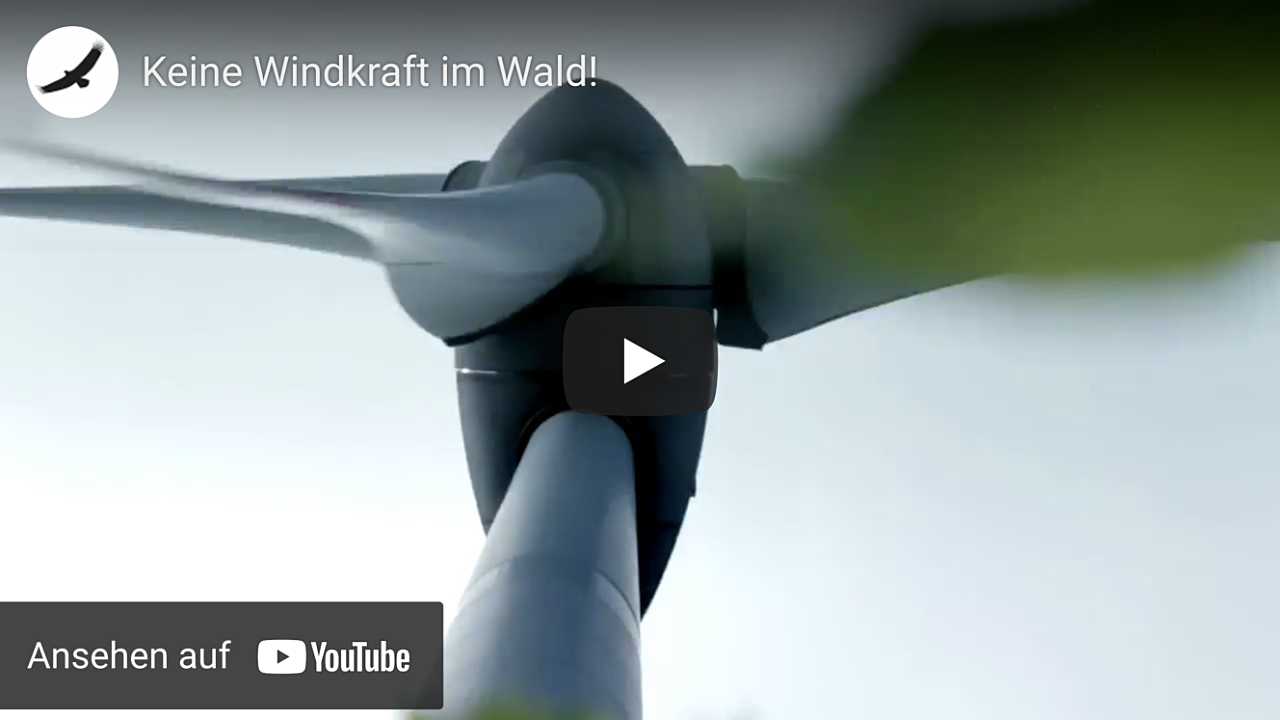
Please click on the image to view the video on YouTube.
Our Foundation rejects on principle trophy hunting (the lust to hunt for pelts, antlers and other trophies). However, we do not unequivocally criticise the culling of selected wild animal species whose numbers have grown exponentially due to the almost complete extermination of their natural enemies (wolf, lynx, bear, wildcat). The blame for the increase, which is damaging to biodiversity and near-natural habitats, can be laid at the door of us humans, who persecuted the natural predators to near extinction. On woodland and open countryside owned or managed by the Foundation, we favour a compact, time-restricted hunting season, in order to avoid long-term disturbance in our biotopes.
Foxes, Martens, Jays and other corvids, as well as birds of prey, are essential species in the structure of biodiversity and are therefore protected by law. Exceptions require well-founded approval from the authority responsible for nature conservation.
Stray cats and dogs are a problem, especially in habitats that have become rare and threatened. Such feral populations should be reported to animal welfare organisations that are permitted to capture and neuter them to prevent further increase and dispersal.
We would gladly abstain from developing small gift incentives and sending them as extras with our project donation mailings. However, since we are not an association with a permanent membership and consequently do not have any income from membership fees, we are dependent on regular, voluntary donations to finance our statutory nature and species protection work. But in the increasingly louder, more colourful and aggressive communication world, a medium-sized foundation like ours can only exist if it effectively draws attention to itself and its project work.
We check each of our project mailings for their profitability after implementation. We find time and again that people donate more when we enclose a small creative object in our project donation letters. Of course, these small additions are only 'cent items', which can be produced inexpensively. They are often purchased in cooperation with other non-profit organisations. A general renouncement of the small gift incentives would result in noticeably lower donation income and endanger the financial viability of some of our strategic species protection projects.
Our foundation is also approached about why we do not use gender language in our written communication. Our decision against the "gender-equitable spelling" demanded by institutions not authorised to do so derives from the position of the Council for German Orthography, an intergovernmental body entrusted by the state authorities with maintaining the uniformity of orthography in the German-speaking world, stated below.
"At its meeting held on 26.03.2021, the Council for German Orthography reaffirmed its view that all people should be addressed with gender-equitable language and addressed sensitively.
However, this is a social and socio-political task that cannot be solved with orthographic rules and spelling changes alone. The Official Rules apply to schools as well as to administration and the administration of justice.
Against this background, the Council has not recommended the inclusion of asterisk ("gender star"), underline ("gender gap"), colon or other abbreviated forms to indicate multi-gender designations within words in the Official Rules of German Orthography at this time".
Gendered German spelling and language is, among other things, also an obstacle to the linguistic integration efforts of people from other language areas living with us and also for people who want to learn the German language abroad.
Just 30 years ago, Great Egrets were an absolute rarity in Germany. Today, they are a familiar sight in many places. The story of Egret K195 is particularly remarkable: since 2018, it has been turning up time and again in our Frose nature reserve during the summer... more information

Following the successful spring bird conservation camps on Cyprus and the Greek island of Zakynthos, our local bird conservationists in Cyprus are once again standing up to the illegal operations of bird poachers and hunters. Yet again, we need your active support so that we can continue our campaign against the slaughter of migratory birds this autumn ... to the project
Postbank Hannover IBAN: DE47 2501 0030 0905 9063 07 BIC: PBNKDEFF
Stiftung Pro Artenvielfalt Meisenstraße 65 33607 Bielefeld Germany Tel. (0049) 0521 2997-883 / -884 / -889 Fax (0049) 0521 2997-885 Office Mo - Fr. 09.00 to 16.00
Foundation Management team@stiftung-pro-artenvielfalt.org Project Management projekte@stiftung-pro-artenvielfalt.org Donations, Donor Care service@stiftung-pro-artenvielfalt.org
 Donation account