News:
|
|---|

|
News:
|
|---|
|
|
… convinced bird conservationists like the 43 volunteer Montagu's Harrier rescuers in Brandenburg, who sacrifice months of their free time and weekends, from April to August, driving thousands of kilometres along village streets and dirt roads in their private cars and kicking their heels for hours on end to spot the Montagu's Harriers in the skies above the endless grain fields of north-eastern Brandenburg.
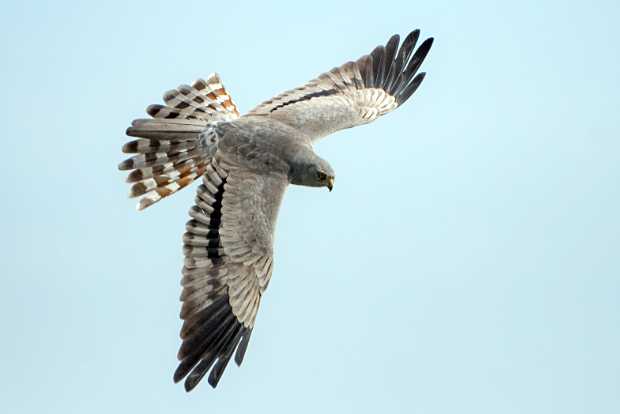
Male Montagu's Harrier in flight © A. Cortese
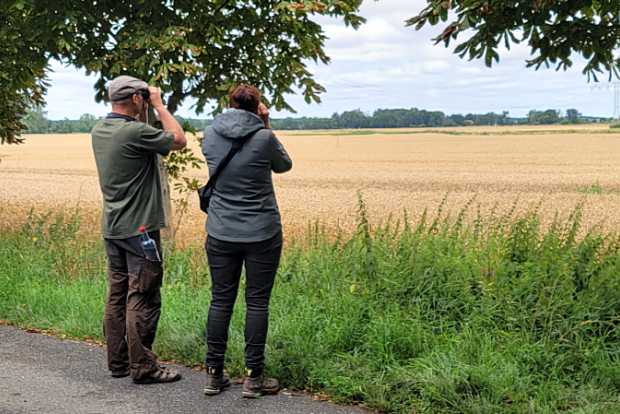
Conservationists on the lookout for Montagu's Harriers © WNN e. V.
What this is all about and why they are doing it is a fascinating and engaging story…
Of the three species of harrier found in Germany (at least for now) – the Western Marsh Harrier, the Eurasian Hen Harrier and the Montagu's Harrier – two have already made it onto the ‘Red List of breeding birds in Germany’: the Hen Harrier is considered ‘threatened with extinction’ and the Montagu's Harrier is considered ‘critically endangered’. However, this scientific classification alone and current nature conservation policy are unlikely to prevent the extinction of these two rare bird of prey species!
Unlike most birds of prey, the three harrier species build their nests on the ground. However, an increasing number of high-voltage power lines and wind turbines fragment the airspace above the open countryside, while intensive agricultural land use is robbing the Montagu's Harriers of their former natural nesting sites in extensive wetlands, moors and heathland. As a result, the maximum of 450 Montagu's Harrier breeding pairs in Germany today are forced to breed mainly in grain fields..
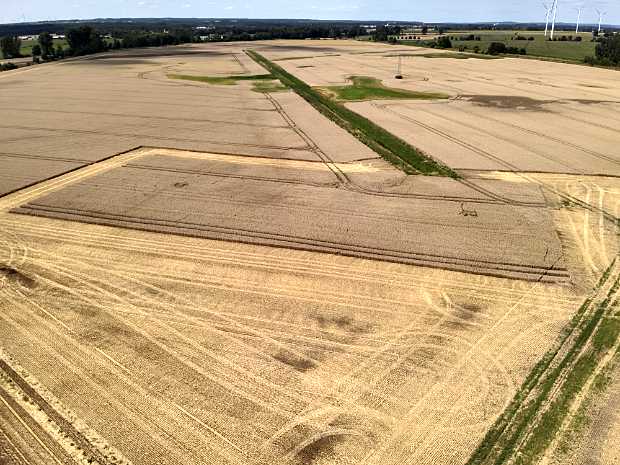
Cereal fields suitable for machinery in Brandenburg… as far as the eye can see © WNN e. V.
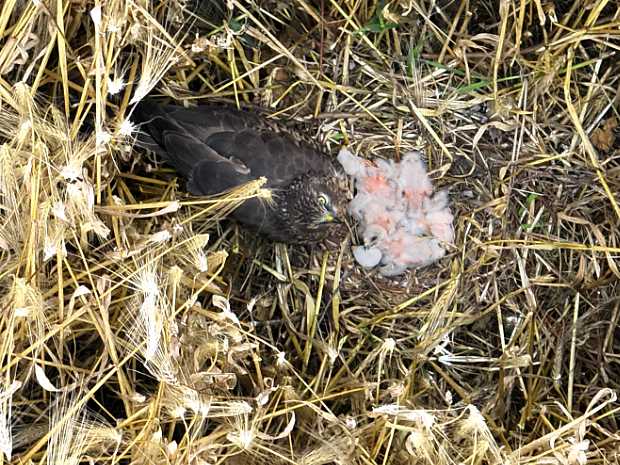
A female Montagu's Harrier on the ground nest with chicks © WNN e. V.
Not a bad idea, bird lovers think, but a cereal field like this is driven several times a year with machines during the cultivation phase and sprayed with agricultural chemicals, and the harvest dates are now 4-6 weeks earlier than 30 years ago. Those who breed on the ground in today's intensively used fields, such as Eurasian Skylarks and Montagu's Harriers, have little chance of successful breeding and rearing their young: nests, clutches and young birds often remain unintentionally on the ground and under the pressure of cost-efficient farming, are shredded and chopped to death.
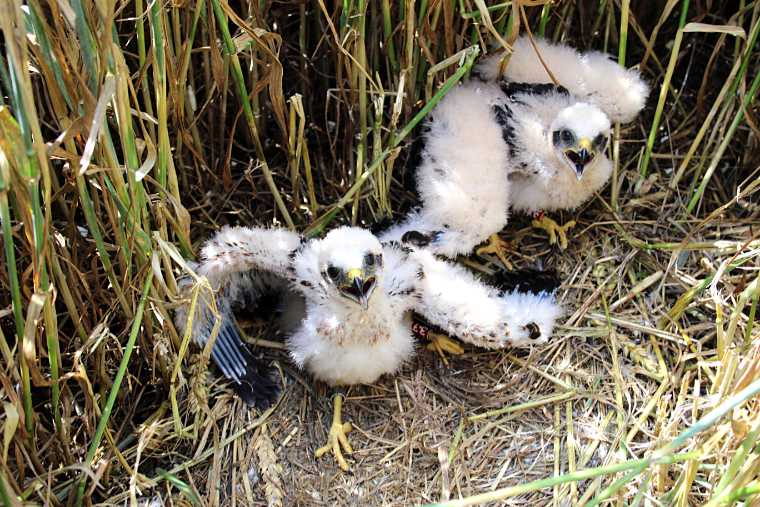
Young Montagu's Harriers on the ground © WNN e. V.
So what can be done to ensure that these few Montagu's Harrier breeding pairs have an undisturbed nesting place and are able to raise their young successfully?
To find out, in late spring 2024, we spent two long days with conservationists in the Montagu's Harrier conservation project financed by our Foundation, scanning the sky above the cornfields for Montagu's Harriers with binoculars until our necks ached. When we finally spotted a breeding pair of Montagu's Harriers in the air, performing courtship flights, or transporting nest material, or photographed a ground nest in the cornfield with the drone, we began the careful search for a nest site in the cornfield on foot, after which we carried poles, fence elements and nets to the nest site to mark them and fence them in. All of this was done, of course, with the prior consent of the landowners!
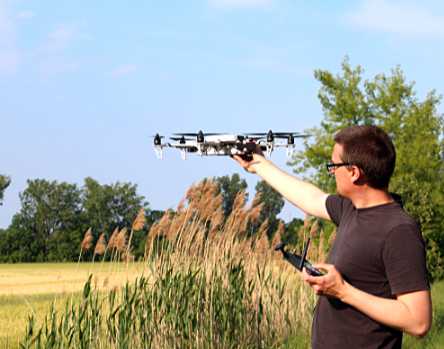
Drone in action for Montagu's Harrier nest search © R. Melz
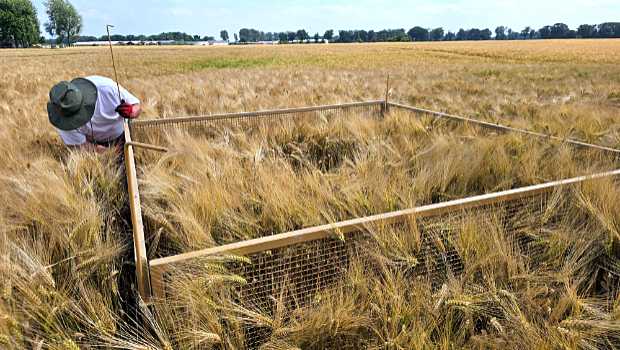
Erection of protective fence around Montagu's Harrier ground nest © WNN e. V.
Only with these time-consuming preventive measures are the nest and breeding sites of the Montagu's Harrier, its eggs and young safe from nest robbers such as foxes, raccoons and wild boar.
In 2024, 15 ground nests were secured with fences in time. To achieve this, the harrier conservationists in north-eastern Brandenburg, up to the slopes of the Oder Valley, were out and about for months in the late afternoons, often until sunset and on weekends. They drove more than 41,000 km of country roads and dirt roads, secured the harrier nests located and regularly checked the fences of the marked nest sites.
The 52 chicks that successfully fledged were the best reward for all the time-consuming conservation efforts.

Drone photo: Montagu’s Harrier nest in a wheat field grain field © WNN e. V.
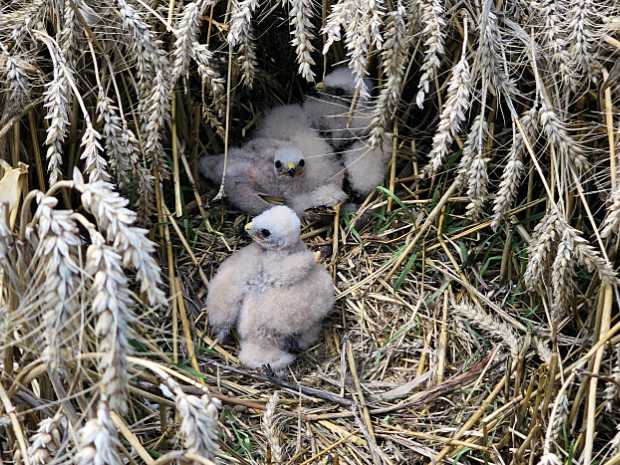
Young Montagu's Harriers in a protected ground nest in with chicks © WNN e. V.
Financing the Montagu's Harrier conservation project in north-eastern Brandenburg lends even greater significance to our land purchase commitment for our Pantani migratory bird sanctuary on the south-eastern coast of Sicily. After all, our Bird Guards have only been observing undisturbed resting and foraging of Montagu's Harriers there for a few years, before they rest and strengthen themselves for the dangerous onward flight to the North African coast of Tunisia.
To strengthen and optimise the conservation efforts in Brandenburg, we want to purchase further urgently needed binoculars, a small compact drone and additional nest protection material for the volunteer conservationists and reimburse them for at least their travel expenses (kilometre allowance) for the planned up to 45,000 km of trips.
Together with you and the active Montagu's Harrier Conservation Society for North-East Germany members, we can turn this exciting project into a real Montagu's Harrier conservation success story.
Please help us to finance the total costs of this year's Montagu's Harrier conservation project in Brandenburg, which amount to approximately 18,000 euros,
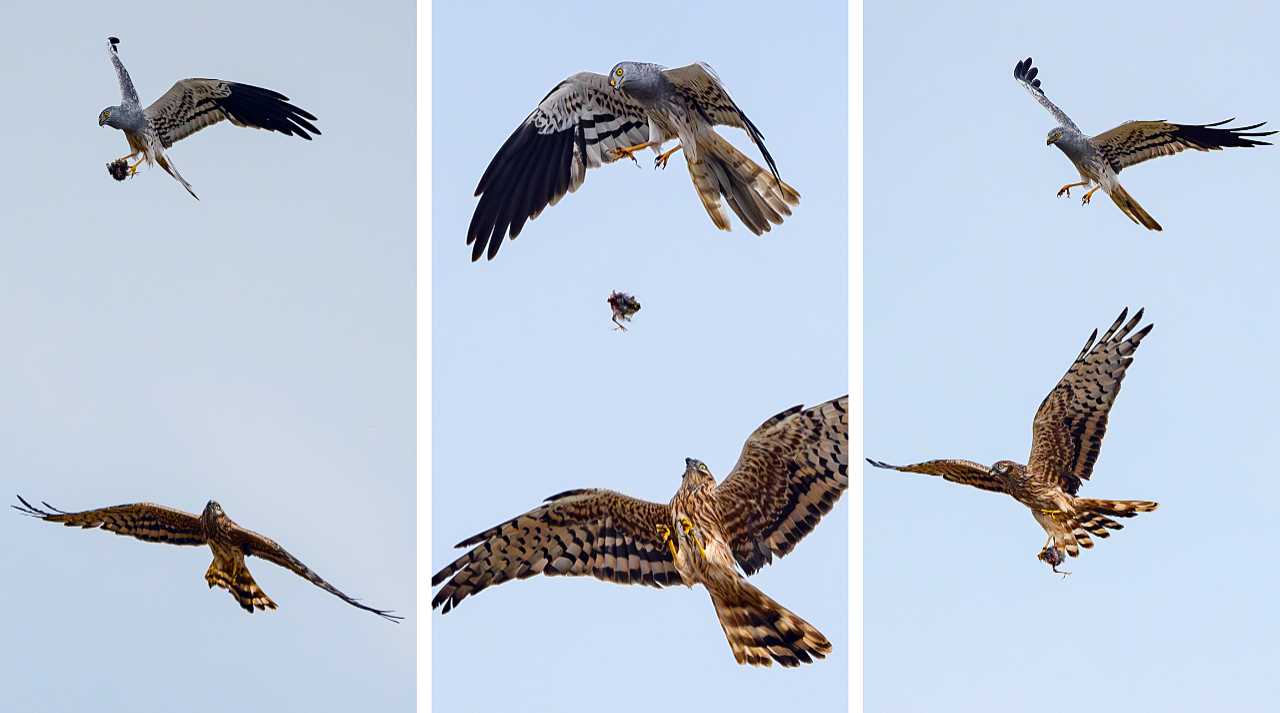
Impressive manoeuvre: Montagu's Harriers hand over prey in flight © picture alliance dpa Patrick Pleul
Older projects of the month can be found in the archive
Copyright information for the image in the title bar:
"Young ringed Montagu's Harrier © S. Leikies"

Just 30 years ago, Great Egrets were an absolute rarity in Germany. Today, they are a familiar sight in many places. The story of Egret K195 is particularly remarkable: since 2018, it has been turning up time and again in our Frose nature reserve during the summer... more information

Following the successful spring bird conservation camps on Cyprus and the Greek island of Zakynthos, our local bird conservationists in Cyprus are once again standing up to the illegal operations of bird poachers and hunters. Yet again, we need your active support so that we can continue our campaign against the slaughter of migratory birds this autumn ... to the project
Postbank Hannover IBAN: DE47 2501 0030 0905 9063 07 BIC: PBNKDEFF
Stiftung Pro Artenvielfalt Meisenstraße 65 33607 Bielefeld Germany Tel. (0049) 0521 2997-883 / -884 / -889 Fax (0049) 0521 2997-885 Office Mo - Fr. 09.00 to 16.00
Foundation Management team@stiftung-pro-artenvielfalt.org Project Management projekte@stiftung-pro-artenvielfalt.org Donations, Donor Care service@stiftung-pro-artenvielfalt.org
 Donate now