Land acquisition project: Murnauer Moos Nature Reserve
|
|---|

|
Land acquisition project: Murnauer Moos Nature Reserve
|
|---|
|
|
The Murnauer Moos Nature Reserve extends from south of Murnau south to Eschenlohe and west to Grafenaschau. With a density of up to 18 m, it has the deepest moor in Bavaria. This unique moor complex is unparalleled in Central Europe today in terms of size and coherence, its diverse landscape meadow types, fens and transition mires, spring pits, backwaters, relic lakes and fully developed raised bogs!
It is home to around 950 plant species and up to 4,000 animal species, an irreplaceable and valuable habitat. The nationwide endangered flora species include Globeflower, Autumn Lady's-tresses, Bug Orchid, Fen Orchid, Siberian Iris, Moor-king, Carex heleonastes, Slender Cottongrass, Bog Rush, Marsh Saxifrage, Swamp Willow and Shrubby Birch.
Endangered bird species that still occur here include Eurasian Hobby, Eurasian Curlew, Corncrake, White-backed Woodpecker, Great Grey Shrike and reptiles and amphibians such as European Tree Frog, Yellow-bellied Toad and Grass Snake, Common European Viper as well as Sand and Viviparous Lizard.
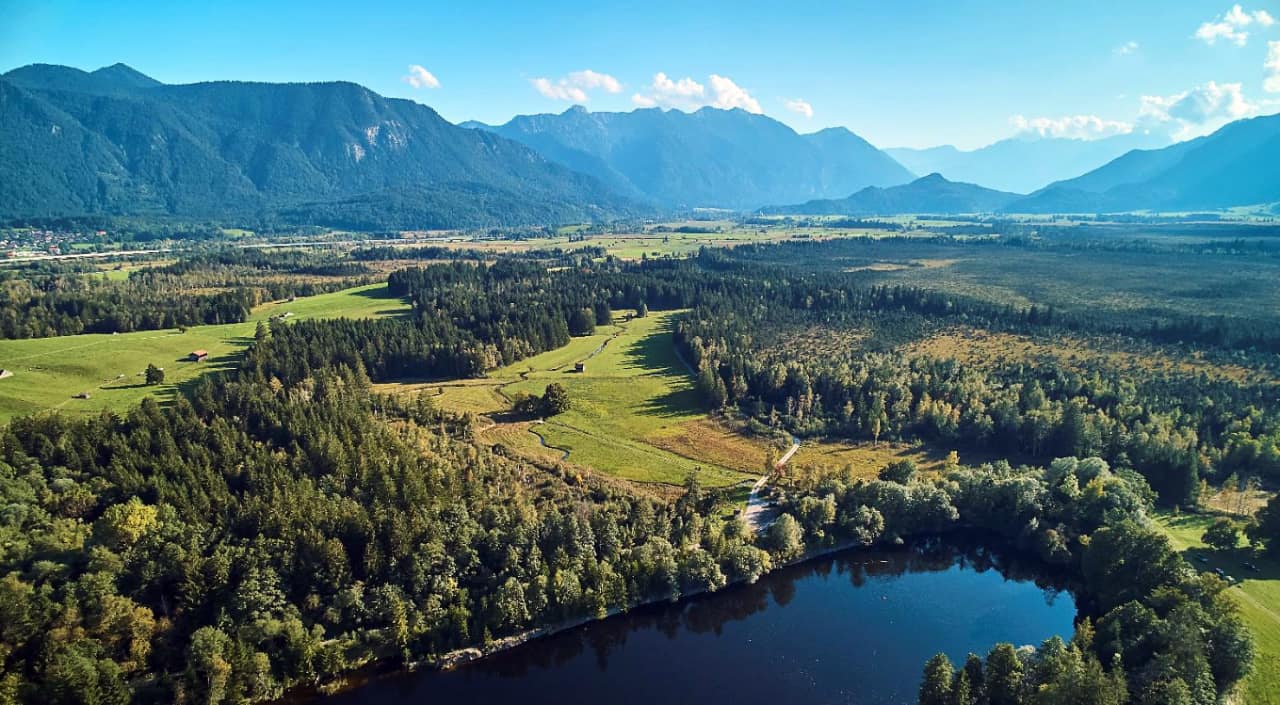
The Murnauer Moos with the Kochelsee and the Fügsee stream on Foundation land © SPA
Until the second half of the 20th century, drainage measures with new ditches, stream-straightening, destructive peat cutting and massive rock quarrying on the so-called Köchel (hard stone cliffs in the fen area) severely affected nature in the Murnauer Moos. Abused and exploited in this way for decades, many rare animal and plant species inevitably disappeared due to abuse and exploitation.
Nowadays, neophytes (invasive introduced species) dominate the former stone quarrying area around the Moosberg Quarry Lake. In particular, Canada Goldenrod and Himalayan Balsam increasingly overrun and spread along the hiking trails, threatening to devalue these parts of the Moos landscape for local flora and fauna.
In accordance with the key objective of securing the large-volume moor body for the future, the valuable core areas must remain a natural landscape free of disturbance and human use. In addition, large sub-areas in the Murnauer Moos and west of the Staffelsee are to be maintained in the context of an extensively-used cultural landscape with semi-natural meadows and nutrient-poor grassland.
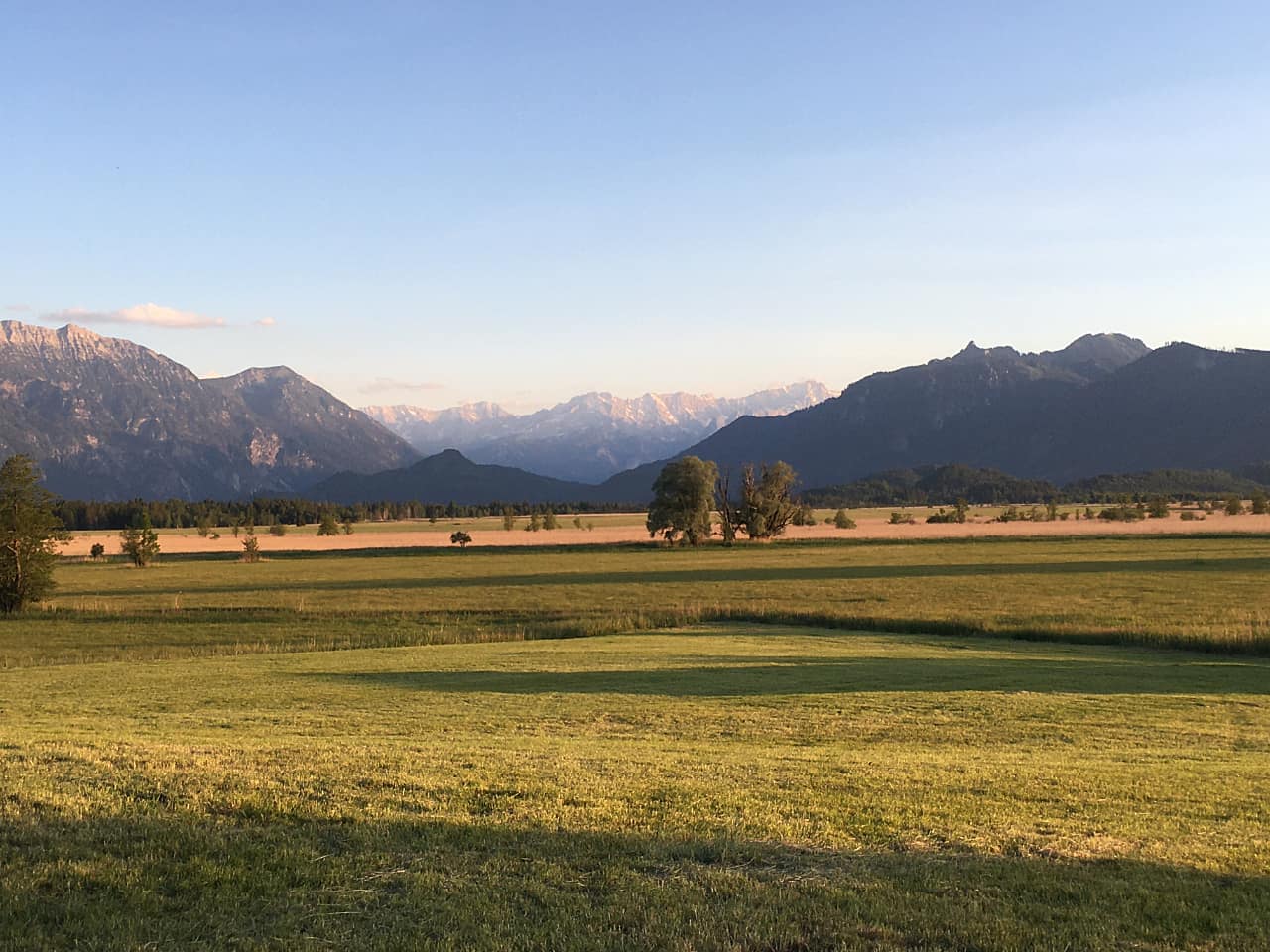
Murnauer Moos after mowing in autumn © SPA
In addition to aspects of species protection, biodiversity and the protection of representative landscapes, climate protection goals - the bog as a CO² store - also play an increasing role today. Like hardly any other area in Germany, the project area Murnauer Moos is a 'Noah's Ark' of inestimable value for many animal and plant species threatened with extinction (including almost 200 species on the Red List!).
The Murnauer Moos and its immediate surroundings at the foot of the Herzogstand-Heimgarten massif and the Laber-Hörnle group of the Ammergau Alps against the magnificent backdrop of the Bavarian Alps are a unique habitat for endangered animal and plant species. Many of these are listed in the Bavarian and German Red Lists. We do not sit back but check all land purchase opportunities that arise for their ecological value and/or biotope-adapted optimisation possibilities. This is without prejudice to our repeated experience: natural paradises have their cost.
In 2012 we decided to purchase an ecologically important plot of land incorporating the almost 4.0 ha Bachwiesen in the middle of the core area of the Murnauer Moos nature reserve!
In the period that followed, with the Weilheim Water Management Office's planning permission and the Garmisch-Partenkirchen district nature conservation authority, the straightened, moor-damaging section of the Weidmoosgraben was diverted into its historic stream bed.
Even this small-scale moss compensation measure sustainably improves the water balance in this part of the Murnauer Moos. It thus creates ecologically-optimised moss habitat for many endangered animal and plant species. In this way, in this scenic location in the middle of the Murnauer Moos, near the Moosberg quarry lake, we were able to put right a hydraulic engineering sin of the past!
In 2020, we were able to purchase another fen area of approx. 1.0 ha in the north-western part of the Murnauer Moos and an ecologically unique 1.6 ha Wiesmahd area directly next to the Murnauer Moos nature reserve. In this Wiesmahd 15 species of butterflies from the Bavarian and German Red Lists find a survival space that has become extremely rare.
For the future, we are planning an extensive landscape conservation measure coordinated with the Garmisch-Partenkichen district lower nature conservation authority to combat Canada Goldenrod and Himalayan Balsam neophytes on the former stone quarrying site around the Moosberg quarry lake.
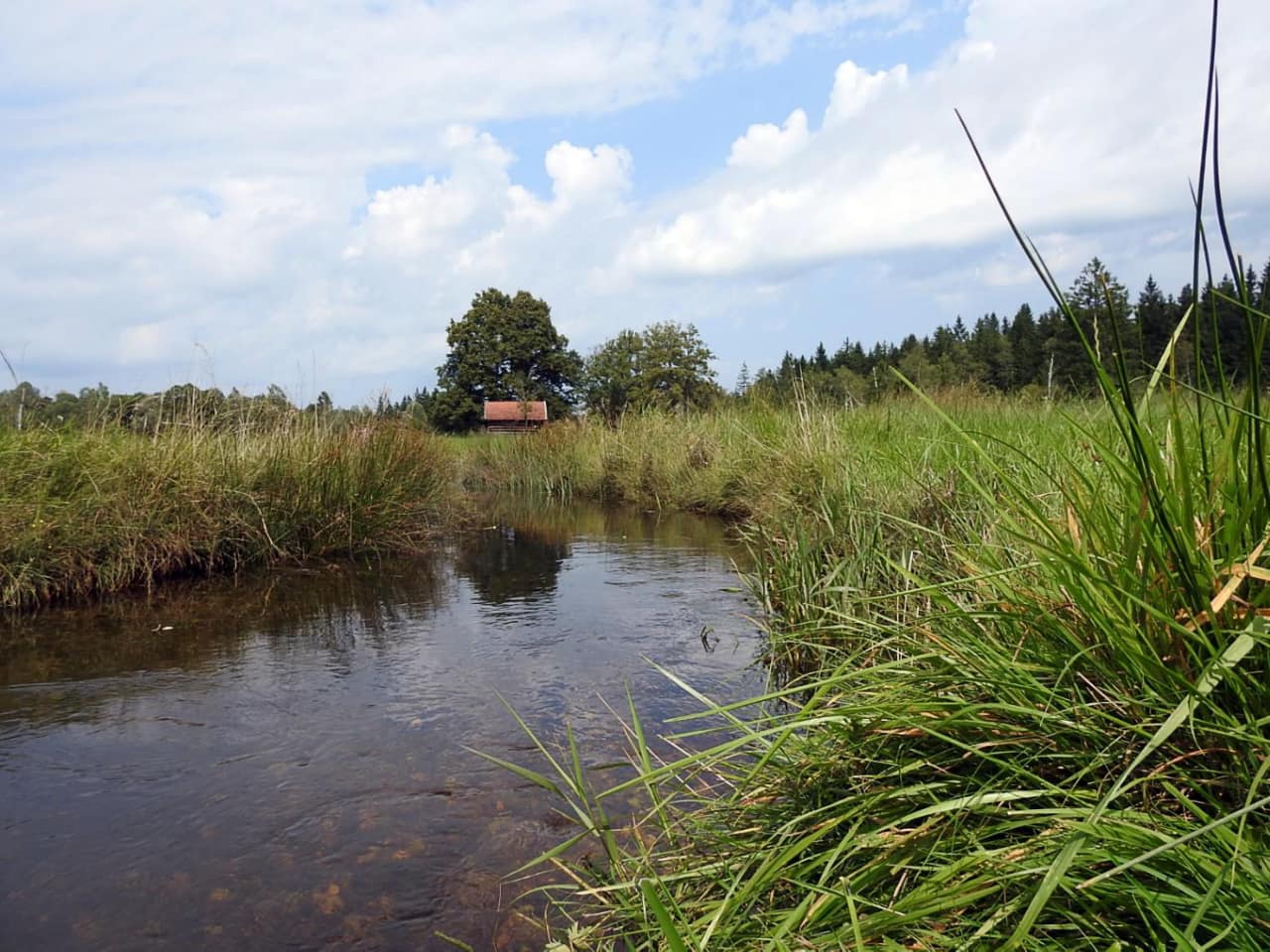
Foundation land with the Weidmoosgraben and species conservation barn © SPA
Eurasian Hobby, Eurasian Curlew, Great Grey Shrike, Common Rosefinch, European Tree Frog, Common European Viper, Dusky Large Blue, Alcon Blue, Marsh Fritillary, Violet Copper, Small Pearl-bordered Fritillary, Heath Fritillary
Eurasian Hobby
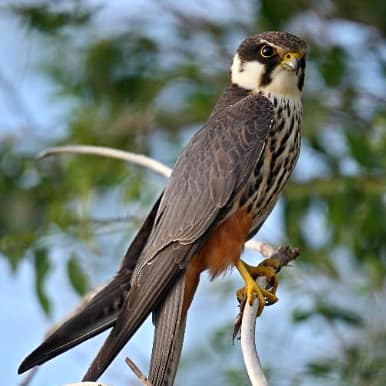
© Pröhl.fokus-natur
Eurasian Curlew
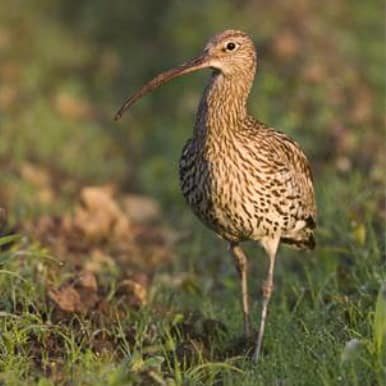
© H. Glader
Common Rosefinch
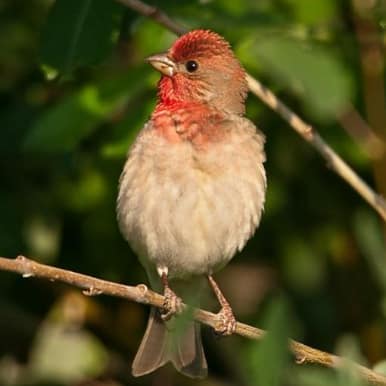
© Pröhl.fokus-natur
Common European Viper

© Leo/fokus-natur
Small Pearl-bordered Fritillary
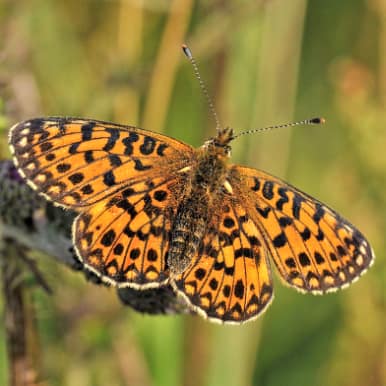
© L. Hlasek
Alcon Blue
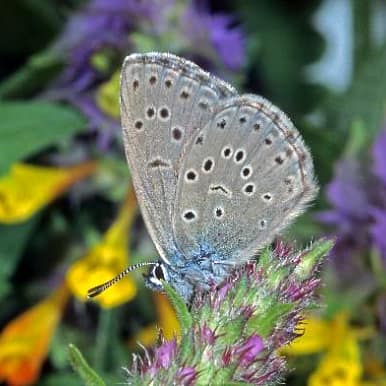
© L. Hlasek
Globeflower
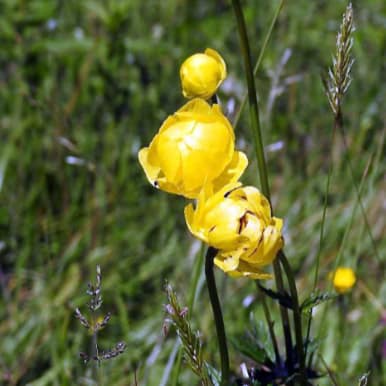
© SPA
Purple Loosestrife
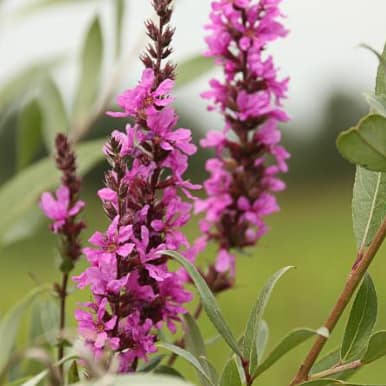
© SPA
Blue Iris
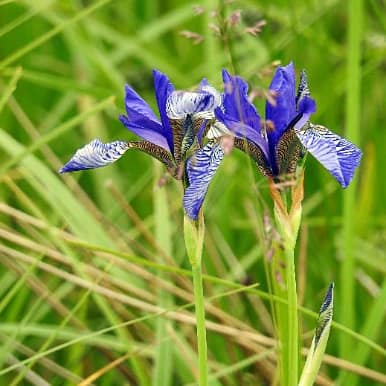
© SPA
Your donation enables the purchase of more ecologically-valuable land.
The information on the copyrights of the images used on this site can be found at Copyrights, unless these are already indicated in or below the image.

Just 30 years ago, Great Egrets were an absolute rarity in Germany. Today, they are a familiar sight in many places. The story of Egret K195 is particularly remarkable: since 2018, it has been turning up time and again in our Frose nature reserve during the summer... more information

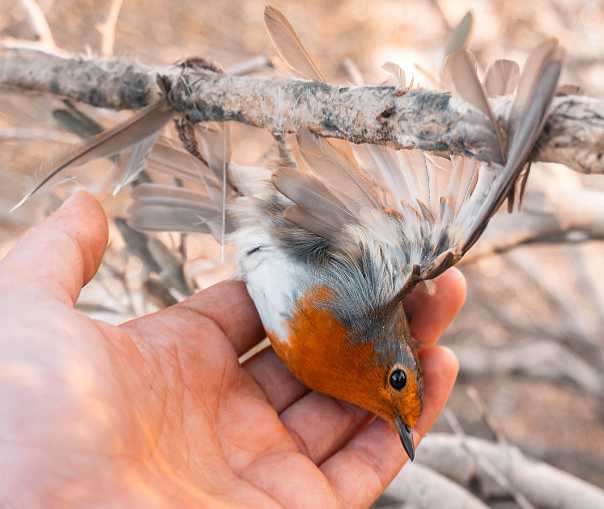
Following the successful spring bird conservation camps on Cyprus and the Greek island of Zakynthos, our local bird conservationists in Cyprus are once again standing up to the illegal operations of bird poachers and hunters. Yet again, we need your active support so that we can continue our campaign against the slaughter of migratory birds this autumn ... to the project
Postbank Hannover IBAN: DE47 2501 0030 0905 9063 07 BIC: PBNKDEFF
Stiftung Pro Artenvielfalt Meisenstraße 65 33607 Bielefeld Germany Tel. (0049) 0521 2997-883 / -884 / -889 Fax (0049) 0521 2997-885 Office Mo - Fr. 09.00 to 16.00
Foundation Management team@stiftung-pro-artenvielfalt.org Project Management projekte@stiftung-pro-artenvielfalt.org Donations, Donor Care service@stiftung-pro-artenvielfalt.org
 Donate now