News: Short & sweet / archive
|
|---|

|
News: Short & sweet / archive
|
|---|
|
|
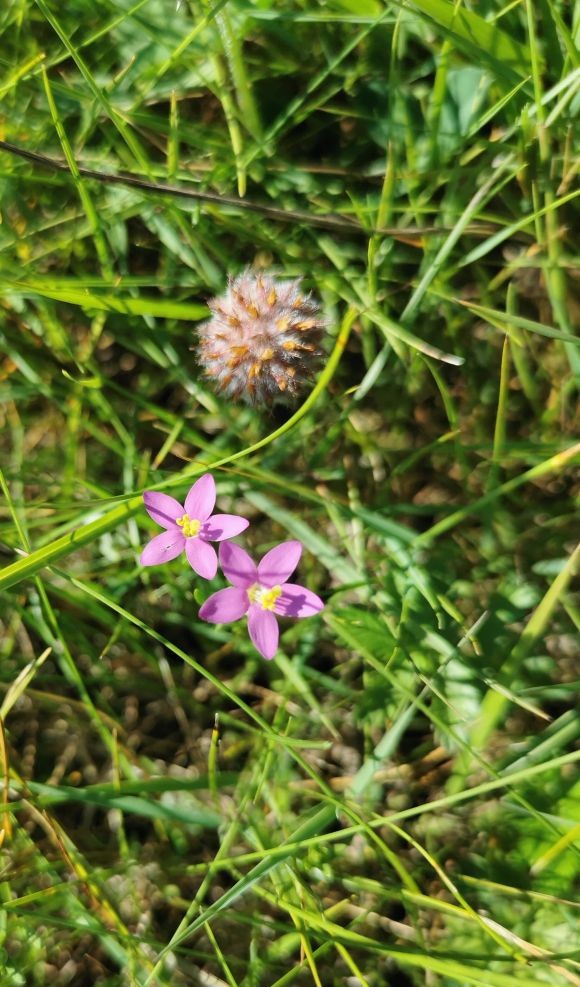
The delicate Centaury herb is listed as critically endangered on Mecklenburg-Western Pomerania’s Red List and has been recorded in our salt marsh habitat. © Prof. Dr. Irmgard Blindow
Rare salt-tolerant plants and valuable habitats: a species survey confirms the importance of our salt marsh plot on Hiddensee.
A recent survey of plant species on our property on Hiddensee has impressively confirmed the high ecological value of the newly acquired land. In addition to numerous typical salt marsh species, several endangered plant species listed on the Mecklenburg-Western Pomerania Red List (RL M-V) were recorded.
Particularly noteworthy is the presence of several plant species associated with the ‘inland salt marshes’ habitat type (FFH habitat type 1340), which is protected throughout Europe. The unusual combination of wet meadow and salt marsh vegetation highlights the special ecological value of this rare biotope.
In addition, several endangered plant species listed on the Mecklenburg-Western Pomerania Red List have been recorded on our site. Notable flora sightings include, amongst others, Meadow Fleabane, Sea Centaury and Lesser Centaury. In addition, numerous butterfly species and other pollinating insects have been observed that use the diverse plant life as a habitat and food source.
The study also confirms the importance of adaptive land management. Extensive grazing and natural soil disturbance caused by root-digging wild boar repeatedly create areas with sparse vegetation, where less competitive, salt-tolerant plants can thrive over the long term. Without this natural dynamic, low-diversity reed stands would spread across our salt marsh area in the long run.
The latest results clearly demonstrate that the long-term conservation and professional maintenance of our newly acquired plot of land on Hiddensee are paying off.
We want to thank Prof. Dr Irmgard Blindow of the Hiddensee Biological Station, University of Greifswald, Kloster, for carrying out the species survey on 23.07.2026 on a voluntary basis.
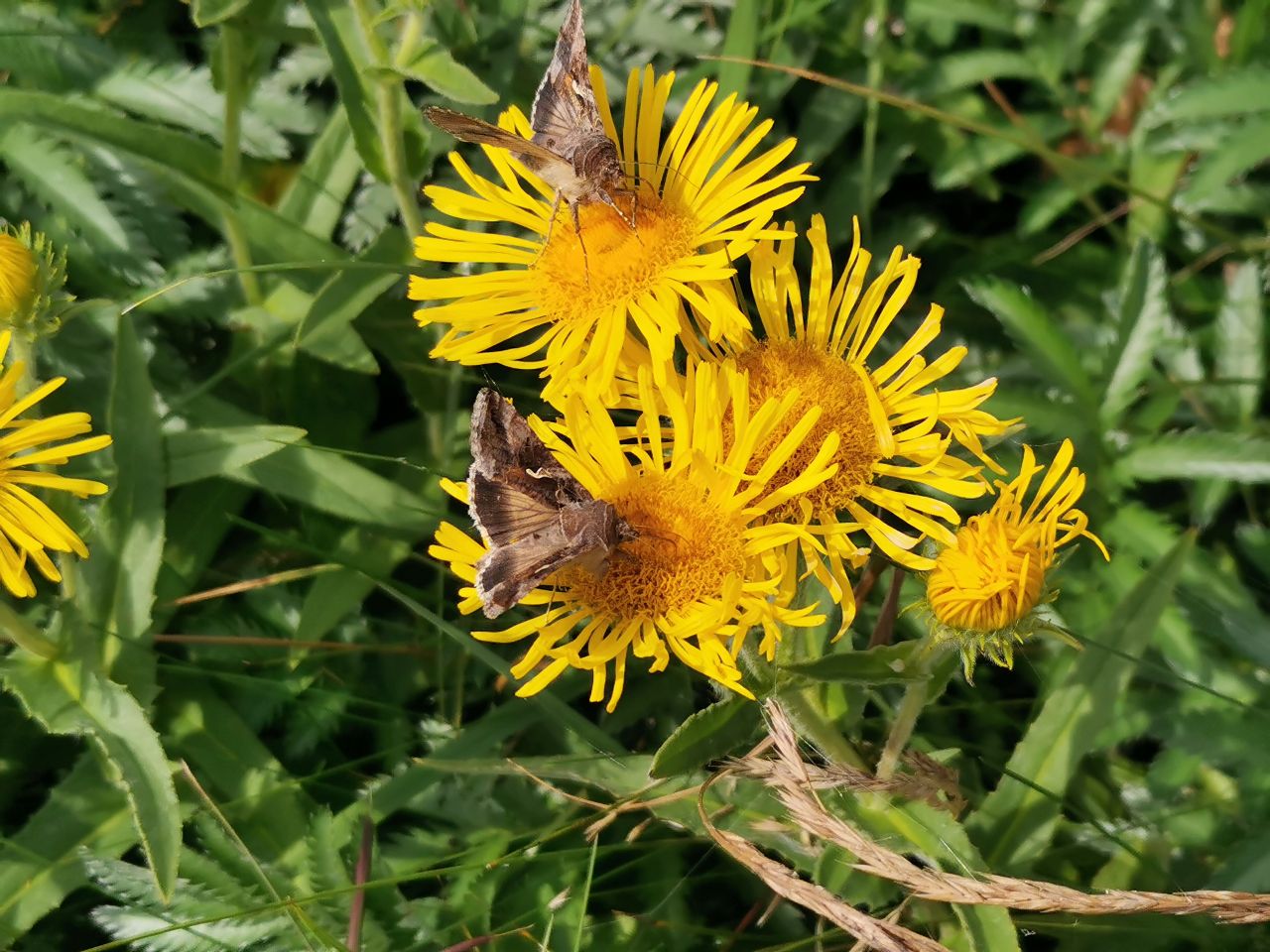
Meadow Fleabane provides a valuable food source for butterfly species such as the Silver Y and numerous other insect species. © Prof. Dr. Irmgard Blindow
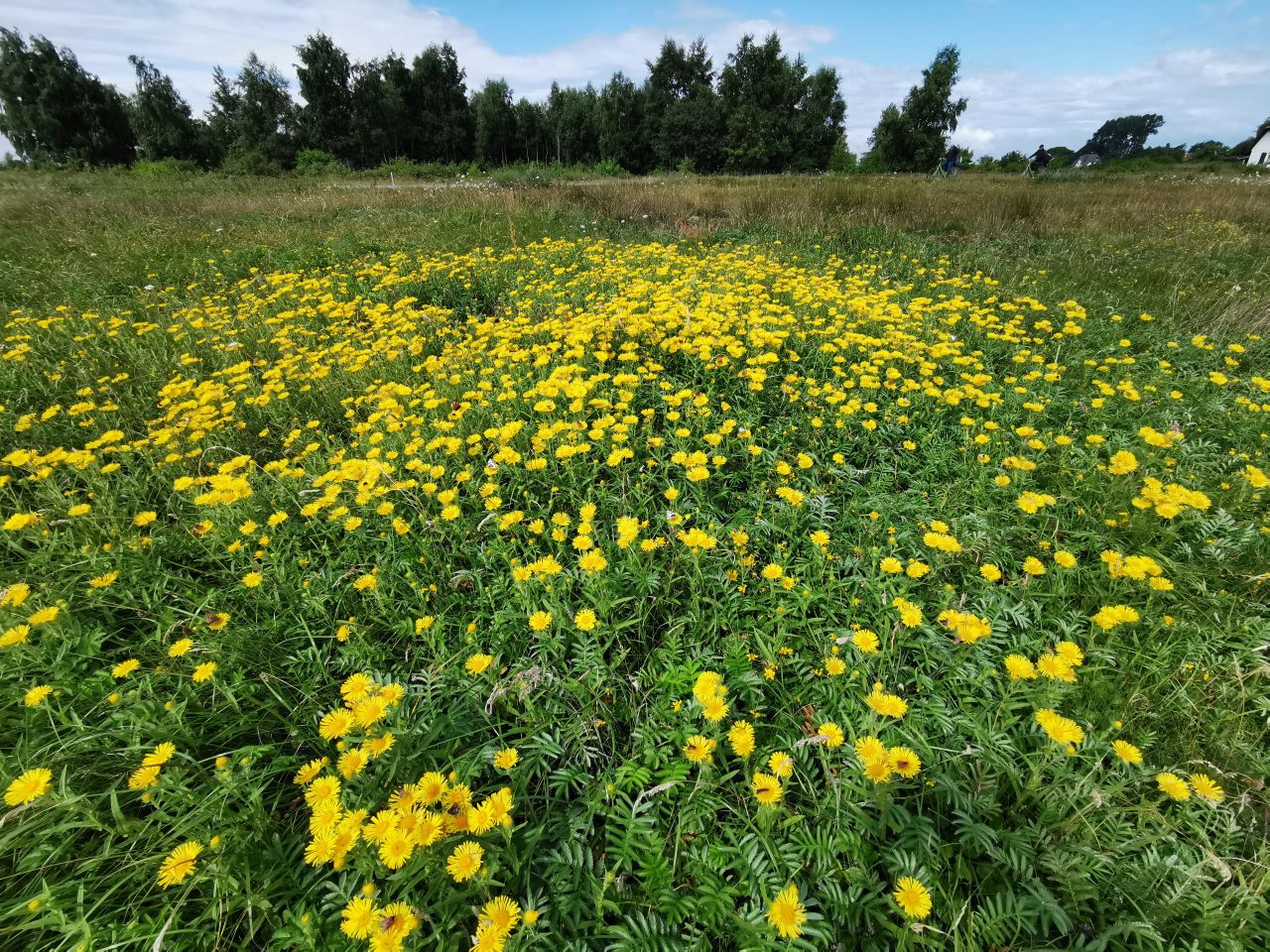
Großflächige Bestände des Wiesen-Alants prägen Teile unseres Schutzwiesengrundstücks auf Hiddensee © Prof. Dr. Irmgard Blindow
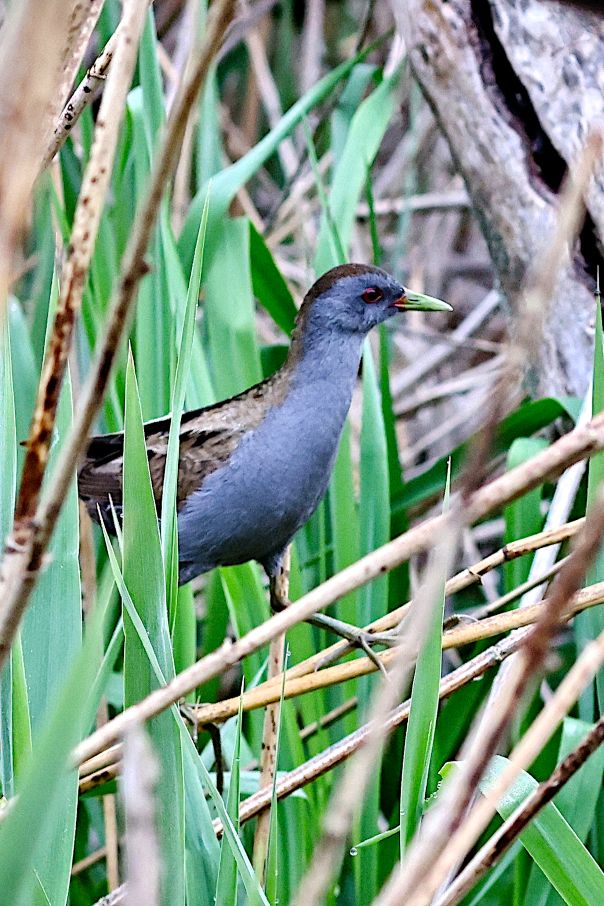
The endangered Little Crake also finds the best possible habitat in our Frose wetland © Uwe Nielitz
Ongoing site management, including biotope optimisation and maintenance measures in the Frose wetland, is key to maximising biodiversity among birds, amphibians and dragonflies.
Recording the species of birds resting, breeding and roosting, and looking after visitors to our birdwatching tower were the main focuses of our site manager’s work in the spring and early summer.
His regular monitoring of the area has yielded numerous encouraging results. For example, no fewer than five pairs of Western Marsh Harriers have established their territories in the wetland, Bearded Reedlings have bred successfully, and Great Bitterns have also been observed on their foraging flights.
The breeding season was less successful for the Common Crane population, as its chicks unfortunately did not survive this year. Predators such as wild boar, raccoons and foxes regularly scour large areas of the reed beds in search of food.
During their moulting season, around 300 Greylag Geese used the wetland as a secure and well-protected refuge.
As early as spring, several species of duck, several Savi's warblers and also Bluethroats were recorded. Our birdwatching tower remains a major attraction for nature lovers, birdwatchers and bird photographers alike.
As the breeding season draws to a close, work begins on controlling neophytes – invasive alien plant species such as ‘Canadian Goldenrod’ and ‘Giant Hogweed’.
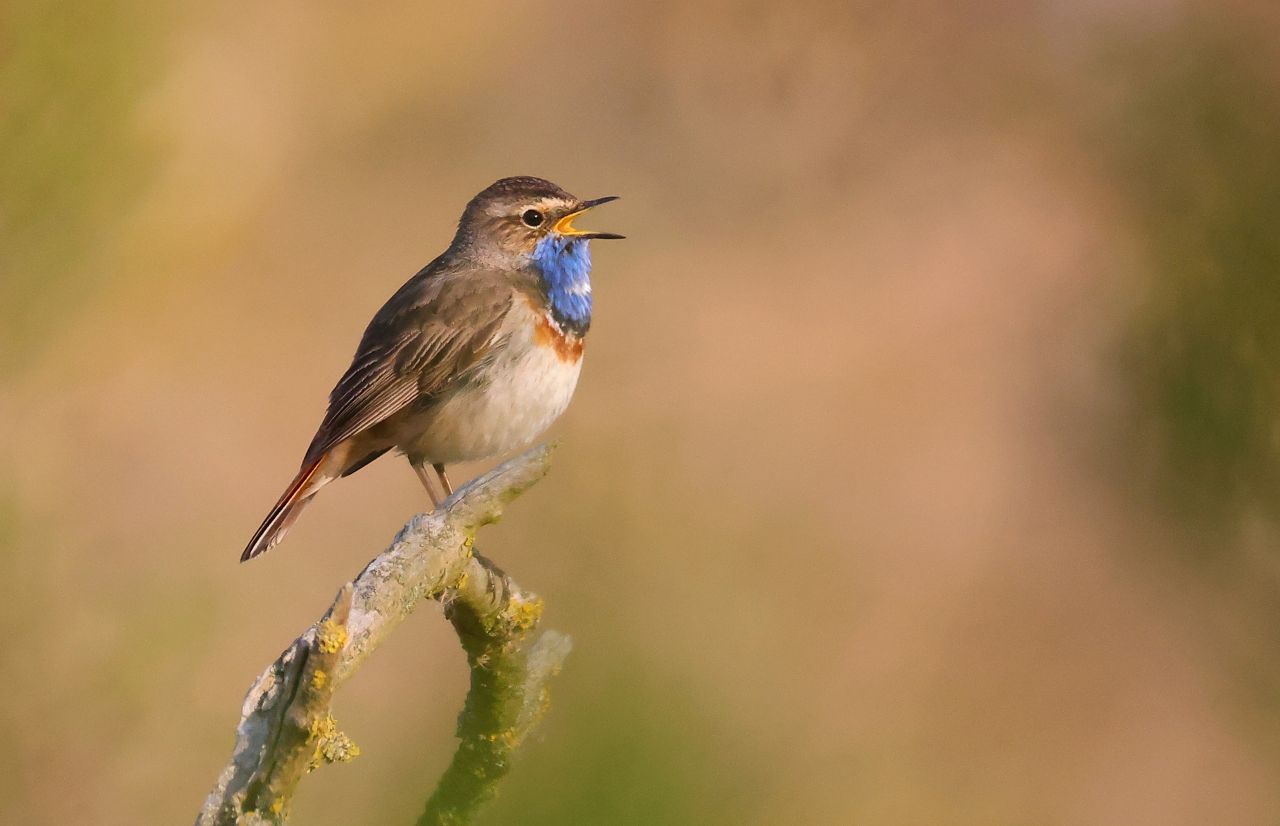
The Bluethroat is one of the characteristic breeding bird species in our Froser wetland © SPA
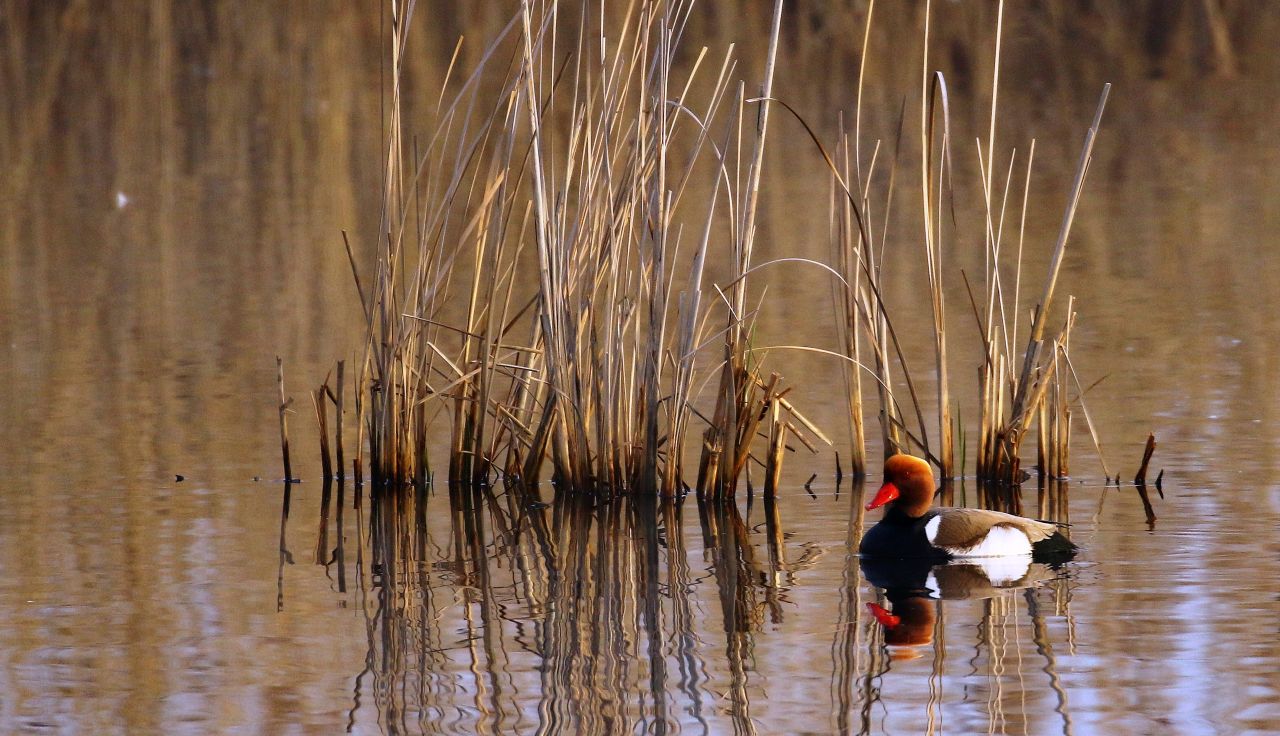
Our wetland, the ‘Seeländereien bei Frose’, is developing into an impressive habitat, resting place and wintering ground for Red-crested Pochard as well as for more than 200 other bird species © Uwe Nielitz
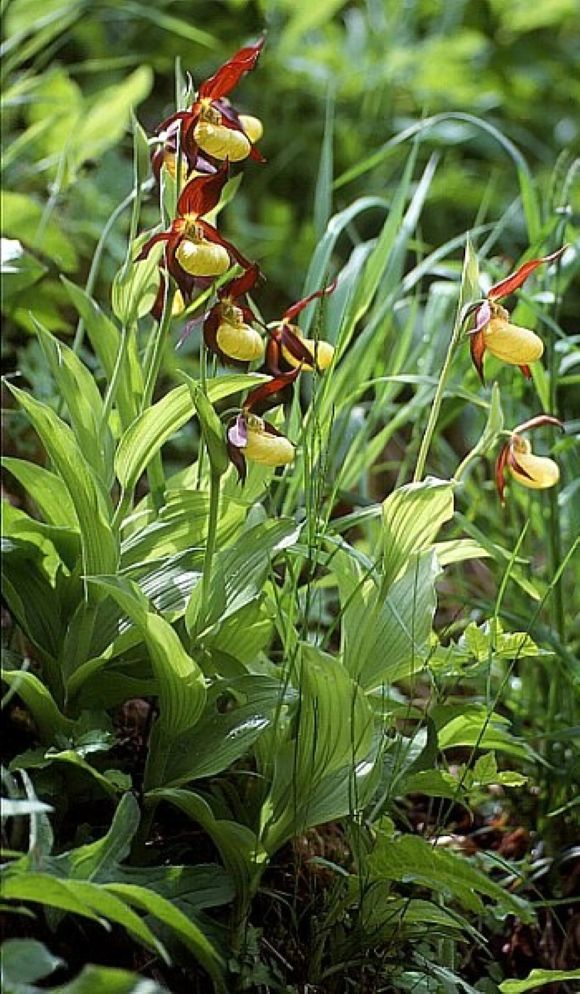
Lady’s Slipper orchids © wikimedia.org
In 2022, with financial support from long-standing donors, our Foundation purchased a plot of hillside spring fen land covering approximately 0.7 hectares in the Ammergau Alps near Bad Kohlgrub, to protect the gentian, orchid and wild bee populations found there.
The Lady's Slipper that grows on our plot is a fairly long-lived species of orchid and, at 20–60 cm in height, is also the largest native orchid species. It has red to dark brown petals and a bright yellow ‘slipper’. This is what gave the orchid its German name. The plant is strictly dependent on calcareous soil.
The self-sterile Lady's Slipper relies almost exclusively on the mining bee of the genus Andrena for pollination. This species of bee requires habitats with sparse vegetation consisting of sand, sandy loam or silt, located no more than 500 metres from where the Lady's Slipper grows!
The greatest threat to this rare and (as yet) healthy Lady's Slipper population on our Foundation's property in the Ammergau Alps is the well-trodden path that has now developed there and the trampling caused by nature lovers interested in orchids, with the resulting damage to the roots. In the long term, this could have dramatically negative consequences for the vitality and future of this orchid site, which is home to up to 200 Lady's Slipper plants.
We will therefore be working with the relevant nature conservation authority and the Ammergau Alps Nature Park Association (Naturpark Ammergauer Alpen e. V.) to agree on specific measures in the near future to effectively protect our land and the valuable Lady's Slipper orchid population and will then implement these measures consistently.
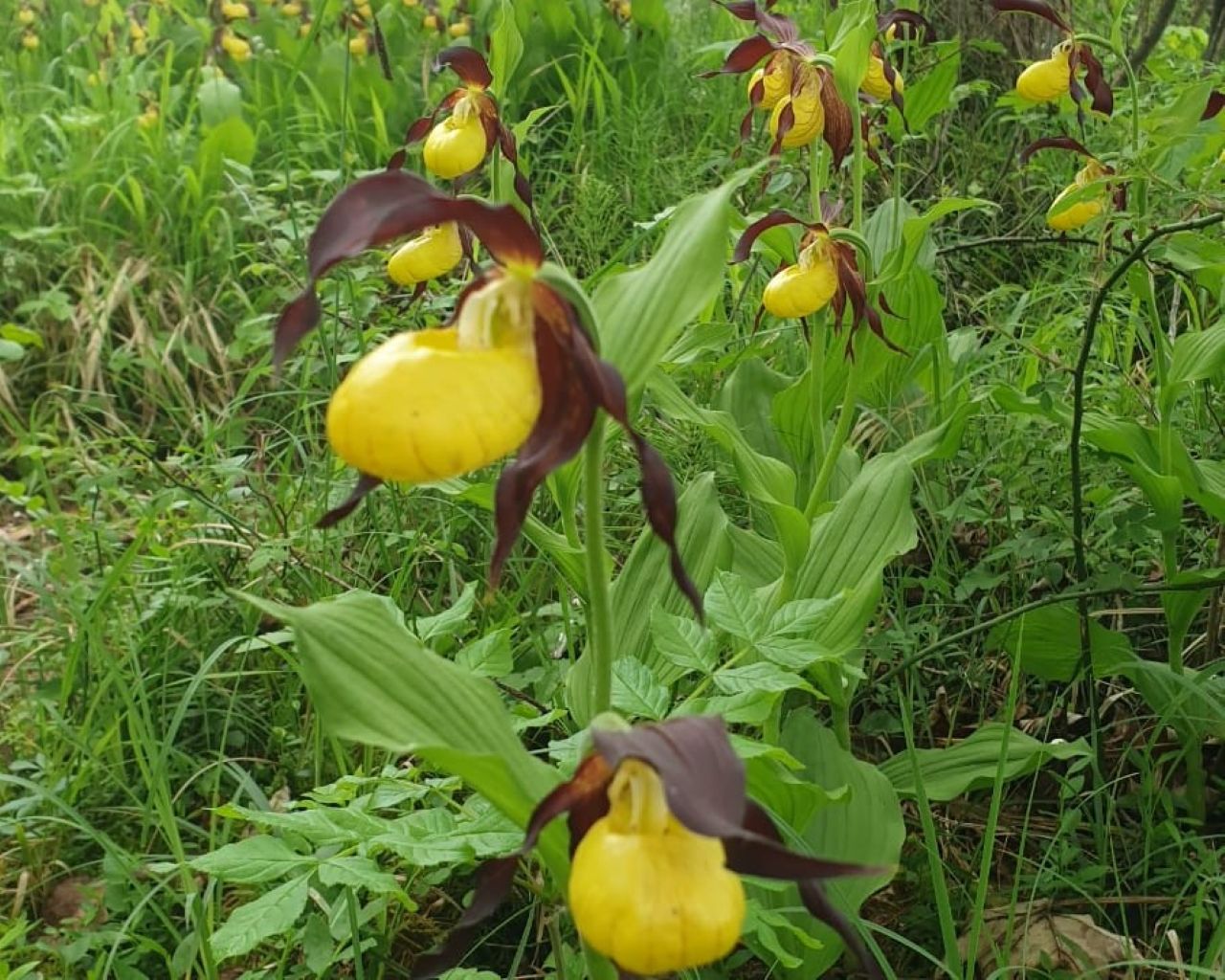
Lady’s Slipper orchids on our foundation’s property © K. Pukall
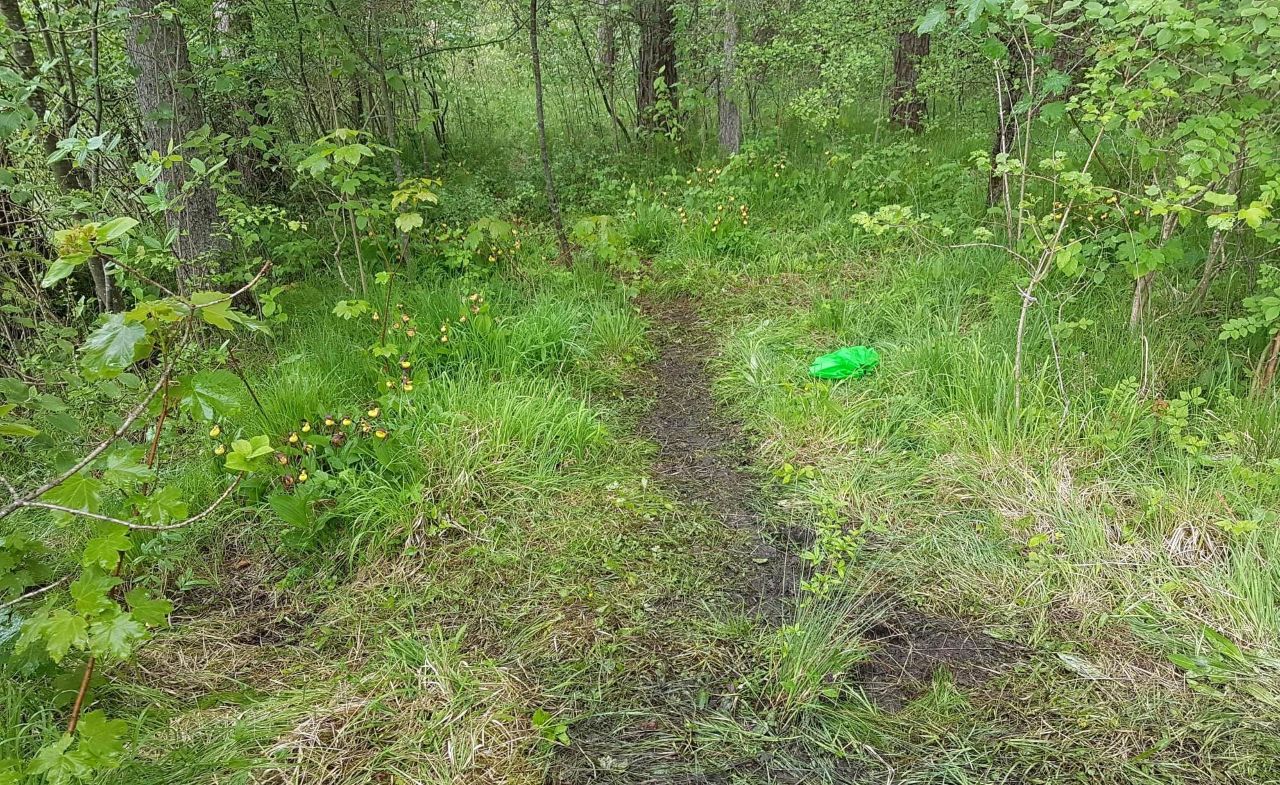
A destructive trail through the Lady's Slipper population © M. Renz
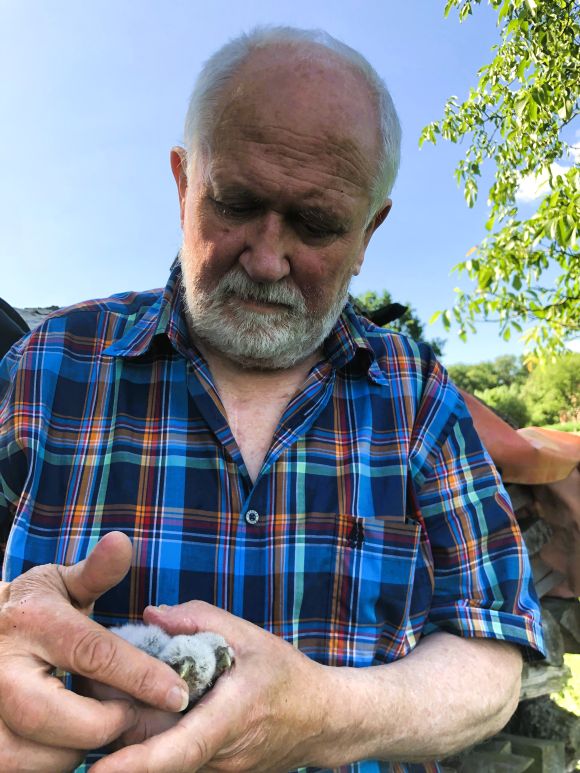
A Little Owl chick briefly removed from a nesting tube for monitoring purposes © SPA
Nine Little Owl chicks and several successful broods: our Little Owl conservation project is yielding encouraging results …
During this year’s Little Owl monitoring programme in the Paderborn District, our Little Owl conservation project manager made several encouraging observations. A total of five adult birds and nine Little Owl chicks were recorded in the nesting tubes we had installed. Our staff have never before documented so many Little Owls in the Paderborn region in a single day’s work.
The results confirm the success of our conservation work. Many of the Little Owl nesting boxes installed by the Foundation Pro Biodiversity since 2019 have already been taken up during the first breeding season – a clear indication that suitable nesting and breeding sites remain in short supply and that it makes sense to install more Little Owl nesting boxes in suitable locations.
The Little Owl chicks recorded in mid-June 2026 provided some interesting insights: experience suggests that young birds should already be fledged by mid-June, yet this year many of the chicks found were still covered in soft down. We suspect that the comparatively cool spring and the resulting food shortage delayed the start of breeding. The supply of mice now found in the nesting tubes and the excellent condition of both the adult and young owls suggest that food is currently plentiful.
The success of this monitoring programme once again demonstrates how important it is to combine nature-friendly habitat management, expert site selection, and regular checks of the nest boxes. Every successful record of breeding encourages us to continue our targeted efforts to support the Little Owl as a characteristic species of the pollarded tree and orchard meadow landscape in East Westphalia, with a view to further strengthening the Little Owl population.
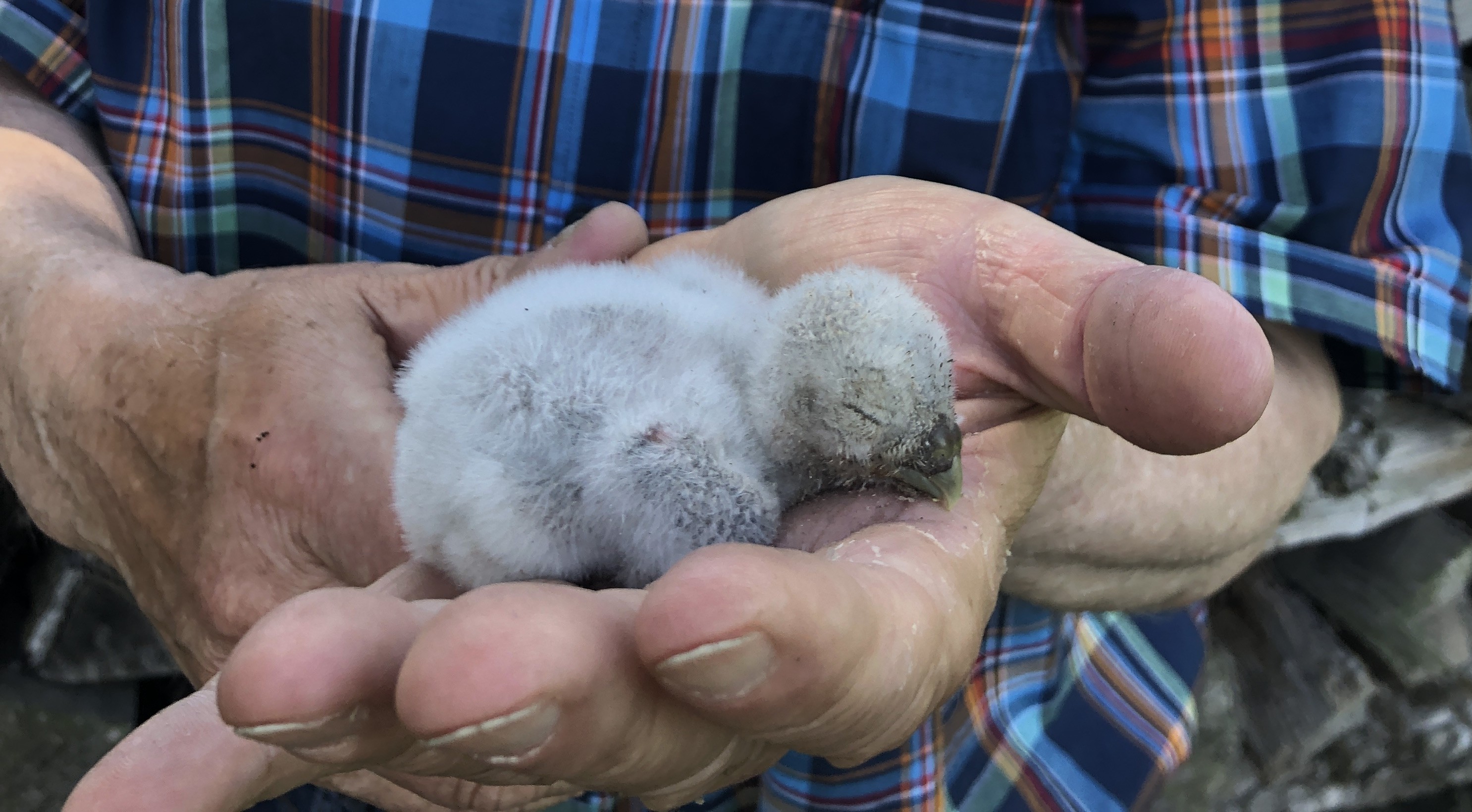
A Little Owl chick temporarily removed from its nest box whilst it was being cleaned – further evidence of breeding in one of our nest boxes © SPA
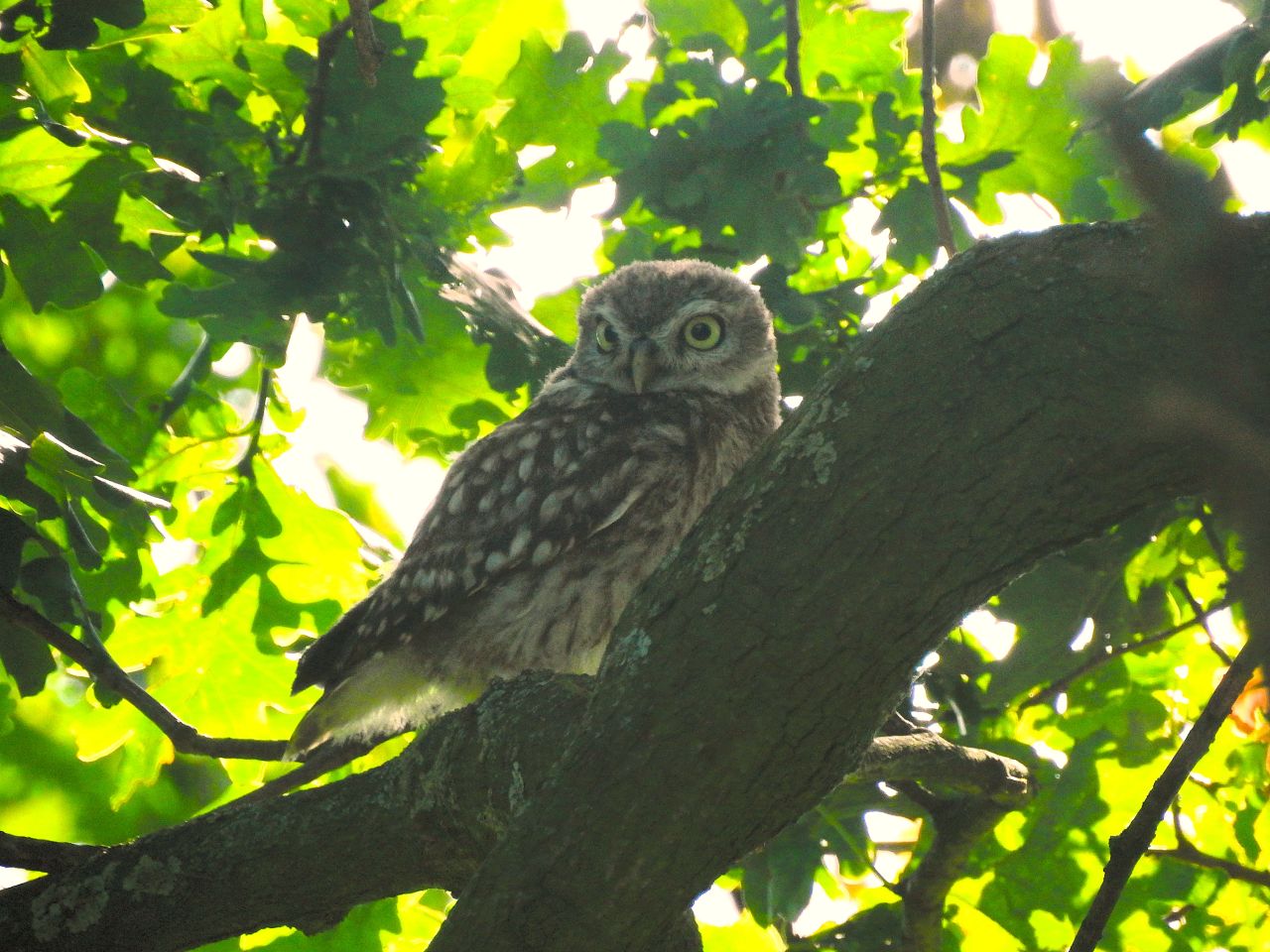
Little Owl in an old farmyard oak in the Paderborn District © SPA
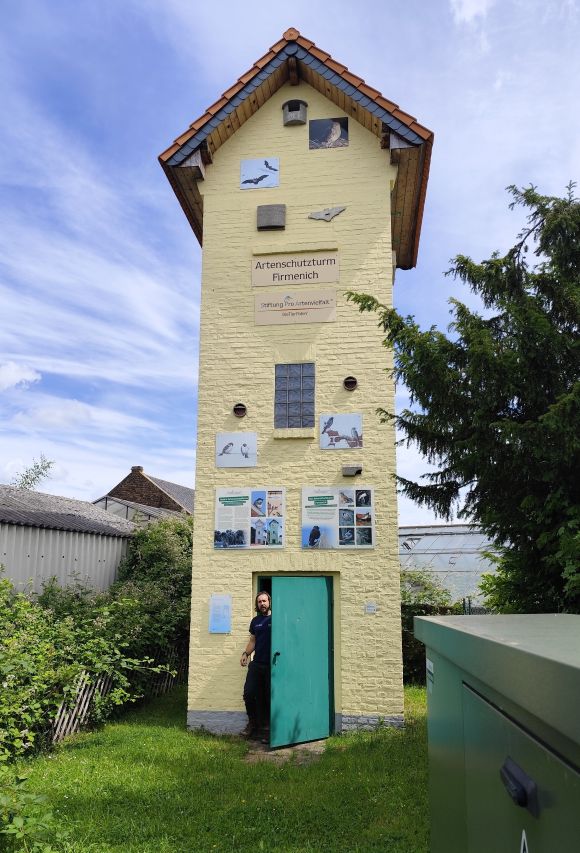
Our species conservation tower in Firmenich provides up to eight different bird species with safe nesting and refuge sites. © SPA
Common Kestrels, Barn Owls, Jackdaws and House Sparrows make use of our species conservation towers – yet the decline in the populations of many structure-nesting birds is unmistakable …
As part of this year’s breeding bird surveys, staff from the Foundation Pro Biodiversity checked all five species conservation towers in the Rhineland. The surveys aim to document the current use of the nest box structures and to monitor long-term population trends among the bird species that breed there.
This year’s results once again demonstrate just how important such species-conservation structures have become in urban areas.
In the towers monitored, Common Kestrels, Barn Owls, Eurasian Jackdaws, Common Starlings, House Martins, House Sparrows, as well as Great Tits and Nuthatches – the latter not typically found nesting in buildings – were recorded.
A pair of Common Kestrels in the species conservation tower in Bouderath provided a particular surprise. The birds of prey had chosen a nest box designed for Jackdaws with an entrance hole measuring just eight centimetres as their breeding site. Common Kestrels usually use significantly larger entrance holes, around 15 centimetres in diameter. This makes it all the more astonishing that the pair of Kestrels nevertheless successfully settled in the comparatively small Jackdaw nest box. At least two young Kestrels, almost ready to fledge, were observed inside. An unusual but remarkable example of how increasingly more bird species are (having to) become flexible in their choice of breeding sites.
Unfortunately, our project staff observed significantly fewer Common Swifts, House Martins, House Sparrows and Common Starlings in the vicinity of the species conservation towers than in previous years. The reasons for this are varied, but increasingly threaten the species’ survival, ranging from the loss of suitable nesting and breeding sites to a massive decline in the insect population.
Whilst we can only influence the decline in insect populations to a limited extent, by creating permanent safe nesting, breeding, and refuge structures for numerous bird species, the species conservation towers of the Foundation Pro Biodiversity are making an important contribution to the regional population of native building-nesting birds.
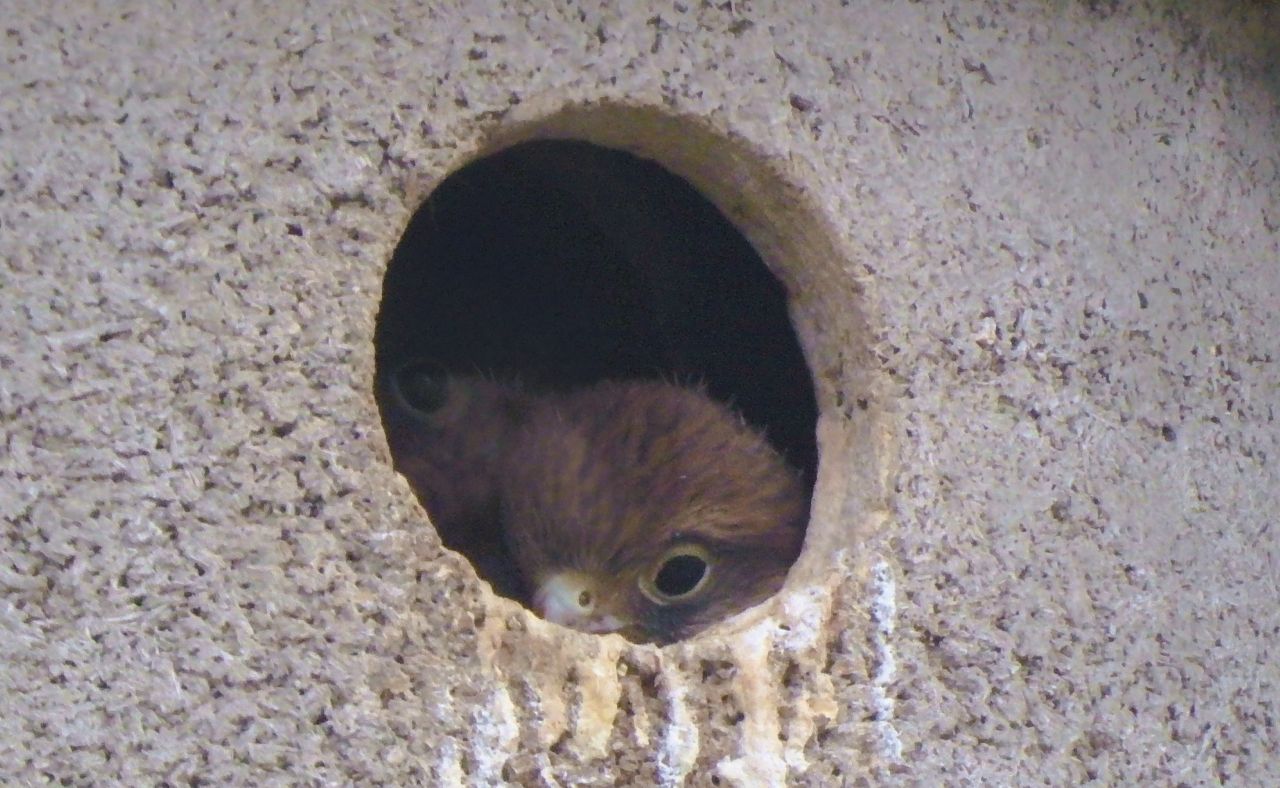
Surprisingly unexpected occupants in the Bouderath Species Conservation Tower: A pair of Common Kestrels is rearing their chicks in a Eurasian Jackdaw nest box. © SPA
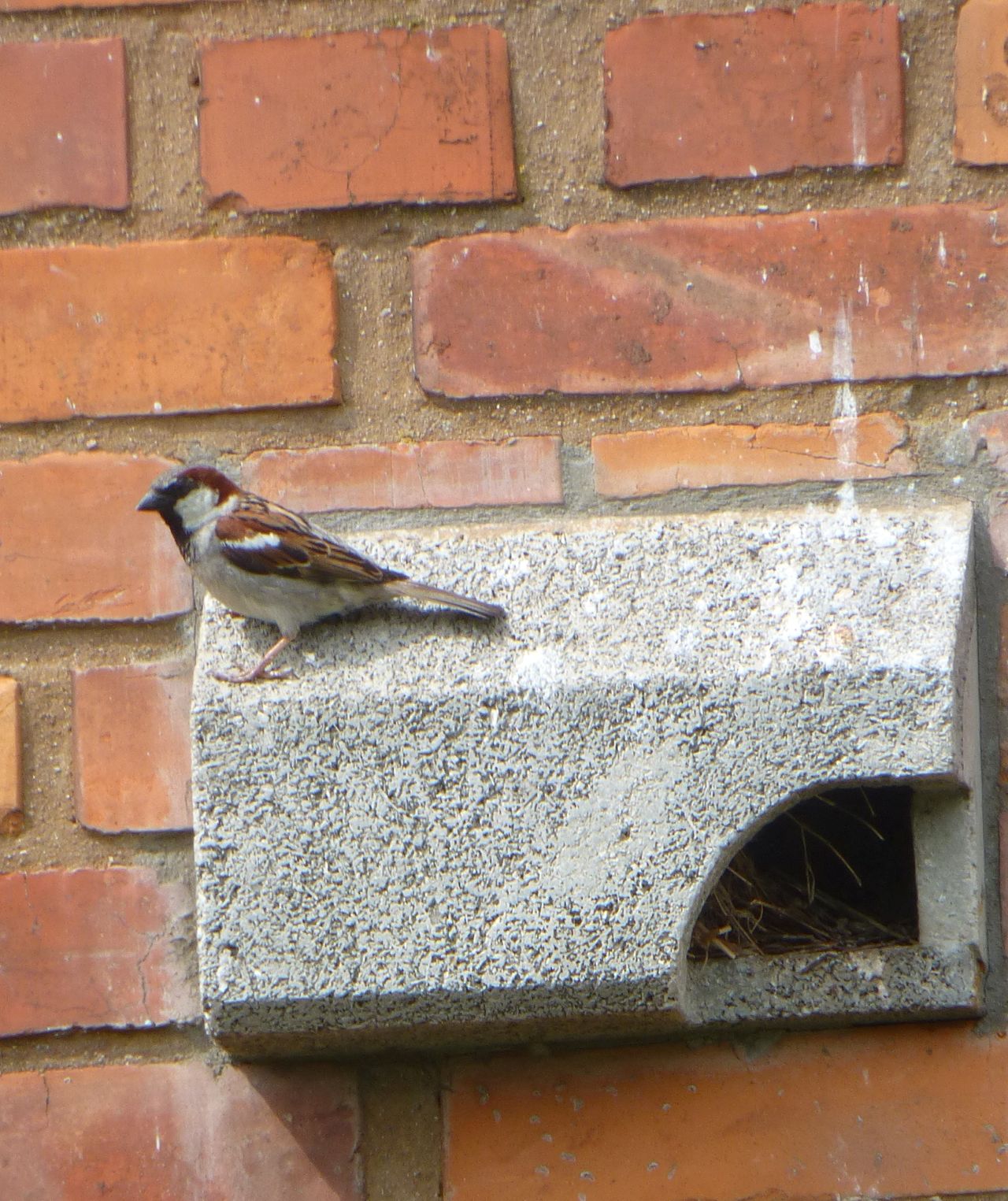
A male House Sparrow on a niche cavity nest box occupied by the breeding pair. © SPA
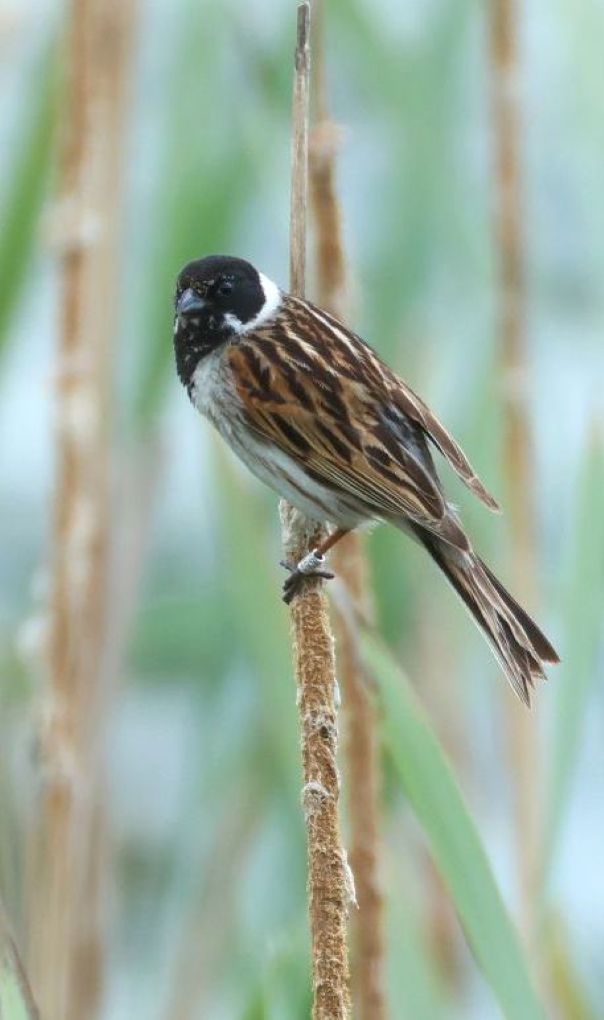
The Reed Bunting is one of the characteristic bird species found in structurally diverse wetlands © M. Pfeifer
Over 60 interested visitors, lots of questions and strong support for the protection of biodiversity – a successful field trip to the Schimmel's Ponds
At the invitation of the Foundation Pro Biodiversity, a total of 64 nature enthusiasts took up the opportunity—offered just once a year—to explore the fenced-off core area of the Schimmel's ponds near Limbach-Oberfrohna during a guided tour lasting around an hour and a half on 30 May 2026.
Despite the forecast of thunderstorms, the weather was kind to us, and a large number of participants had already gathered before the event began. Following a brief introduction by our CEO, Roland Tischbier, and the ornithologist Jens Hering, the tour took us along the pond embankments directly into the project area, past five of the north-western ponds and the water buffalo grazing there.
Amidst the croaking of countless Common Water Frogs and accompanied by watchful Mute Swan parents with their cygnets, Tufted Ducks and, of course, Mallards and their ducklings, the project managers provided information on the habitat restoration measures implemented over the past 12 months, as well as on future plans for the further ecological enhancement of the Schimmel's ponds. Information on the successes achieved so far for birdlife, including sightings of rare species such as the Reed Bunting, Jack Snipe and Red Phalarope, also attracted great interest.
The overwhelmingly positive feedback from participants was very encouraging. Many expressly welcomed the conservation measures taken by the Foundation Pro Biodiversity, including the comprehensive enclosure of the core area, which provides the necessary peace and quiet for the water buffalo and goats roaming freely there (as landscape managers) and for the bird, amphibian, reptile and insect species found there to forage and reproduce.
For the Foundation Pro Biodiversity and its project partners, the event was heartening proof that interest in the comprehensive protection of our wetland area, which covers just under 12 hectares, is growing steadily in the region.
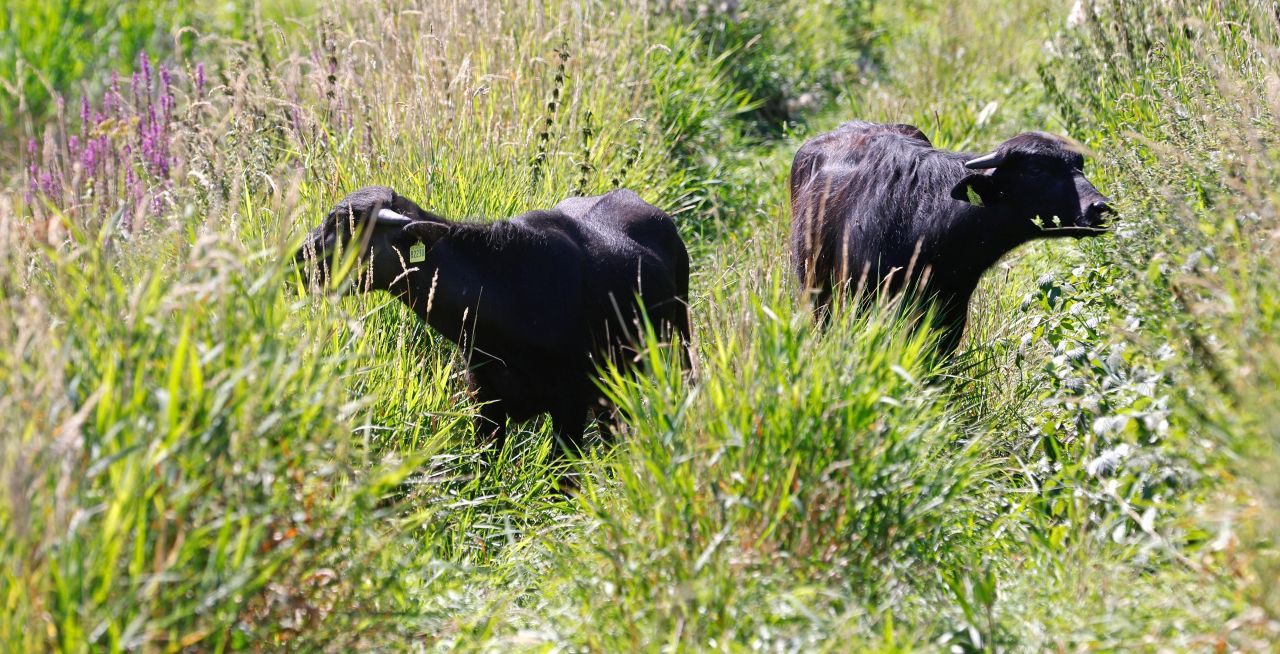
Water buffalo as natural landscape managers of the Schimmel's Ponds © M. Pfeifer
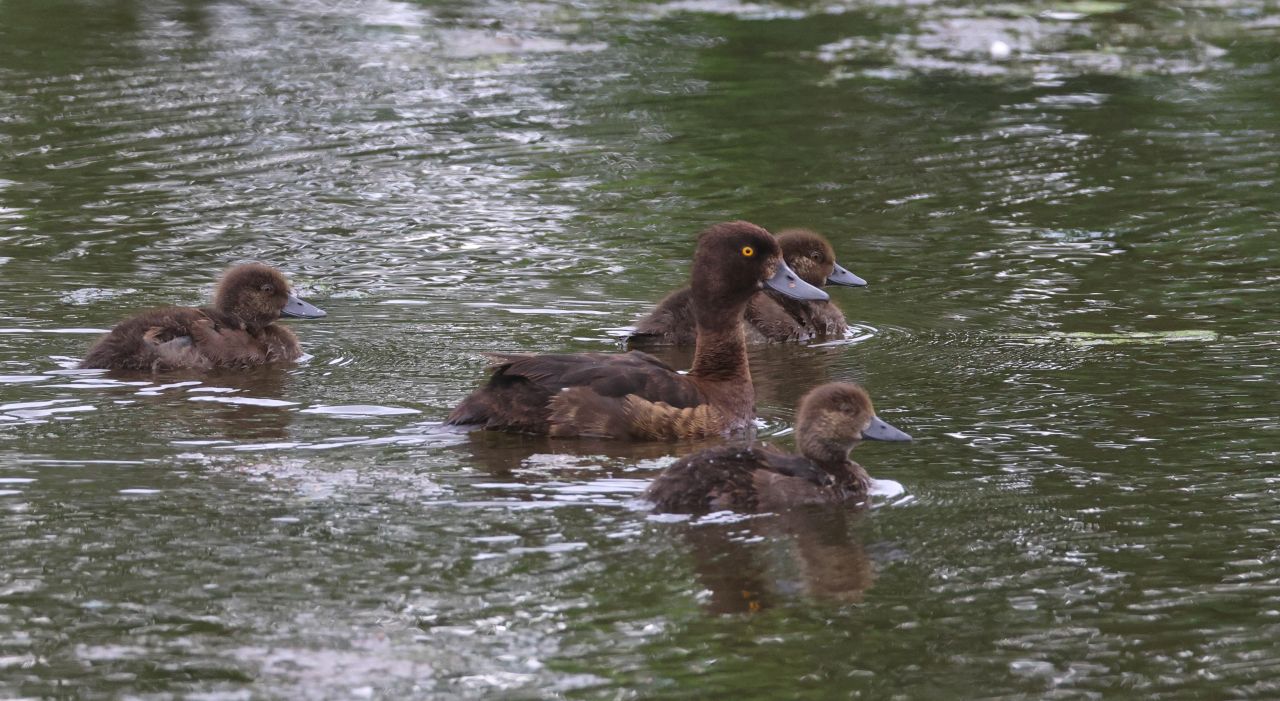
A Tufted Duck with her ducklings in the Schimmel's Ponds © M. Pfeifer
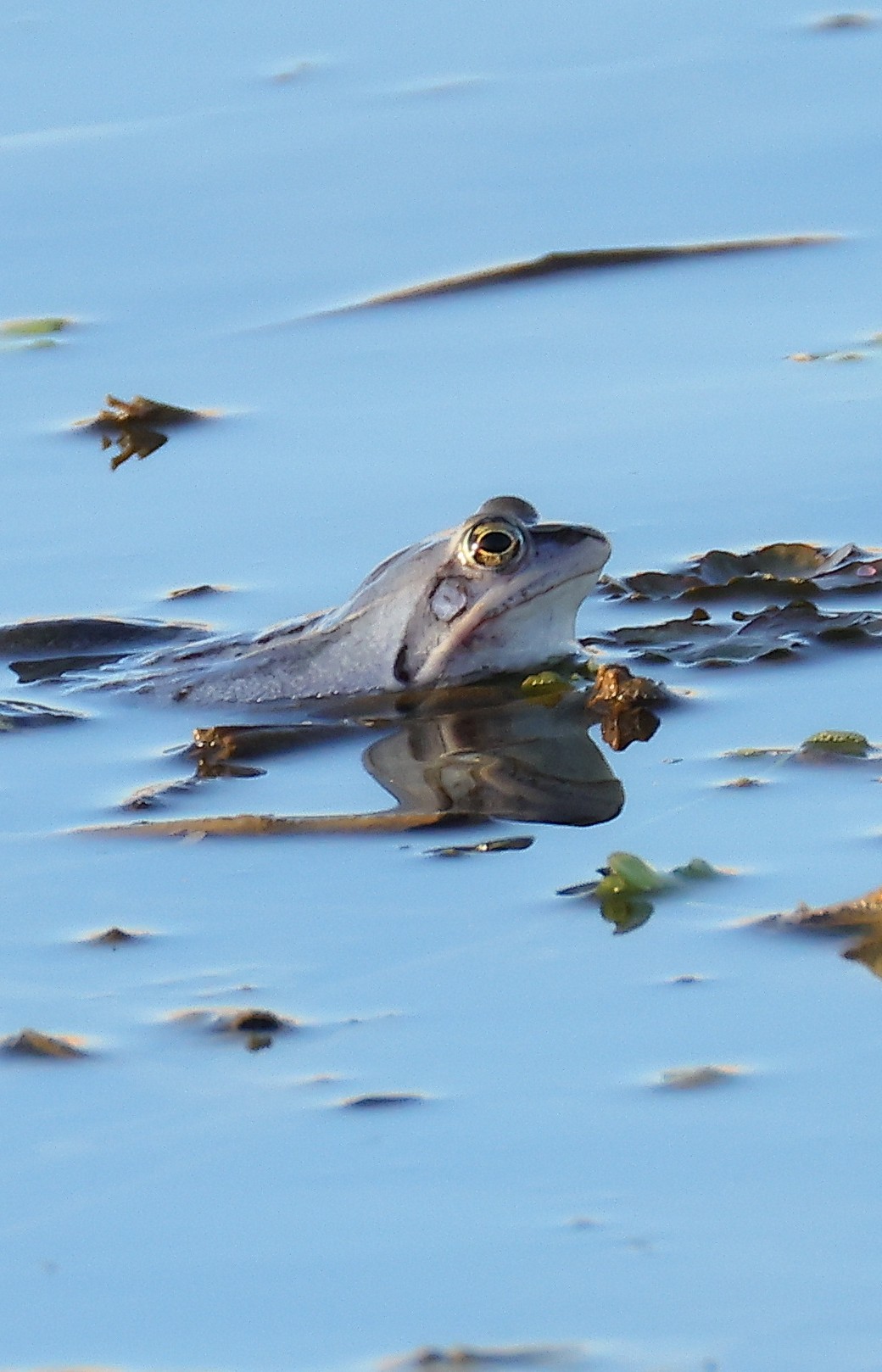
Moor Frog in the ‘Seeländereien bei Frose‘ wetlands during the brief spring courtship season © SPA
When the water ‘bubbles’ and an endangered amphibian species reveals its presence and all its vitality in the 'Seeländereien bei Frose' wetlands ...
The population of the Moor Frog in Saxony-Anhalt has declined significantly in recent decades. Drainage, habitat loss and increasingly dry periods are taking a heavy toll on this amphibian species. Today, the Moor Frog is classified as endangered in Saxony-Anhalt and has declined to just a few, mostly isolated remnant populations (see Saxony-Anhalt State Office for Environmental Protection, Red List).
This makes the recent observations in the ‘Seeländereien bei Frose’ wetland complex – which covers just under 75 hectares and of which our Foundation owns 32 hectares – all the more encouraging. At the beginning of April, up to 40 calling male Moor Frogs were observed here. This is thought to be one of the last stable populations in the region.
During the brief spawning season, the males take on a distinctive blue colour and attract attention with their soft, ‘bubbling’ calls – an impressive yet now rare natural spectacle that can only be observed in a few places.
However, the area's dynamics also highlight the vulnerability of this population. In recent years, a lack of rainfall just a few weeks after the breeding season has led to many water bodies drying up drastically. This jeopardises the reproductive success of an entire year.
Maintaining stable water levels is therefore crucial. Through targeted habitat restoration measures, the Foundation Pro Biodiversity aims to ensure water availability well into the summer months, thereby helping to stabilise the wetlands near Frose in the long term as a valuable habitat for amphibians, insects and water-dependent bird species.
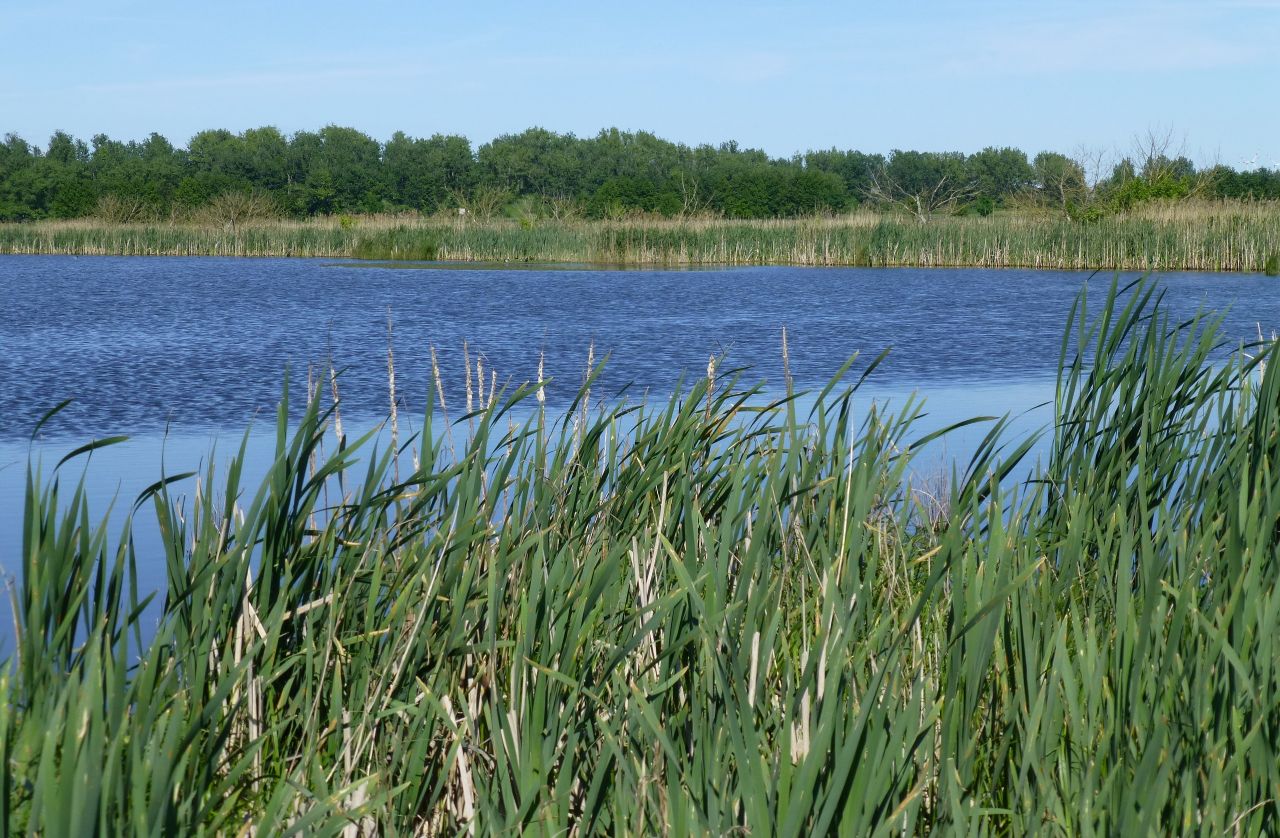
Open water areas and reed beds in the 'Seeländereien bei Frose' wetland complex – vital refuges for wetland species that have now become rare. © SPA
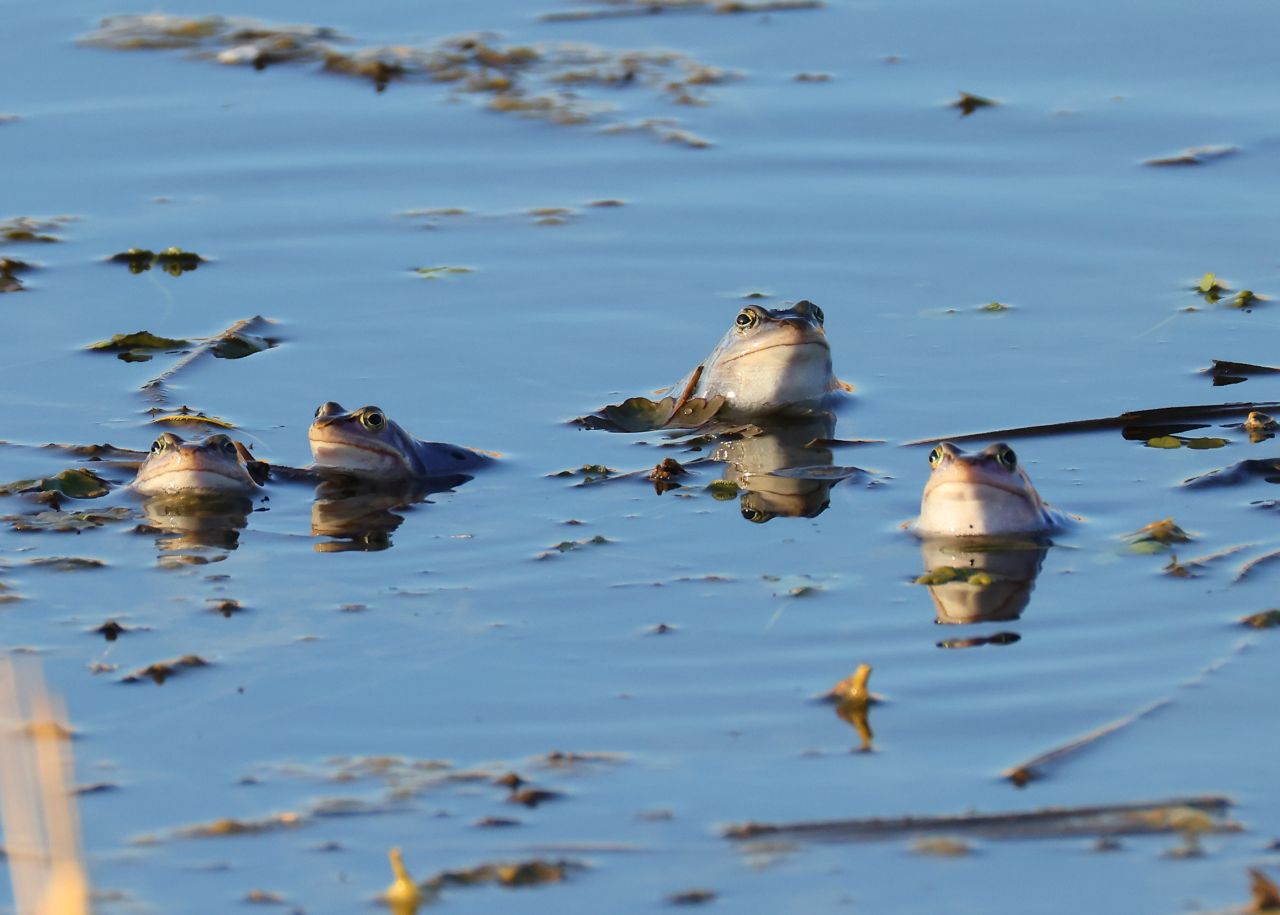
Male Moor Frogs calling during their short breeding season – a rare natural spectacle in spring. © SPA
 M. Pfeifer.jpg)
Spring from a bird’s-eye view: Our Schimmel’s ponds – a new, diverse habitat for numerous species © M. Pfeifer
This spring is showing that targeted habitat restoration measures are gradually transforming this former fish farm back into a wetland rich in structure and biodiversity.
As spring now progresses rapidly, a new phase of development is becoming apparent at the ‘Schimmel’s ponds’ in the Limbach pond area south of Limbach-Oberfrohna. Whereas just three years ago the pond area was dominated by intensive fish farming, a diverse natural pond landscape is now gradually re-emerging. Spring is revealing the results of the targeted and extensive biotope restoration and development measures initiated by the Foundation Pro Biodiversity in 2024.
The pond area, covering around twelve hectares (120,000 m²), forms part of a significant wetland in south-west Saxony – a region otherwise lacking in water – and already provides a valuable habitat for a wide variety of waterbird species.
After acquiring the land in 2023, we agreed and adopted a comprehensive plan of action in consultation with local conservationists and the regional nature conservation authority. The top priority was to restore the technical water management system to allow for variable water levels in the 12 ponds – a fundamental prerequisite for the development of a wide variety of aquatic habitats. Shortly afterwards, the rapidly encroaching scrub growth on and around the pond embankments was cut back; as some ponds had dried up, large stands of reeds and cattails were partially removed, and the embankments were restored.
With the start of this year’s vegetation growth season, it is already clear just how quickly nature is responding to these measures. The sun-exposed pond banks, now open again, provide ideal conditions for insects, amphibians, and numerous bird species. Last year, extensive grazing by our ‘natural landscape managers’ – water buffalo, Highland cattle and goats – helped the natural development.
A remarkable increase in the diversity of migratory and breeding birds is already evident. The varied landscape structure, comprising open water bodies, damp mudflats along the banks, and structurally rich shoreline areas, creates a mosaic of habitats unique to the region.
This spring, the long-term goal of this ambitious nature and species conservation project is becoming increasingly clear: through natural processes, with only gentle guidance, former intensively farmed fishponds are being transformed into a vibrant wetland that provides a habitat for biodiversity, whilst also impressively demonstrating just how effective consistent, privately funded nature conservation can be.
 M. Pfeifer.JPG)
Mute Swan with cygnets © M. Pfeifer
 M. Pfeifer.jpg)
Tufted duck with offspring © M. Pfeifer
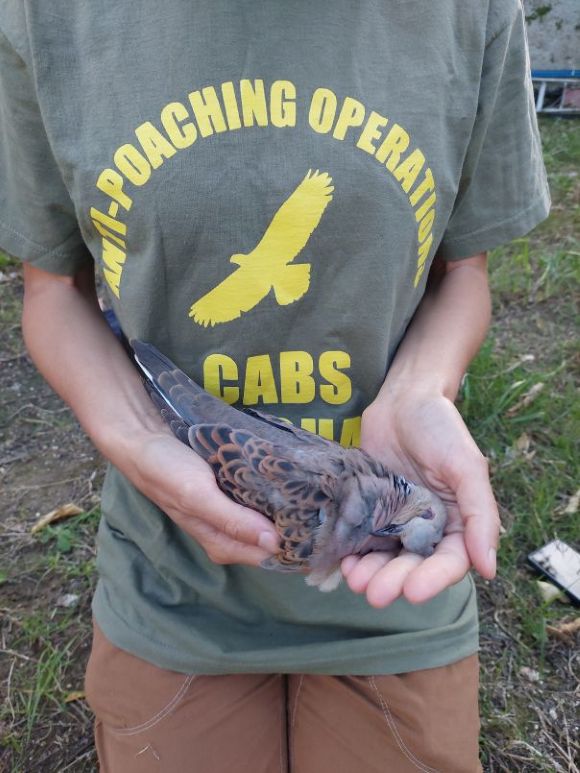
A sad reminder of the illegal spring bird hunting on Zakynthos: a dead Turtle Dove © Committee Against Bird Slaughter (CABS)
More hunting sites discovered – but fewer shots fired:
How the illegal spring hunt for our migratory birds on Zakynthos continues to evolve ...
Again, this spring, teams from the Committee Against Bird Slaughter (CABS) and the Foundation Pro Biodiversity are working together on the Greek island of Zakynthos to combat the illegal hunting of migratory birds. The latest figures show that the intensive bird conservation efforts of recent years are having an impact – even though the situation remains a serious one.
Compared with last year, more active bird hunting sites have once again been identified. At the same time, however, a significant decline in the number of shots fired has been recorded – an important indicator that the pressure of surveillance is having an effect on illegal hunters.
Results of the 2026 Spring Bird Conservation Camp
(figures for 2025 in brackets for comparison):
Despite the increase in the number of hunting sites discovered, there is a positive trend: significantly fewer shots were recorded during our operations than in previous years. In previous years, over 100 shots could be heard on individual days – this spring, the maximum number was around 60 to 70 shots per day, with the focus remaining on the well-known problem area around Keri.
Another significant difference compared with last year is that our response teams have so far been spared physical attacks this spring – a development we attribute to consistent law enforcement and increased vigilance with regard to illegal hunting activities.
Nevertheless, the work on Zakynthos is far from over. During the operations, previously unknown hunting sites were discovered, and these will receive higher monitoring priority in future campaigns. The aim remains to curb illegal spring hunting of migratory birds further and, in the long term, to put a complete stop to it.
The campaign on Zakynthos demonstrates once again that, thanks to the close cooperation between the Committee Against the Slaughter of Birds (CABS) and our Foundation, our annual spring presence on the ground, and the financial support of dedicated donors, we are able to make measurable progress in the practical protection of migratory birds.
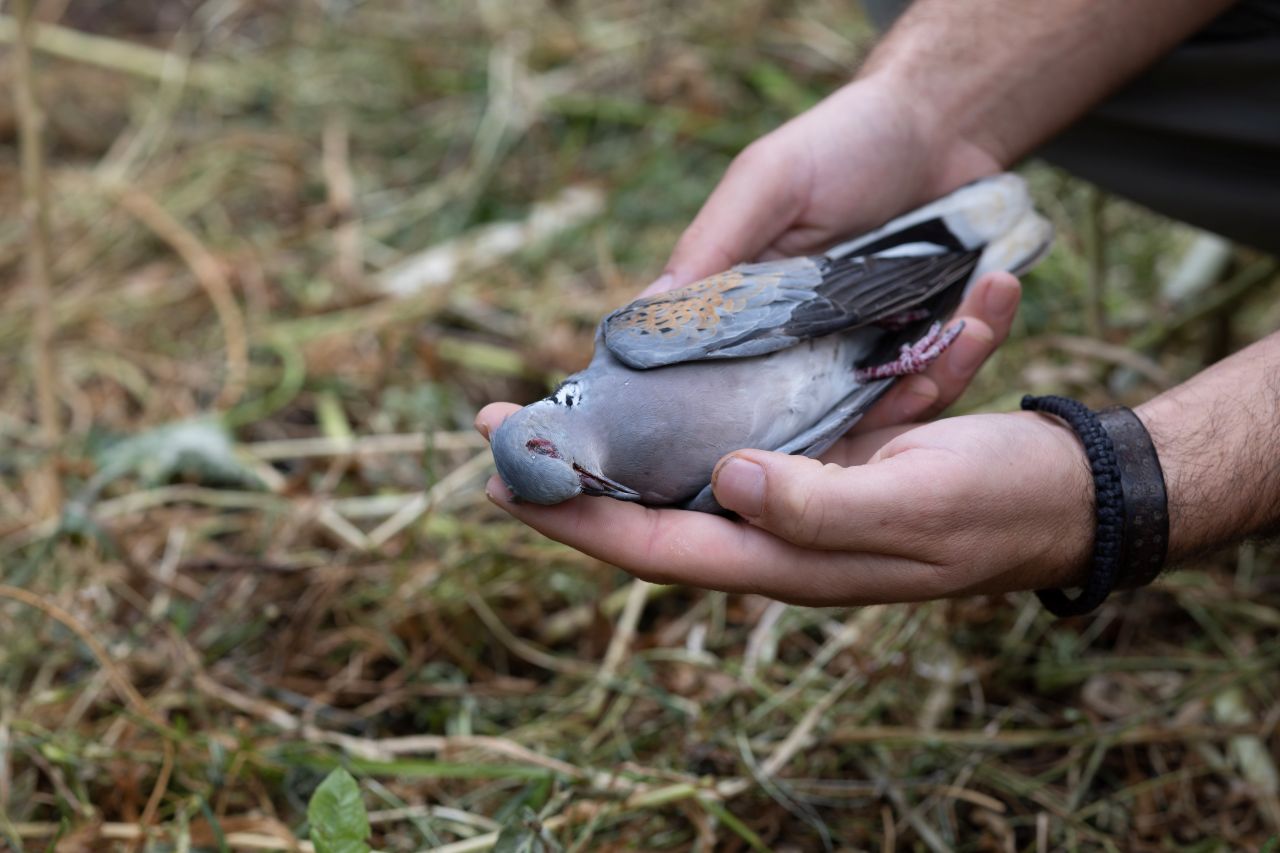
Victim of illegal spring hunting on Zakynthos: a shot Turtle Dove © Committee Against Bird Slaughter (CABS)
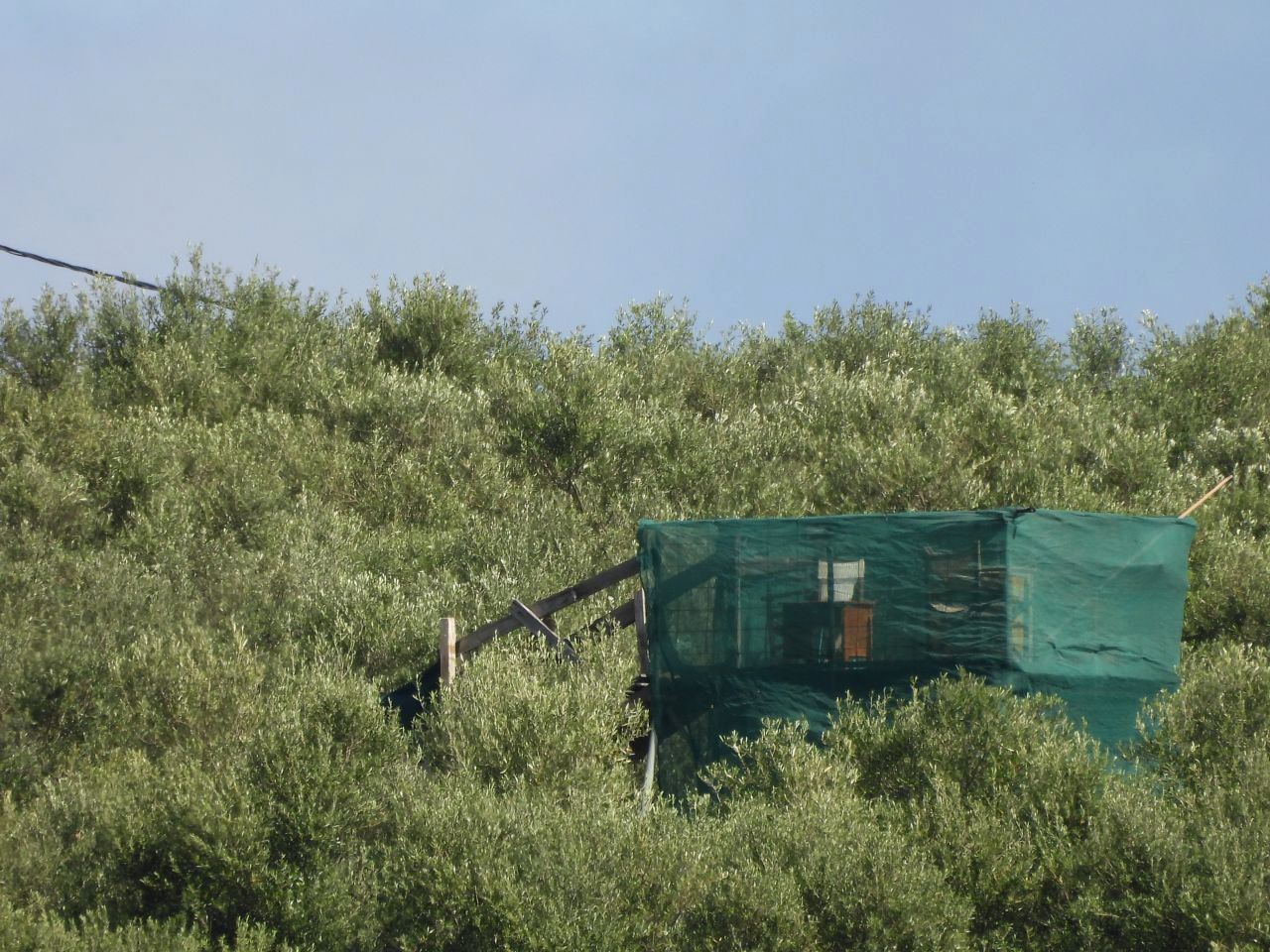
Well camouflaged, but nevertheless discovered: an illegally used hunting hide on Zakynthos © Committee Against Bird Slaughter (CABS)
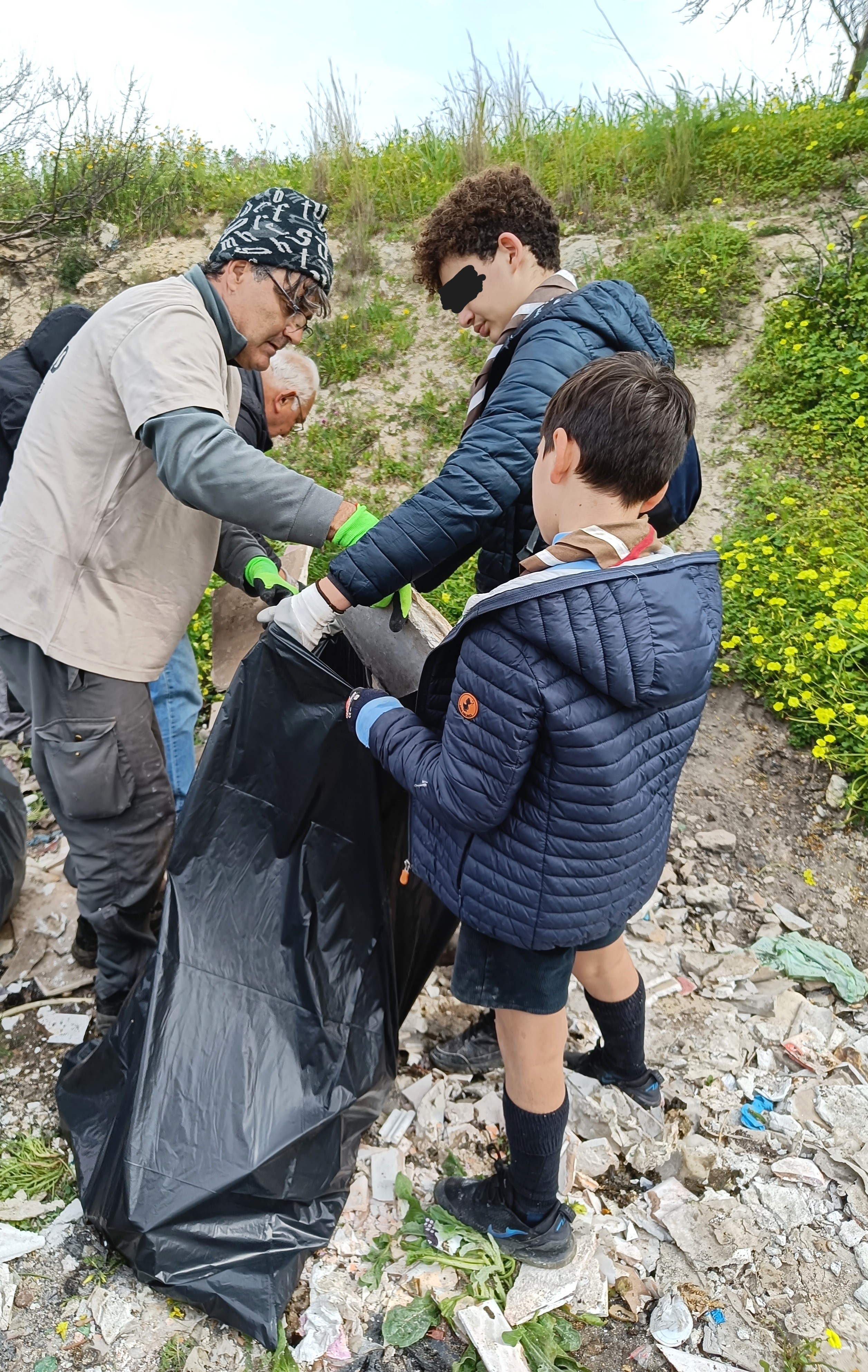
Hard-working helpers at the clean-up campaign © SPA IT
40 volunteers, six refuse collection lorries and a major effort to protect nature – a community initiative at Pantano Cuba clears rubbish from valuable dry slopes …
For the first time, a concerted joint effort has succeeded in completely clearing the dry slopes along the road bordering our Pantano Cuba conservation area to the east – slopes that were heavily littered with vast quantities of illegally dumped rubbish. This is an important contribution to the protection of the sensitive Mediterranean scrubland, which is adapted to dry habitats and characterised by Wild Thyme, Rosemary and Oregano!
This initiative was organised by the two Bird Guards of the Foundation Pro Biodiversity in close collaboration with the municipality of Pachino (SR), the environmental group ‘Pirati Della Marza’ and the association ‘Borgo Sostenibile’. A total of eight organisations took part in the initiative, including several local environmental groups, a scout group comprising numerous young people, and other dedicated conservationists. Despite the limited number of participants due to poor weather, around 40 volunteers were mobilised, sending a strong message in support of practical nature conservation in the local area.
The results of this coordinated effort are impressive: more than 200 bin bags, each with a capacity of 120 litres, were filled, amounting to a total volume of around 15-18 cubic metres of rubbish. In total, six lorryloads of rubbish were collected. In addition to ordinary household waste, large quantities of problematic waste were also collected, including old tyres, mattresses, furniture, scrap metal and various household appliances.
The municipality of Pachino provided logistical support for the campaign by supplying refuse collection vehicles, collection materials, and bins free of charge and by ensuring proper waste disposal. The Syracuse Provincial Police ensured the campaign ran smoothly by closing roads and implementing security measures.
The high level of motivation among all those involved, the visible results, and the great success have already encouraged our Bird Guards to plan a second rubbish collection campaign for April 2026. The aim is to finally clear all litter from the dry slopes along our land and the local road all the way to the coastal village of Granelli.
This initiative is a striking example of how community involvement can bring about tangible and rapid improvements to the countryside and biodiversity.
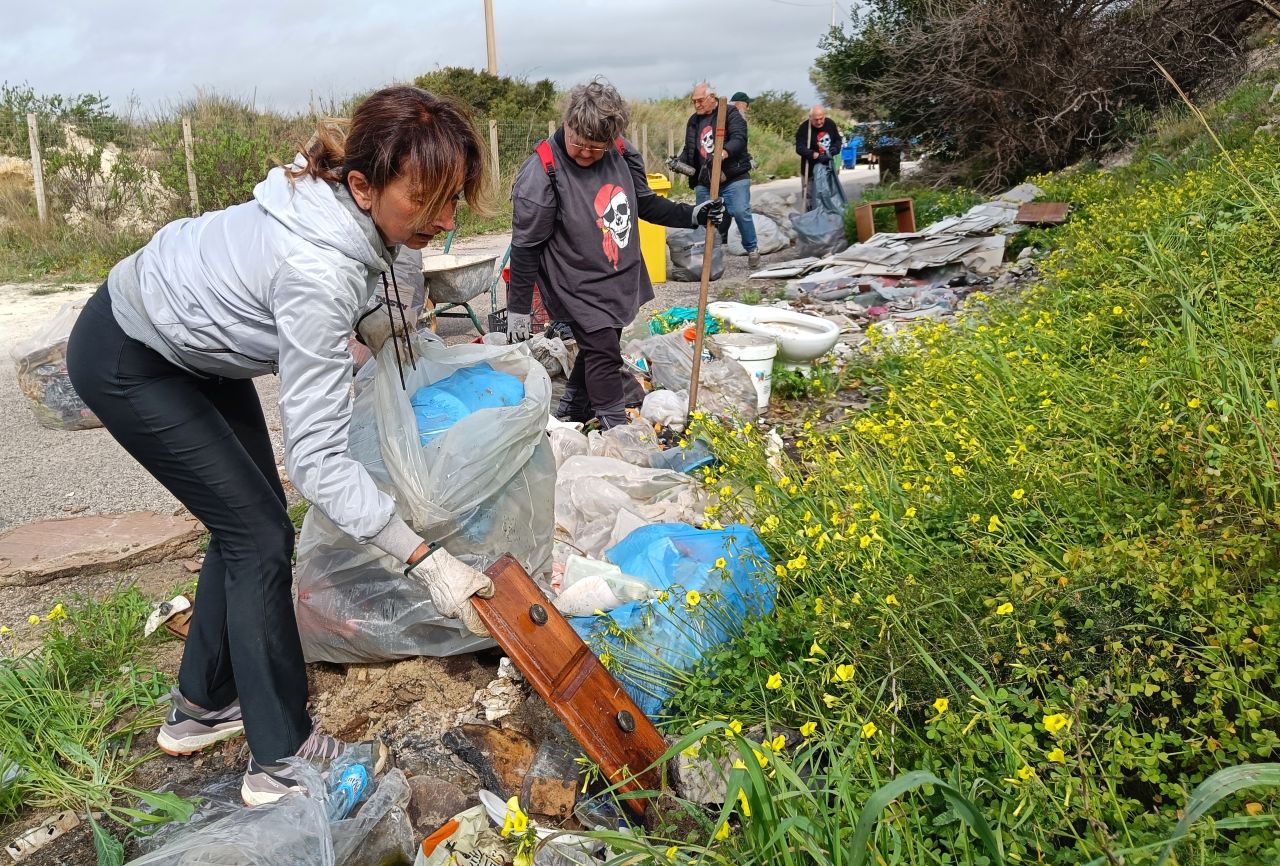
The Pirati Della Marza environmental group is back in action © SPA IT
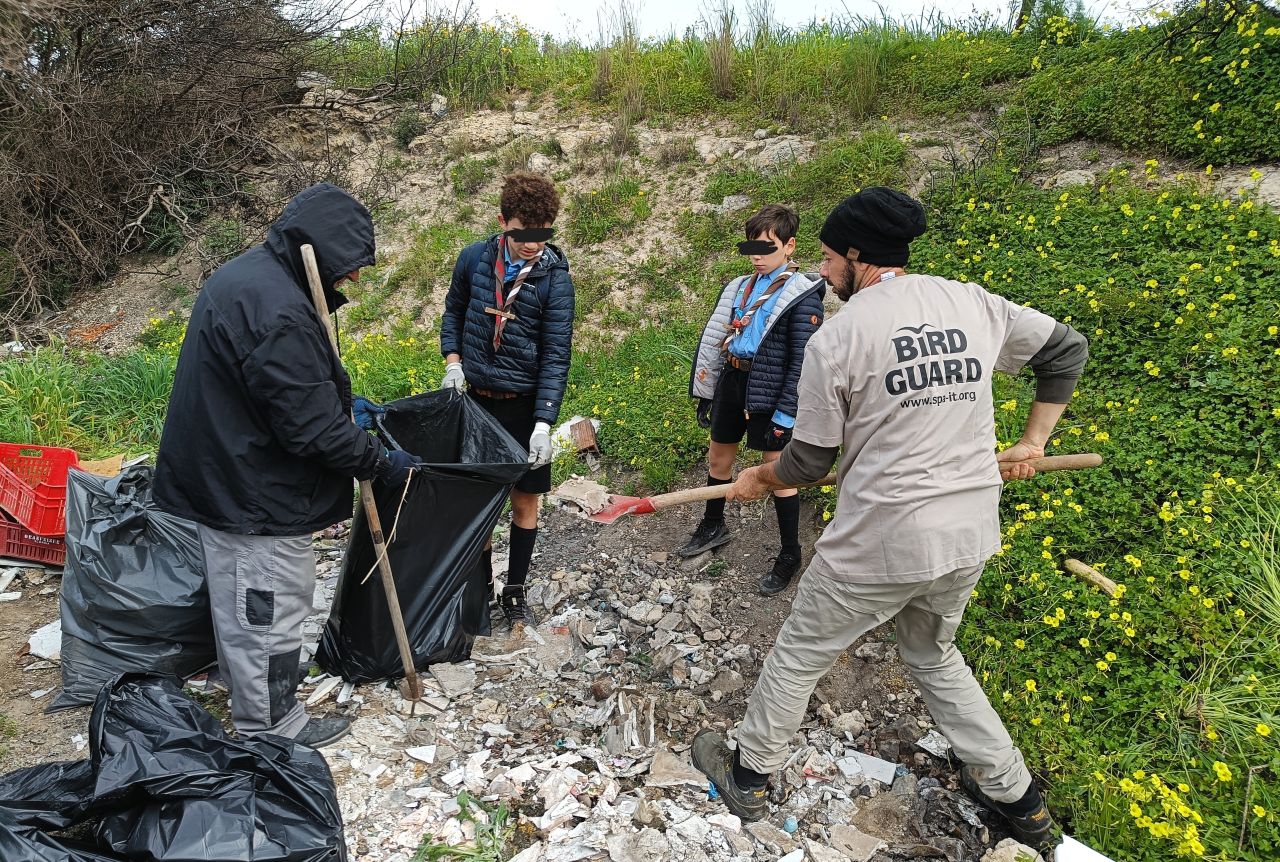
Illegally dumped construction waste also destroys biodiversity © SPA IT
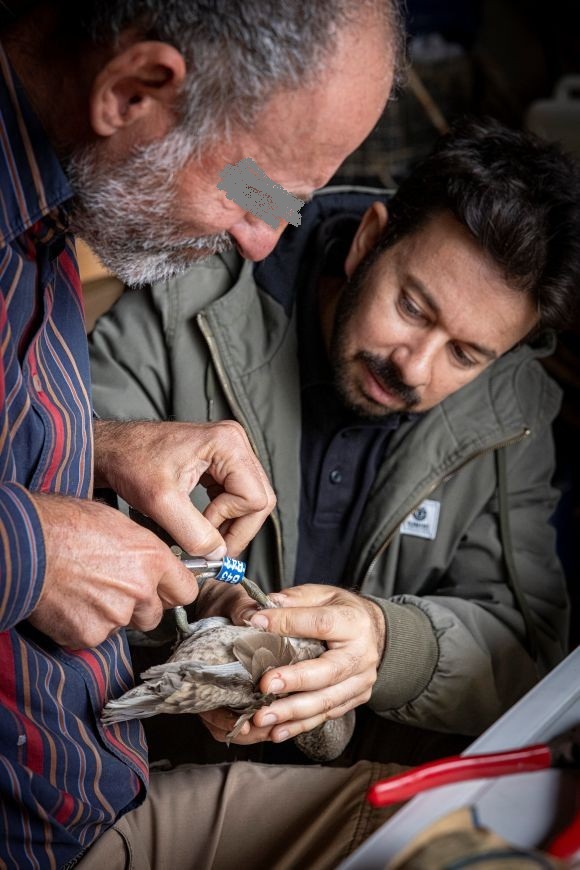
Before release into the wild – ringing a Marbled Duck from a conservation breeding programme © W. Silvestrini
A challenging rescue mission that will significantly reinforce the small remaining population of Marbled Ducks in Sicily...
As part of the EU species conservation programme LIFE18, which supports and co-finances projects across Europe to strengthen populations and secure the existence of endangered species and their habitats, the Foundation Pro Biodiversity has made a significant contribution to strengthening the population of the Marbled Duck, which is native only to southern Europe and is now threatened with extinction.
This delicate duck species – scientifically known as Marmaronetta angustirostris – has sandy brown camouflage colouring, an unusually narrow beak and a strikingly calm demeanour. For years, it has been one of the most rapidly declining waterbird populations in the Mediterranean region. Its populations have been shrinking dramatically worldwide for decades because its habitats, intact waters with protective vegetation, are losing their ecological quality, being destroyed by human intervention and disappearing due to desiccation.
Extensive biotope restoration and development measures were implemented in close cooperation with regional nature conservation authorities in Sicily.
These focused on the shore and shallow-water zones of the Pantano Longarini wetland area owned by the Foundation, and on the near-natural redesign of parts of the former fish-farming canal system on the south side of the lagoon. At the suggestion of the Foundation Pro Biodiversity, this LIFE18 project is also co-financing the purchase of land near the lagoon and its partial conversion into new wetlands with small bodies of water – a key measure to expand the habitats of this endangered duck species by creating extensive new biotope structures.
A second key component of the LIFE18 species conservation project was the release of a total of 100 Marbled Ducks into our Pantani nature reserve between 2023 and 2026. These young ducks come from an EU-funded Marbled Duck breeding station in Spain. After a 14-day acclimatisation period in an outdoor aviary located in the middle of the Pantani reserve, the last 20 Marbled Ducks were released into the wild at the beginning of March 2026 as part of this LIFE18 funding project. All Marbled Ducks are ringed, and some also carry a mini GPS transmitter, which allows their flights and habitat use to be documented over a set period.
We can already see that this LIFE18 species conservation project has given a significant boost not only to the population of the Marbled Duck, but also to the Ferruginous duck, which is threatened throughout Europe, and the Western Purple Swamphen, which is critically endangered.
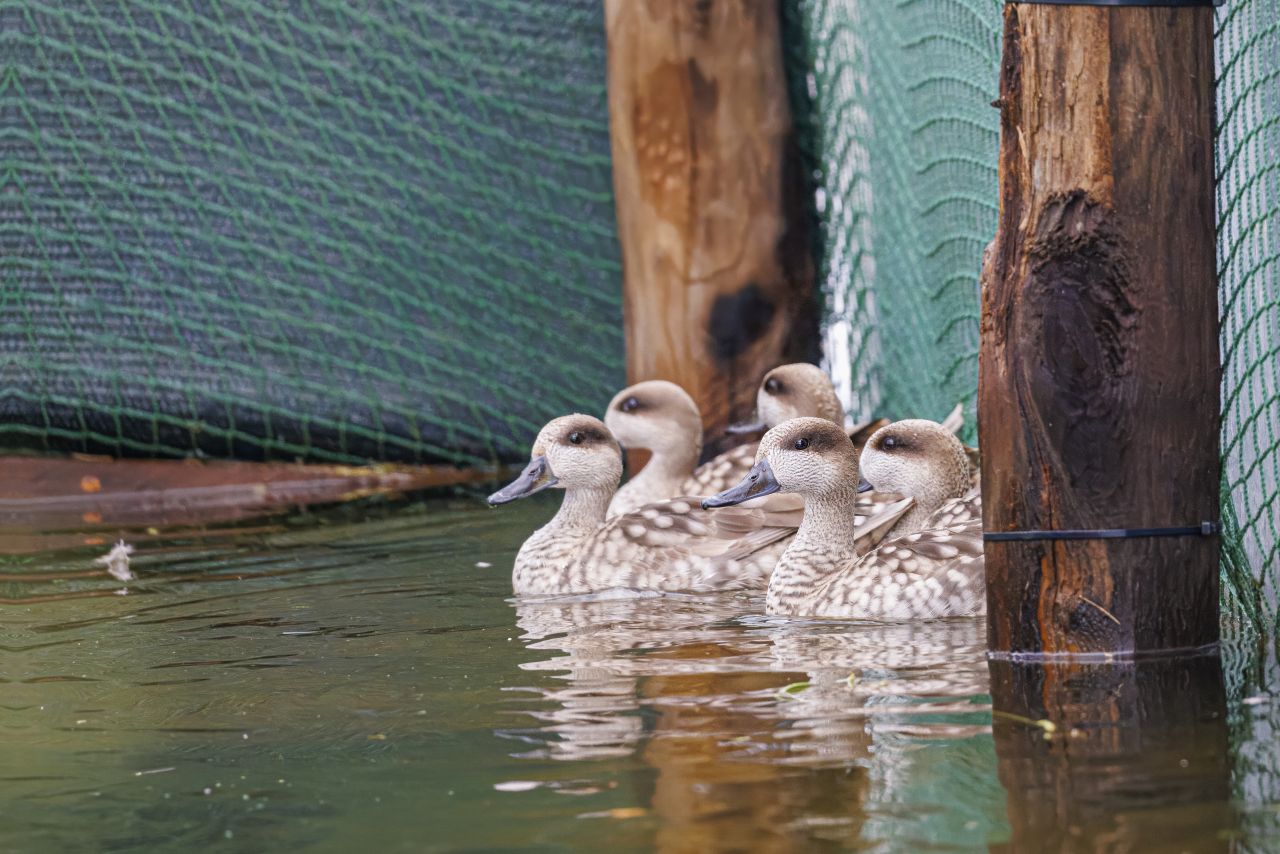
Marbled Ducks awaiting release in the rewilding aviary © W. Silvestrini
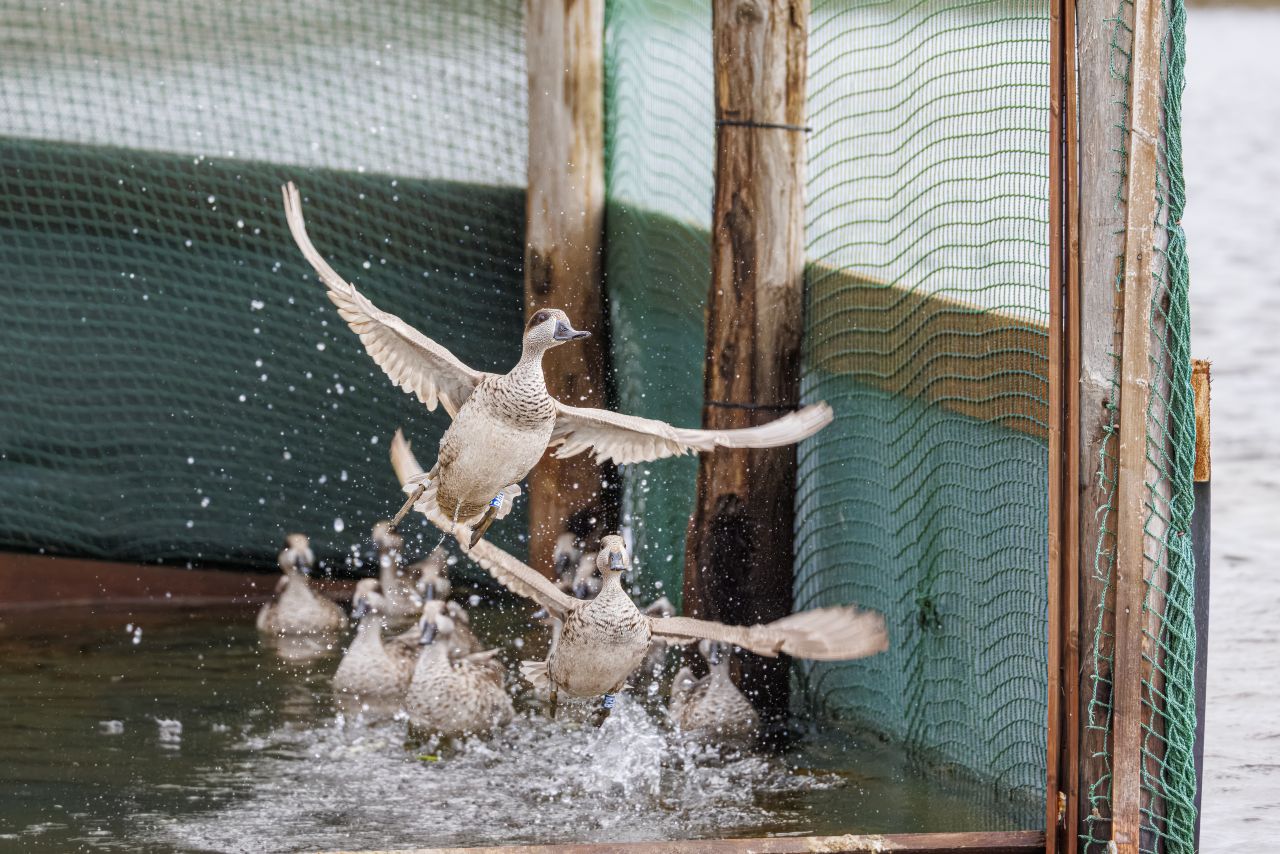
Release into the wild – the moment the Marbled Ducks are set free © W. Silvestrini
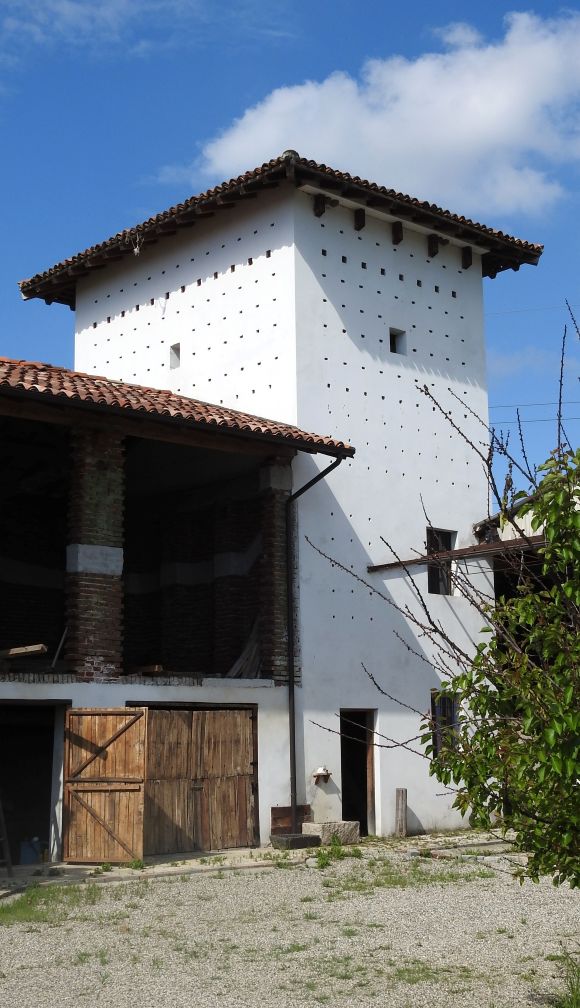
Borgolavezzaro, Italy - farmhouse with species protection tower © SPA
Life begins anew – awakening from hibernation
With the relatively early awakening from hibernation this year, many bird species that nest in buildings begin their new breeding season in March. Species such as Jackdaws, Italian Sparrows, House Sparrows, Black Redstarts and White Wagtails take advantage of the first milder days to secure their nesting sites and breeding grounds. They are among the bird species that breed twice a year in succession. This natural conservation strategy compensates for the relatively high mortality rate among young birds, particularly evident in urban habitats.
To establish our proven species protection tower strategy in Italy, the country of historic rural dovecotes, we worked with one of Italy's most renowned bird conservationists at his farm in the northern Italian municipality of Borgolavezzaro (province of Piedmont). We converted the old, unused dovecote into a species-protection tower for birds and insects that make their home in buildings. Designed as a prototype species-protection tower for Italy, the former dovecote has now developed into a species-protection building teeming with bird and insect life.
Today, the tower is home to an extensive breeding colony of Jackdaws, which has steadily grown over the years. Inside the tower and on its façade, Starlings, Italian and House Sparrows, as well as Common Swifts and House Martins, use many of the 440 breeding cavities and artificial nests. A special highlight: the species protection tower now offers a protected breeding and retreat area for a pair of Barn Owls and even a pair of Stock Doves. This is unique in Europe, as this species of wild dove usually breeds in tree hollows in forests!
This positive development has not gone unnoticed. Our first species protection tower project in Italy has attracted widespread interest in the surrounding area and is now inspiring private individuals and communities to convert their historic dovecotes into species protection towers, thereby putting cultural and historical buildings threatened with decay to good use and giving them a new lease of life.
This demonstrates that species conservation is not only necessary – it can also be contagious. Step by step, from a single tower, a network of valuable species conservation habitats is being created, which will strengthen the future of endangered building breeding birds in the region in a sustainable manner.
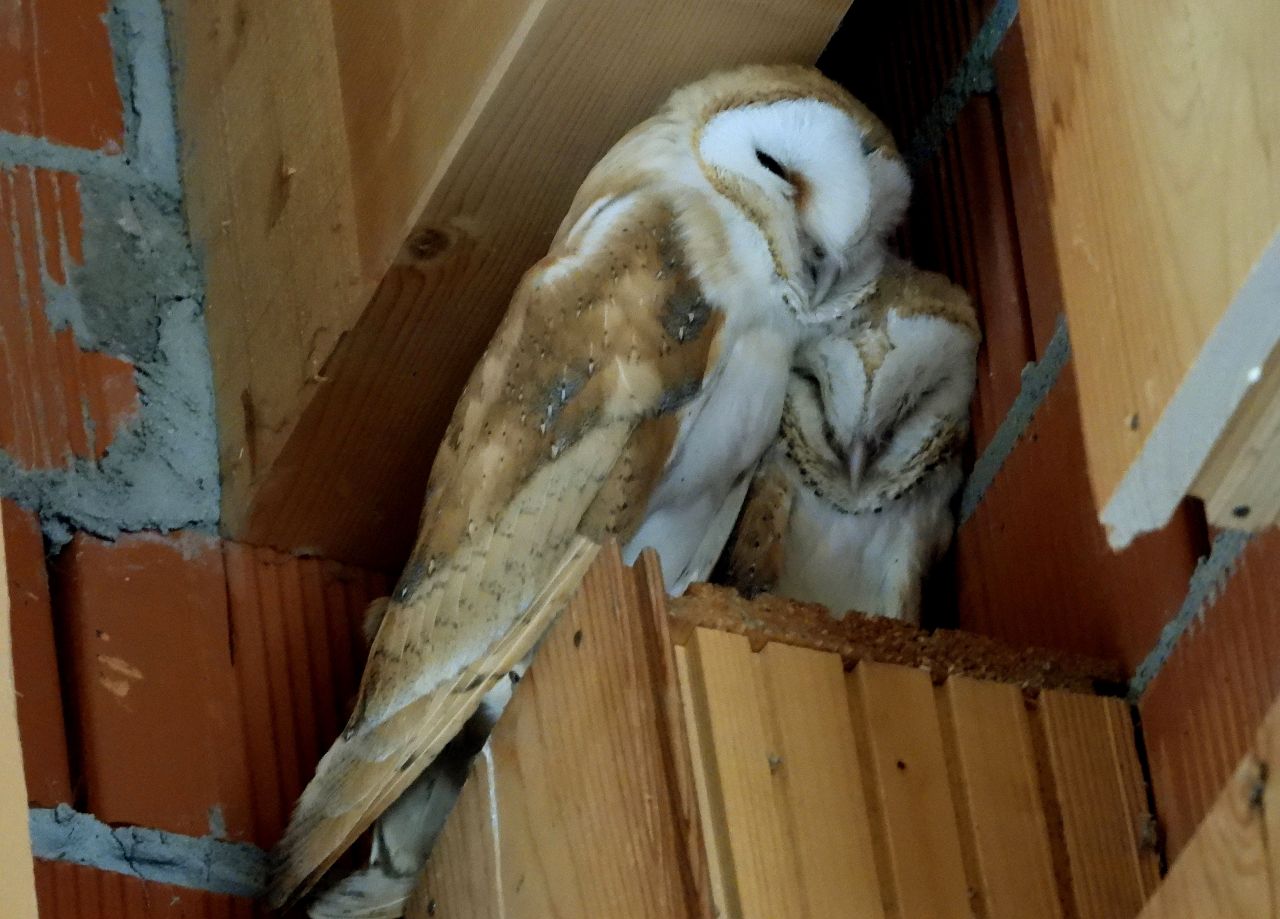
Barn Owl pair in the Borgolavezzarro species conservation tower © A. Rutigliano
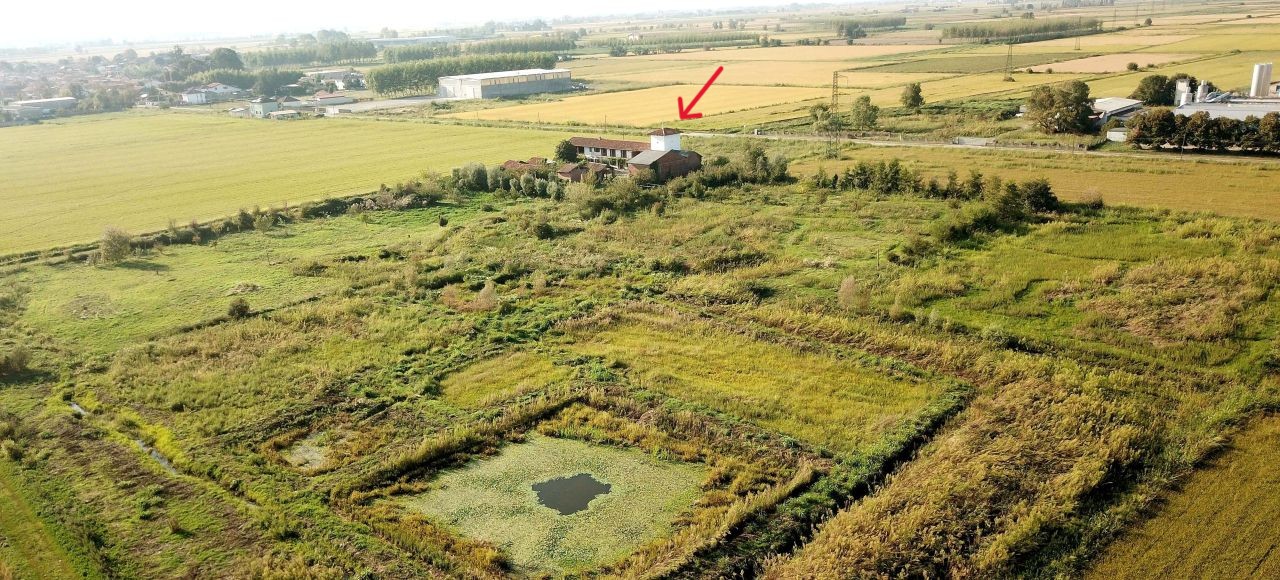
Borgolavezzarro – farmstead with species protection tower & biotope © A. Rutigliano
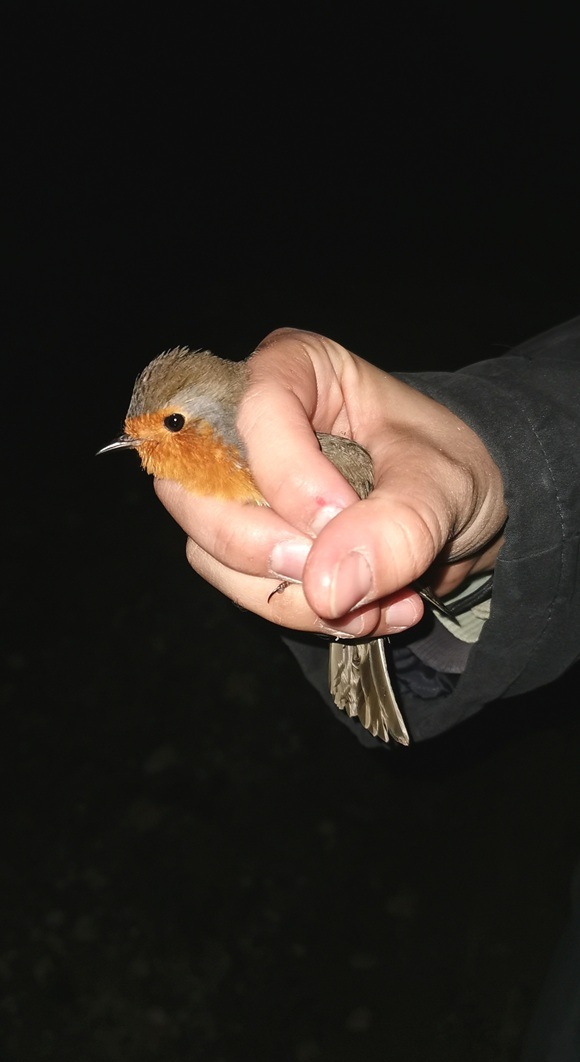
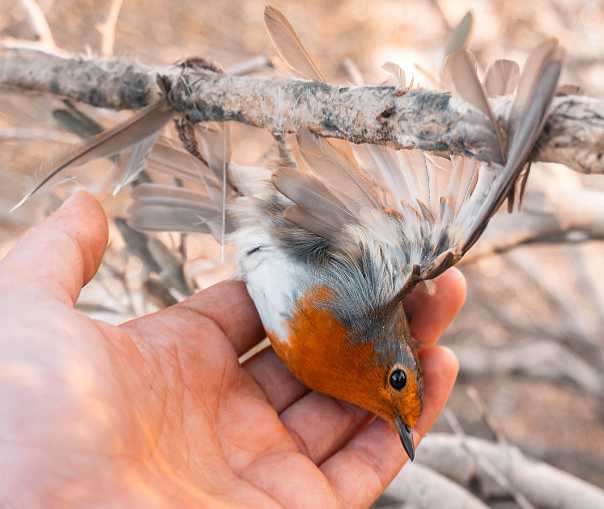
Robin freed from a mist net at night © Committee Against Bird Slaughter
The winter thrush stopover on Cyprus has come to an end – and it has brought unpleasant surprises not only for song thrushes, but also for many bird poachers and hunters...
Even halfway through this year's Winter Bird Protection Camp, our bird conservationists were still hard at work at night and early in the morning, searching for trapping sites, rescuing Song Thrushes, dismantling migratory bird-trapping devices, and reporting bird poachers and illegal bird hunters.
During nighttime operations, our bird protection activists rendered three additional trapping sites harmless by removing mist nets. During early morning operations, they caught two bird poachers red-handed as they were trapping birds with limesticks. Two more bird hunters were caught using illegal electronic bird call devices and reported to the authorities.
One of the bird poachers caught with limesticks had built a permanent aviary in which 15 Song Thrushes and 3 Wood Pigeons were being kept illegally. All the birds had been caught in the wild and did not have officially registered rings. As a result of our criminal complaint, the head of the state gamekeeper organisation informed us that this bird poacher would be ‘rewarded’ with an extra penalty for illegally caging wild birds and that all birds would be released.
Final results of the Cyprus Winter Bird Protection Camp (6 weeks):
Illegal trapping and poaching
Illegal bird hunters
As the massive migration of Song Thrushes over Cyprus ended in mid-February this winter, our bird conservationists were able to wrap up this year's winter migratory bird conservation camp on 17 February 2026 and begin their well-deserved journey home.
We can therefore expect the first Song Thrushes and Mistle Thrushes to arrive in their breeding grounds in Germany as early as the end of February 2026. Although our volunteer bird conservationists have said ‘farewell’ to Cyprus for the time being, we will be back in Cyprus in April at the latest to continue our work protecting migratory birds and, as always, we will be flying the flag for courageous and effective migratory bird conservation.
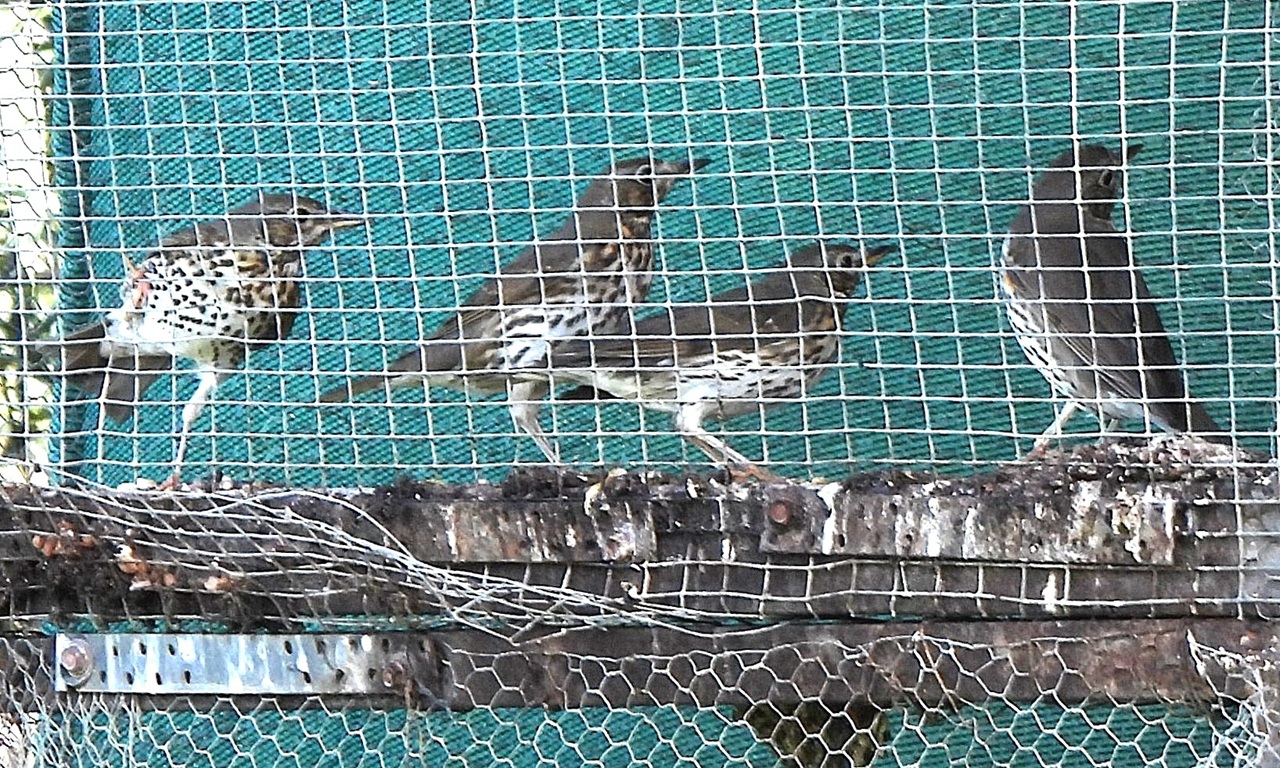
Illegally caged Song Thrushes in an aviary © Committee Against Bird Slaughter
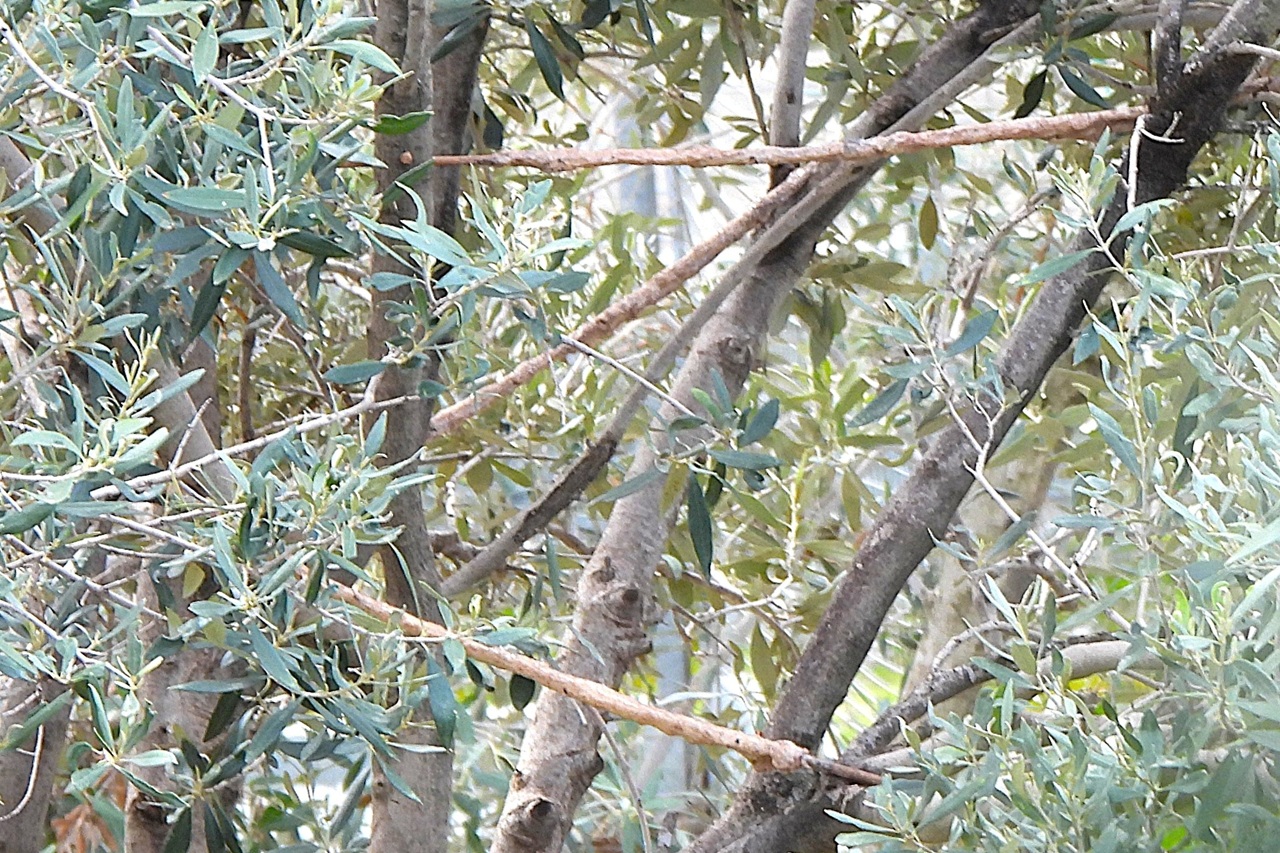
Limesticks set up and ready for trapping in an olive tree © Committee Against Bird Slaughter
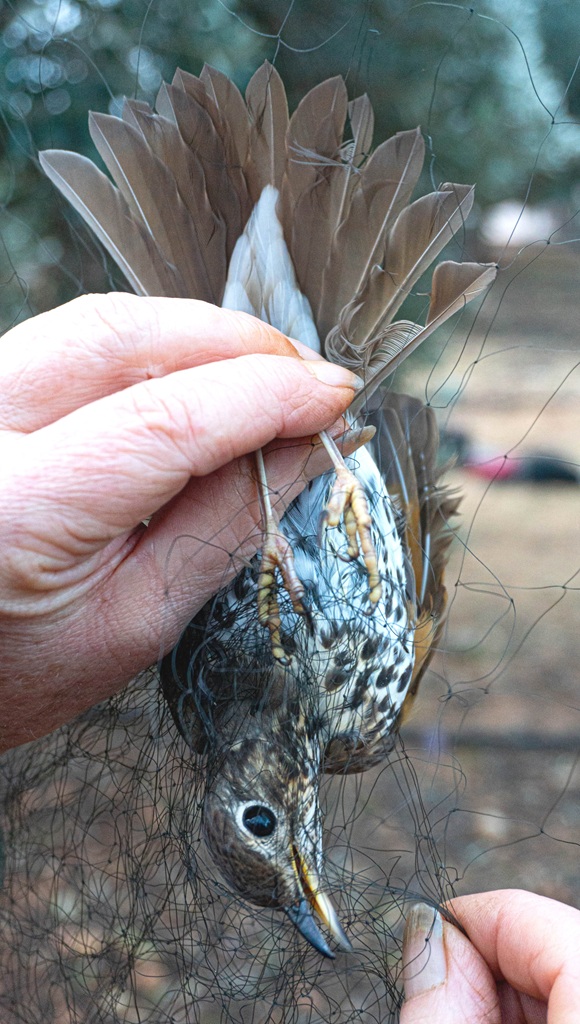
Song Thrush freed from mist net © Committee Against Bird Slaughter (CABS)
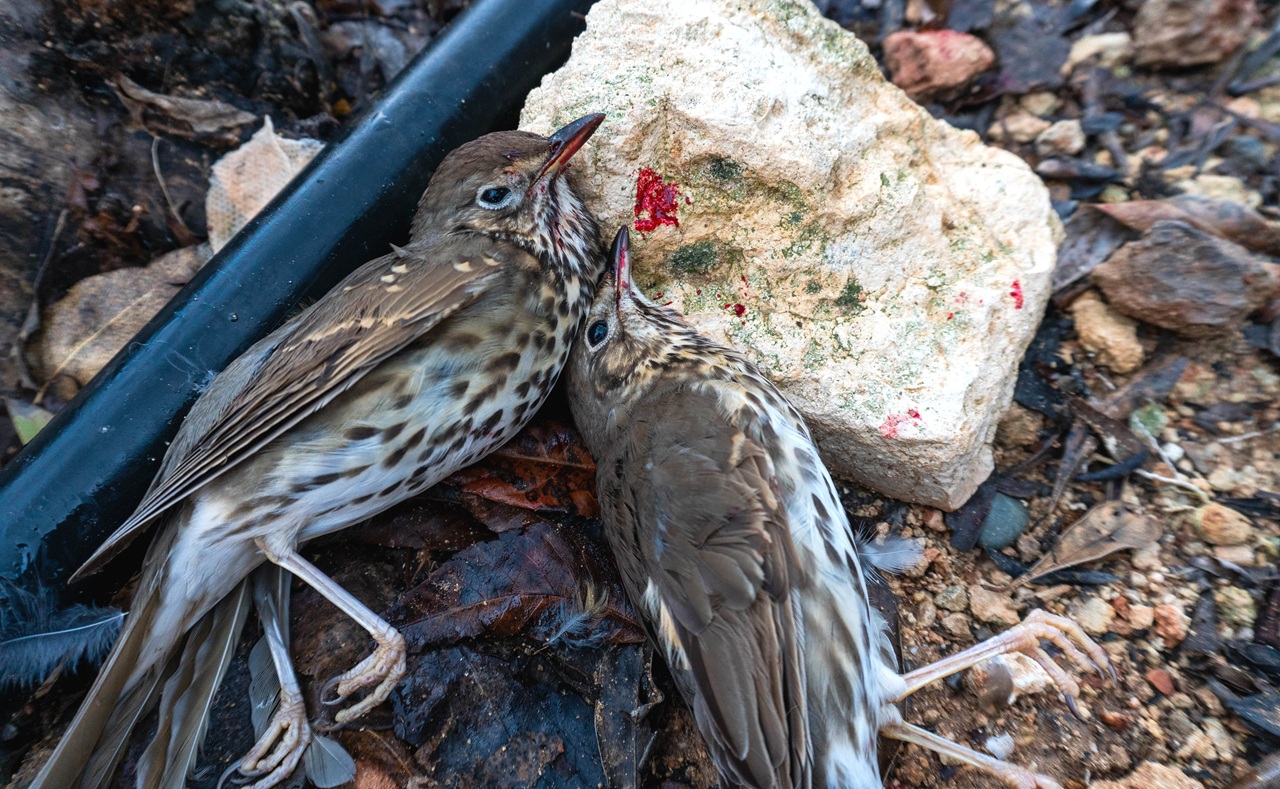
Shot song thrushes – victims of illegal hunting © Committee Against Bird Slaughter (CABS)
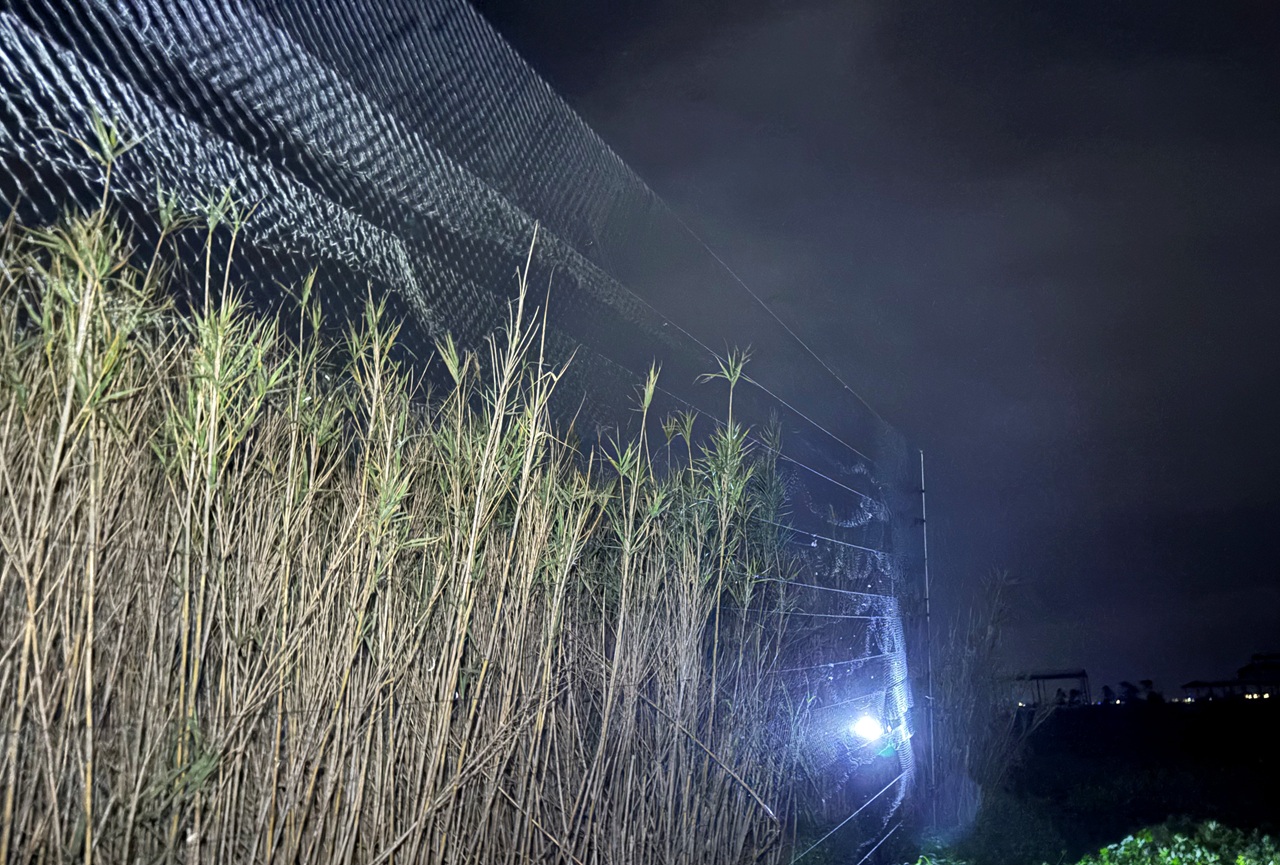
Night-time dismantling of an illegal mist net © Committee Against Bird Slaughter (CABS)
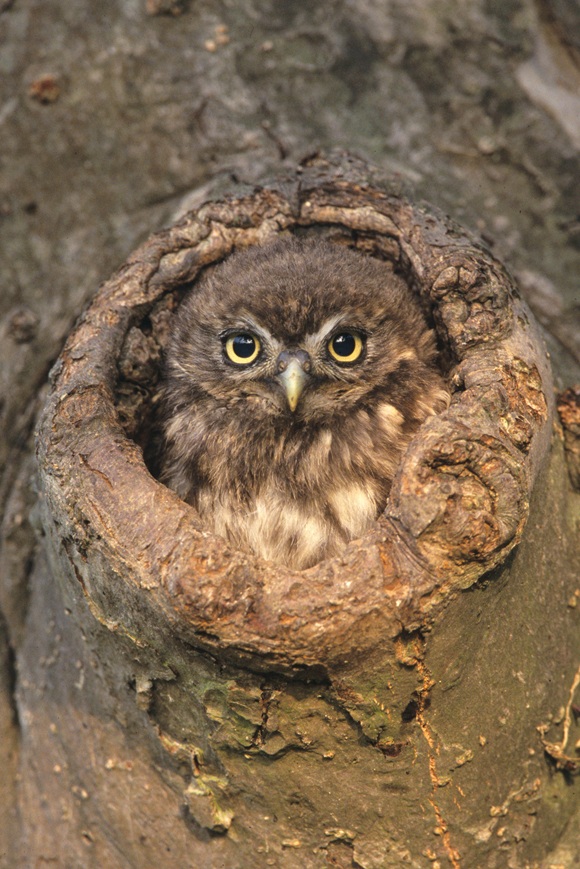
A Little Owl in its apple tree cavity © H. Glader
Cutting (pollarding) old willow trees to secure and protect natural Little Owl nesting and breeding sites is not a job for the faint-hearted
The persistent cold winter weather, with light frost at night, this January in East Westphalia, in the districts of Paderborn, Gütersloh and Soest, has allowed our volunteer Little Owl conservationists and the tree care company we employ to rapidly pollard the willow trees that were selected by our colleague Herbert in summer 2025 and contractually agreed for maintenance.
Of the 780 willow trees we planned to prune this winter, from early November 2025 to late February 2026, more than 550 trees have already been professionally ‘topped’, putting us ahead of schedule.
We therefore want to continue to take advantage of the frosty weather, which is ideal for this hard work, and, if the weather remains cold, create up to 900 pollarded willow trees this winter... that would be a record number of well-maintained willow trees. See also the chart below.
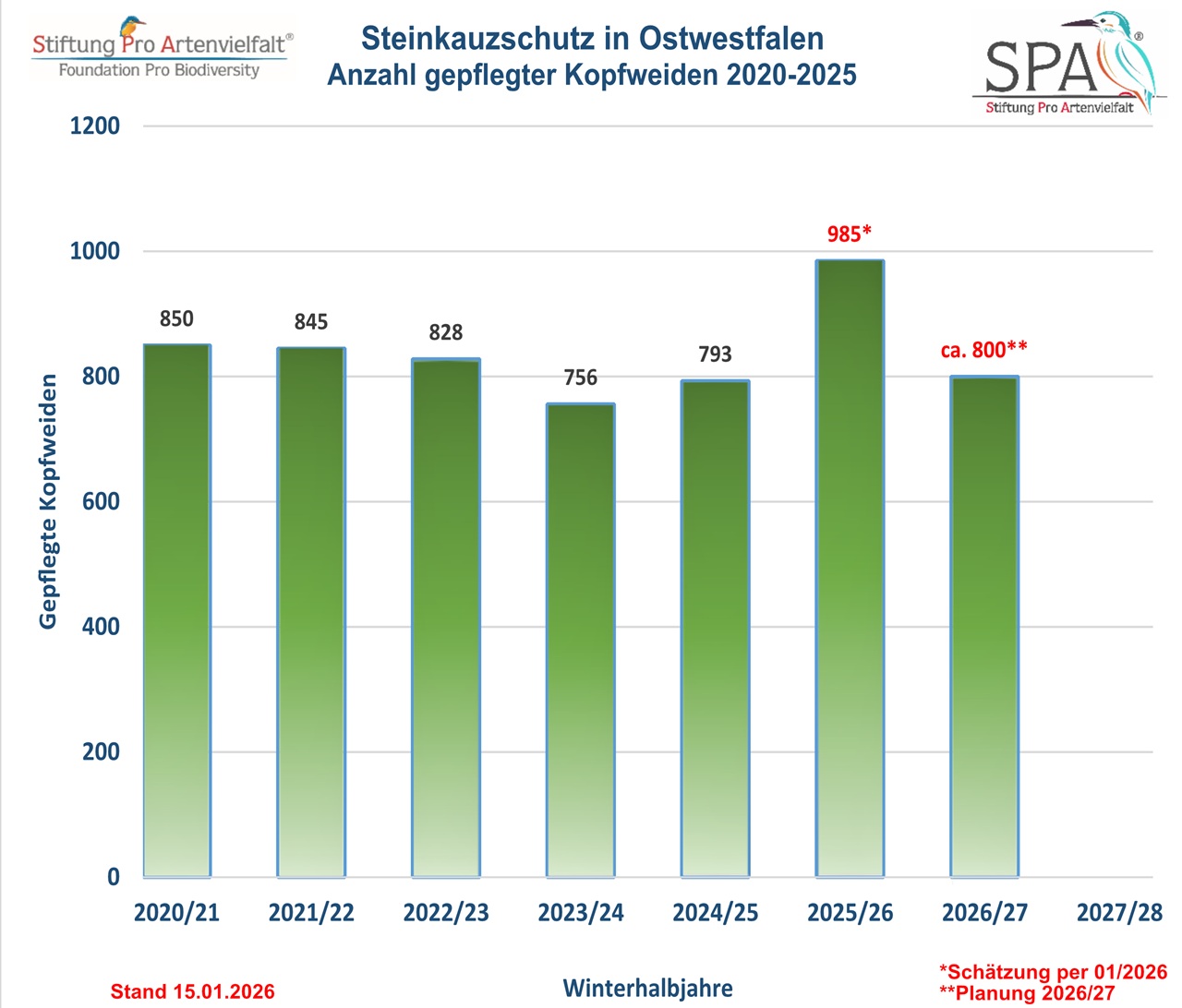
Chart: Pollarded Willow Care – Little Owl Protection Project © SPA
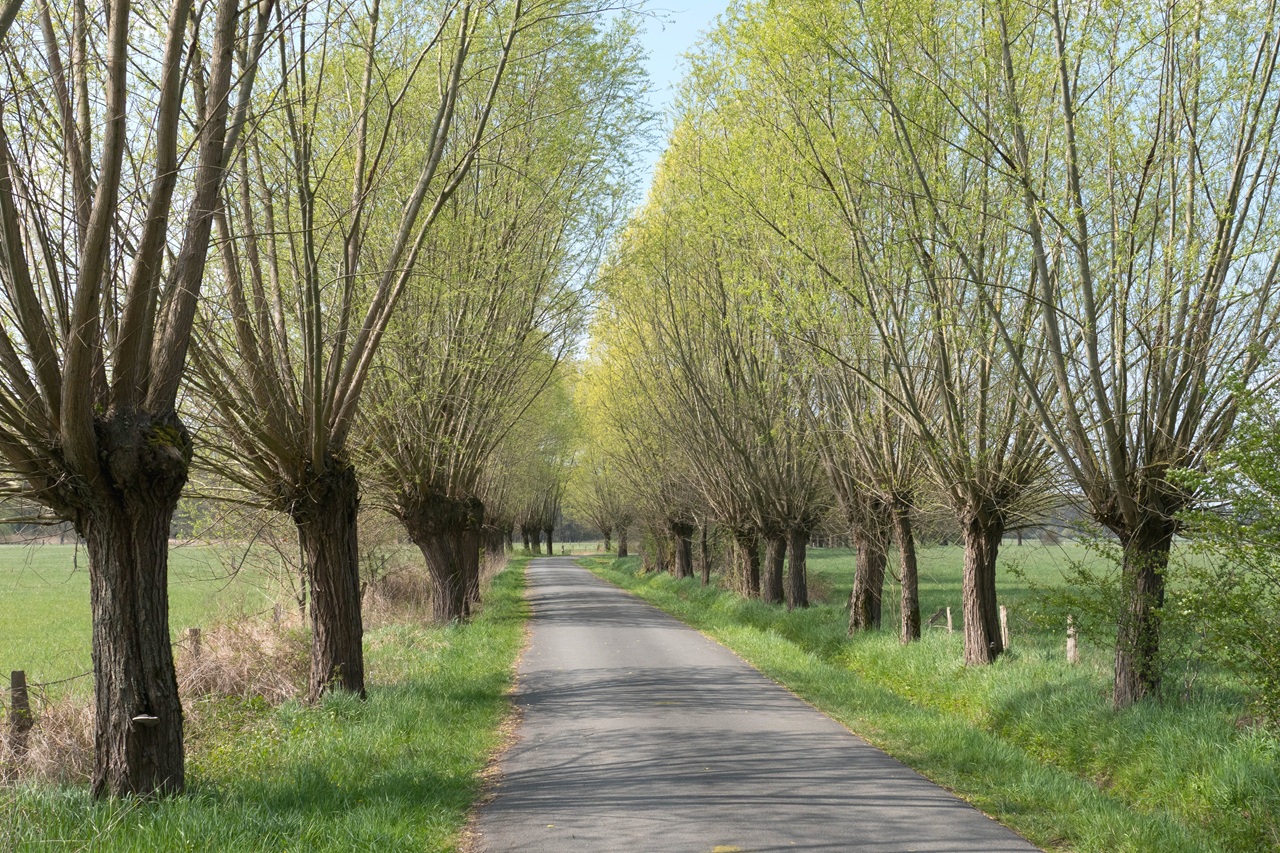
Avenue of pollarded willows maintained by us in 2022 © SPA
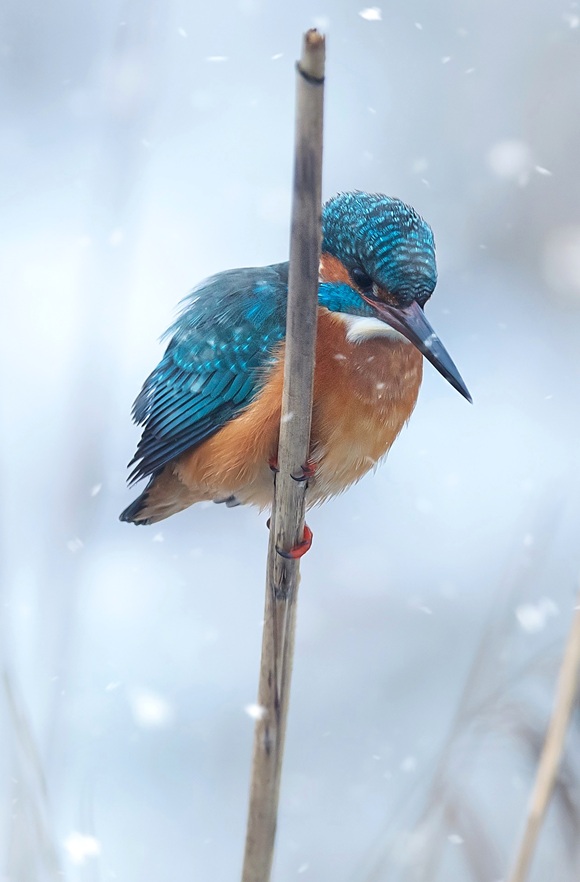
Kingfisher in driving snow © A. Kneifel
We extend our heartfelt Christmas and New Year wishes, along with our sincere thanks, to all who have supported our Foundation's work for the benefit of nature and biodiversity with such dedication and commitment throughout 2025.
Despite political and economic changes in Germany and around the world, our 23rd year of work in species conservation was positive and successful for our nature and species protection projects. Thanks to the continued financial support of many long-standing, loyal donors and sponsors, as well as new donors and sponsors, we were able to consistently conduct our statutory project work in 2025. Once again, you deserve our heartfelt thanks.
We would also like to express our heartfelt thanks to the tenants and area managers of our Foundation's nature conservation areas for implementing our statutory objectives, and the species protection land use guidelines designed for this purpose, with great competence and passionate conviction for the benefit and consolidation of our biotope habitats and the diversity of wildlife species that is found there.
We are well prepared and optimistic as we enter our 24th year of work in species protection, and we will continue to develop our existing nature and species conservation projects with great passion. We are particularly looking forward to working with you to successfully address the challenges ahead for new nature and species conservation projects in Germany and Italy.
The teams at the Foundation Pro Biodiversity in Bielefeld and Sicily wish you and your families a peaceful and joyous Christmas and a happy and healthy New Year in 2026!
Thank you for your loyalty and your continued support.
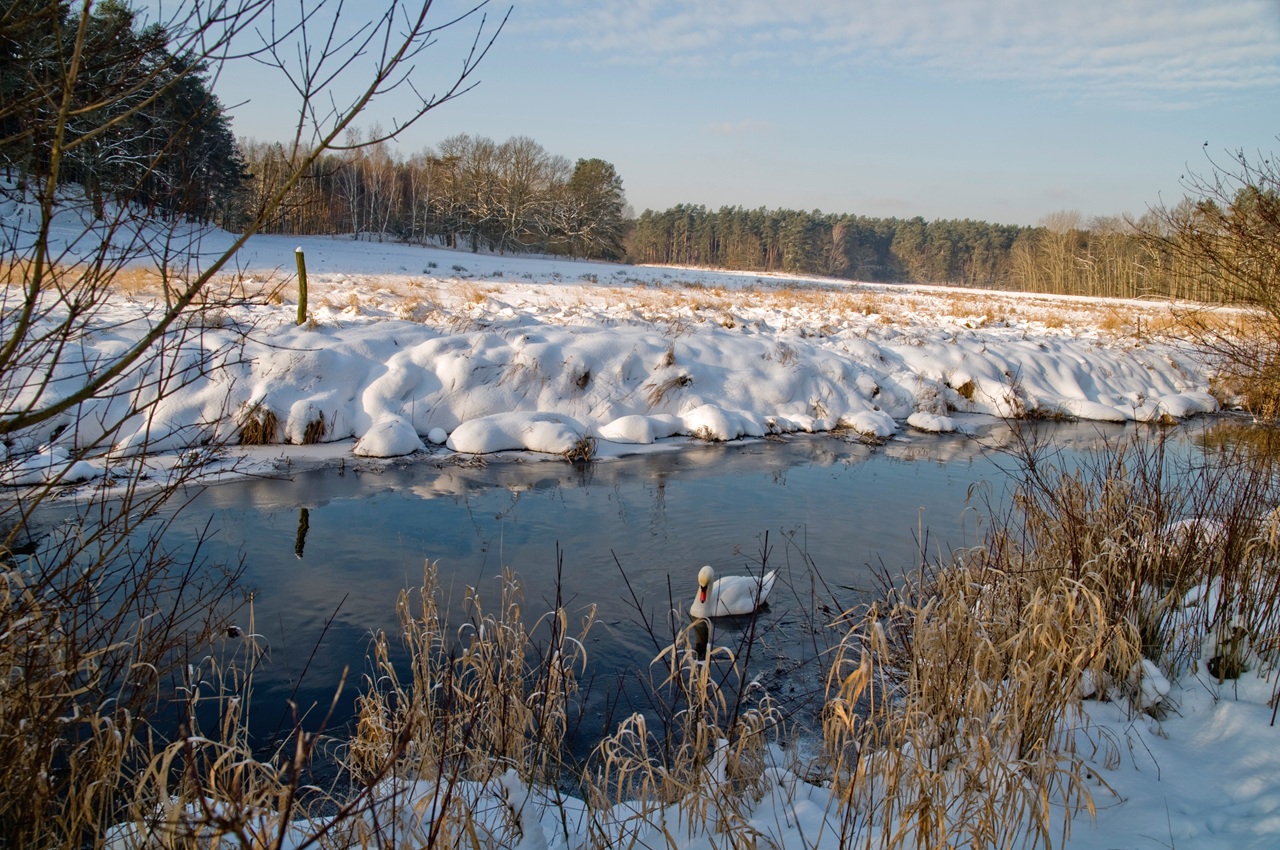
Our wintry Finowtal lowland moor conservation area © SPA
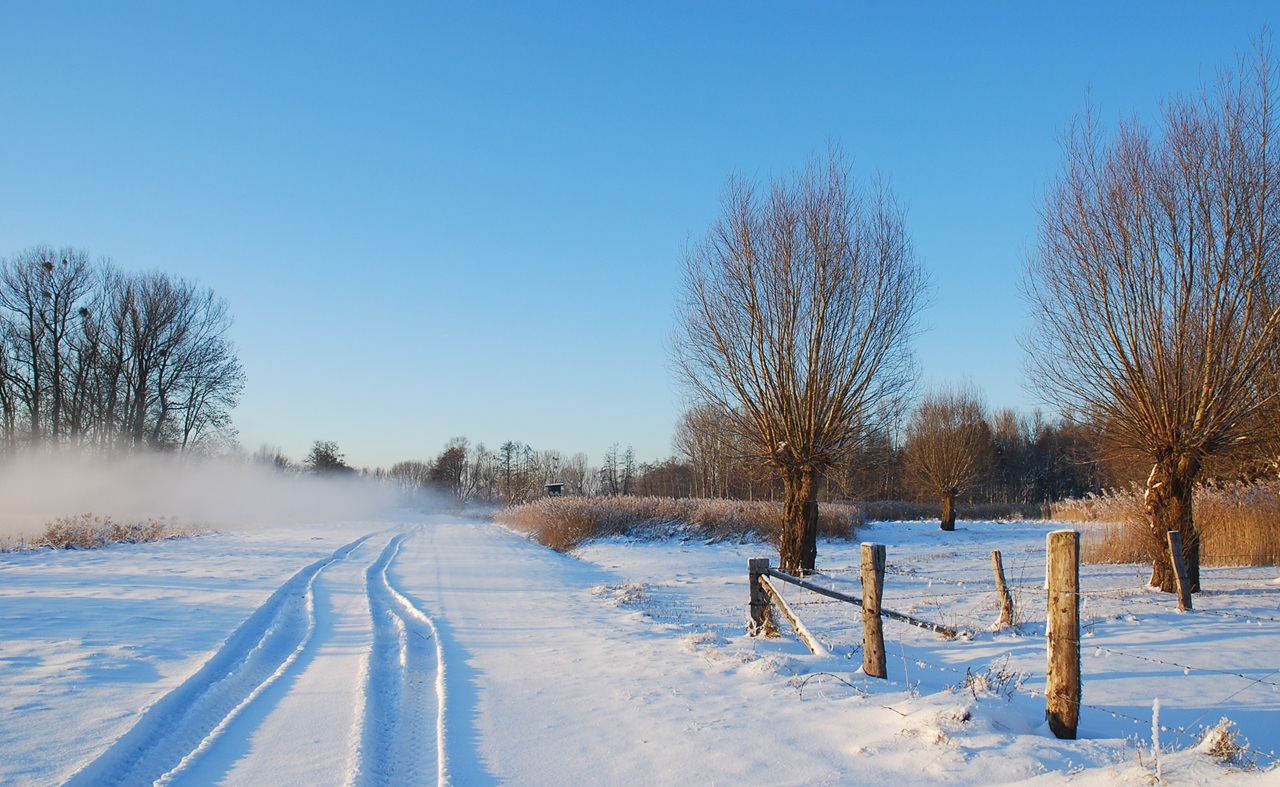
Our Little Owl Conservation Project – Pollarded Willow maintenance in the Paderborn Region © SPA
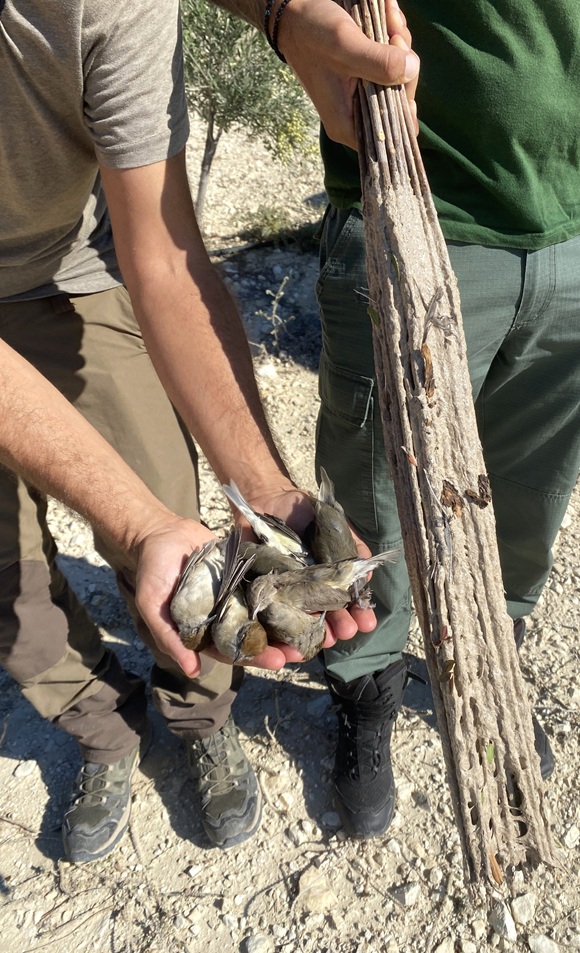
Dismantled limesticks and songbird victims © Committee Against Bird Slaughter (CABS)
Cyprus Bird Protection Camp / Final Report Autumn 2025
The Autumn Bird Protection Camp special operations ‘Occupy Akas’ and ‘Dead Air’ required our bird protection teams to carry out extensive and time-consuming on-site preparations for the missions and a variety of media activities. However, the results were well worth the effort.
The Autumn Bird Protection Camp, which has now come to an end, will be remembered as a milestone in our bird protection efforts against the ‘big players’ in the bird slaughter business in Cyprus. For many years, we have fought in vain against the mass industrialised illegal trapping of migratory birds by ‘Akas’ and ‘Trikkis’ (our code names). Their social status and influence, as well as their extensive network in the bird slaughter scene, have regularly prevented even politicians and the police from consistently enforcing the applicable laws.
The previous ‘cheap’ fines did not prevent their bird slaughter activities for even a single day. With our actions this year and the extensive publications and professional media work, the police could no longer ignore these serious violations of the applicable EU Birds Directive and Cypriot nature conservation laws. As a result, an anti-terrorism police unit was also deployed during police operations on the properties of ‘Akas’ and ‘Trikkis’. ‘Akas’ was caught three times engaging in illegal bird trapping with nets, and ‘Trikkis’ five times!
The result was that these bird slaughter professionals finally received hefty fines totalling almost €150,000! In bird-slaughter currency, this corresponds to the proceeds from 40,000 to 50,000 illegally killed songbirds, which small-time bird poachers can obtain from black-market bird dealers.
The successes against the ‘big players’ did not dissuade our bird protection teams from investing another eight weeks of work in searching for trapping and hunting sites, monitoring and documenting illegal bird trapping and hunting activities in a manner admissible in court, dismantling illegal trapping equipment and filing further criminal charges.
The overall results of this year's autumn bird protection camp in Cyprus are equally impressive.
Overall results of the CABS & SPA Autumn Bird Protection Camp 2025 on Cyprus
(10 September – 25 November):
Bird trappers / illegal bird hunters
The good news for migratory birds that have chosen Cyprus as their wintering ground is also bad news for Cyprus's bird poachers and hunters: Cyprus, we'll be back. Our bird conservationists will soon return for the Winter Bird Protection Camp on Cyprus... That's a promise!
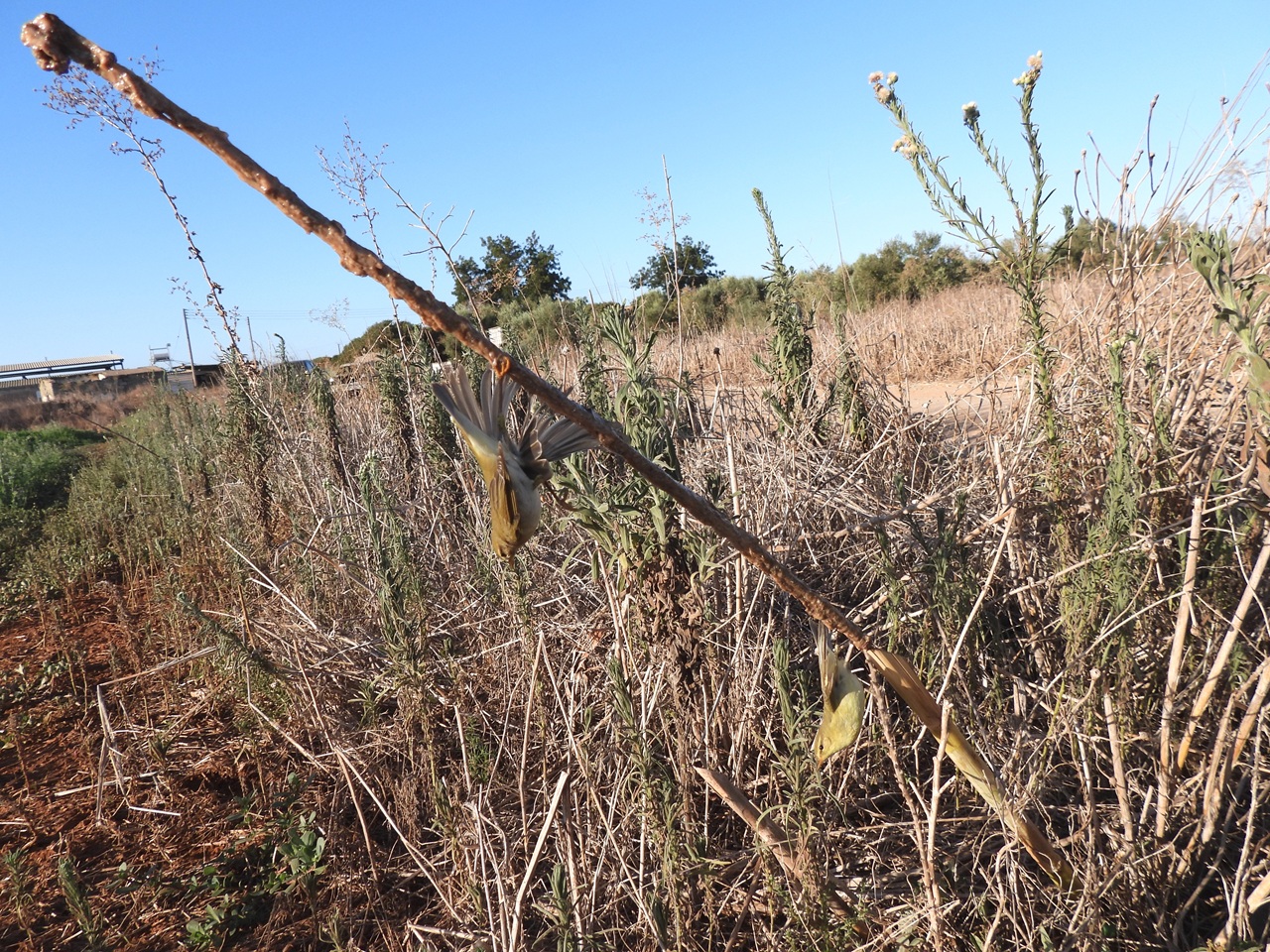
Willow Warbler caught on an illegal limestick © Committee Against Bird Slaughter (CABS)
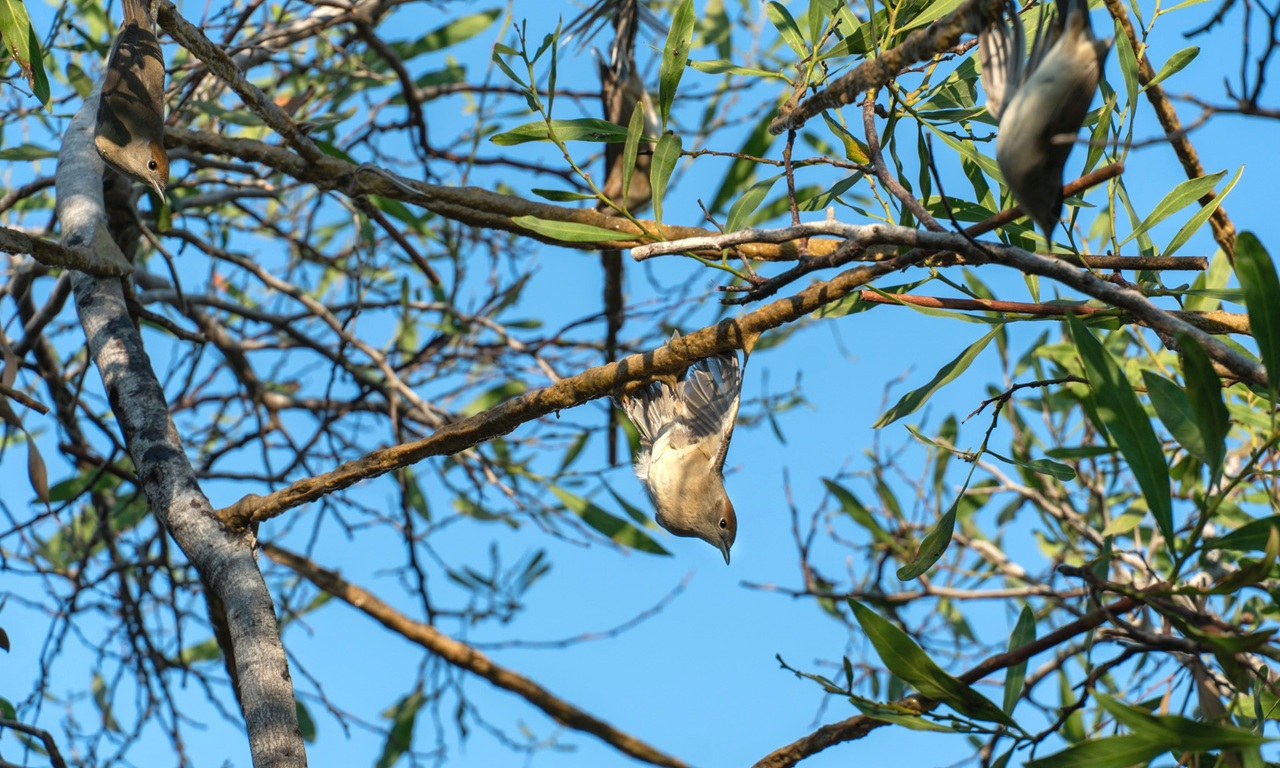
Spot the birds: how many Eurasian Blackcaps are trapped on the limesticks? © Committee Against Bird Slaughter (CABS)
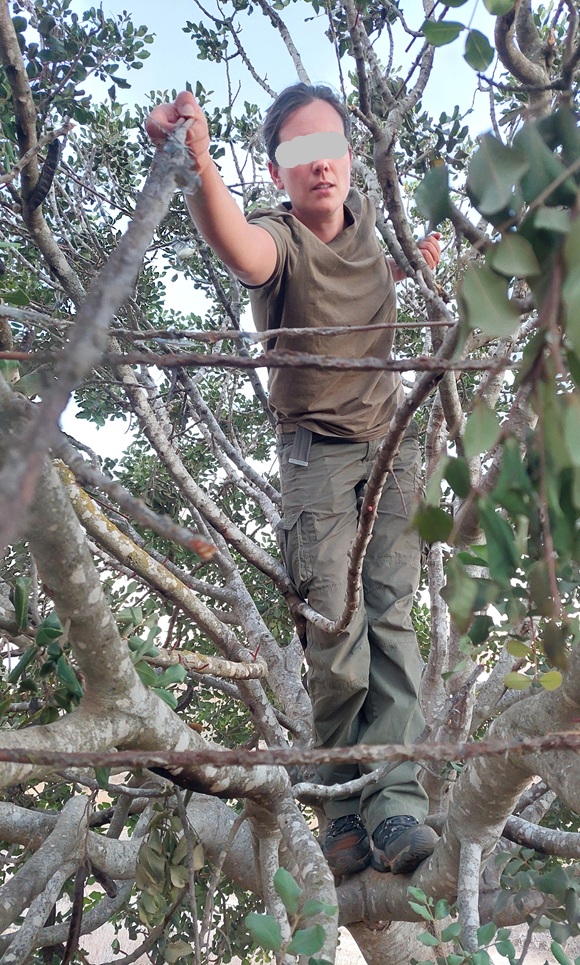
Bird conservationist removing illegal limesticks © Committee Against Bird Slaughter (CABS)
2nd Cyprus Bird Protection Camp Report 2025
The special operations “Occupy Akas” and “Dead Air” have also brought very positive results. Although both operations ran only for several days and ended around 2 weeks ago, they achieved results that had never been accomplished before. The Cyprus Police finally recognised professional trapping as a serious issue that needs to be dealt with.
They carried out several well-organised anti-poaching operations against the two biggest trappers in Cyprus: Akas and Trikkis. In total, the Cyprus Police seized 15 nets from Akas and 16 nets from Trikkis. During one particularly successful operation at the Akas site, police found seven nets set and freed 350 migrating birds from the nets. At Trikkis' site, police found 11 nets set and freed 150 birds. A further 150 birds were already dead when police officers arrived at the trapping location.
As a result of police operations, Akas has been issued a fine totalling 30,000 euros. Trikkis was fined the same amount. It is the first time in the history of our Cyprus Bird Protection Camps that the big trappers were confronted with such hefty fines.
Overall results of the CABS & SPA Autumn Bird Protection Camp 2025 in Cyprus from 10 September to 10. October:
Bird trappers
Bird hunters
We hope very much that the Cyprus Police will continue such consequent operations against big trappers until the end of the autumn bird migration period and the corresponding trapping season. This is the only way to put a stop to professional bird poaching, which makes a lot of money from illegally killed songbirds.
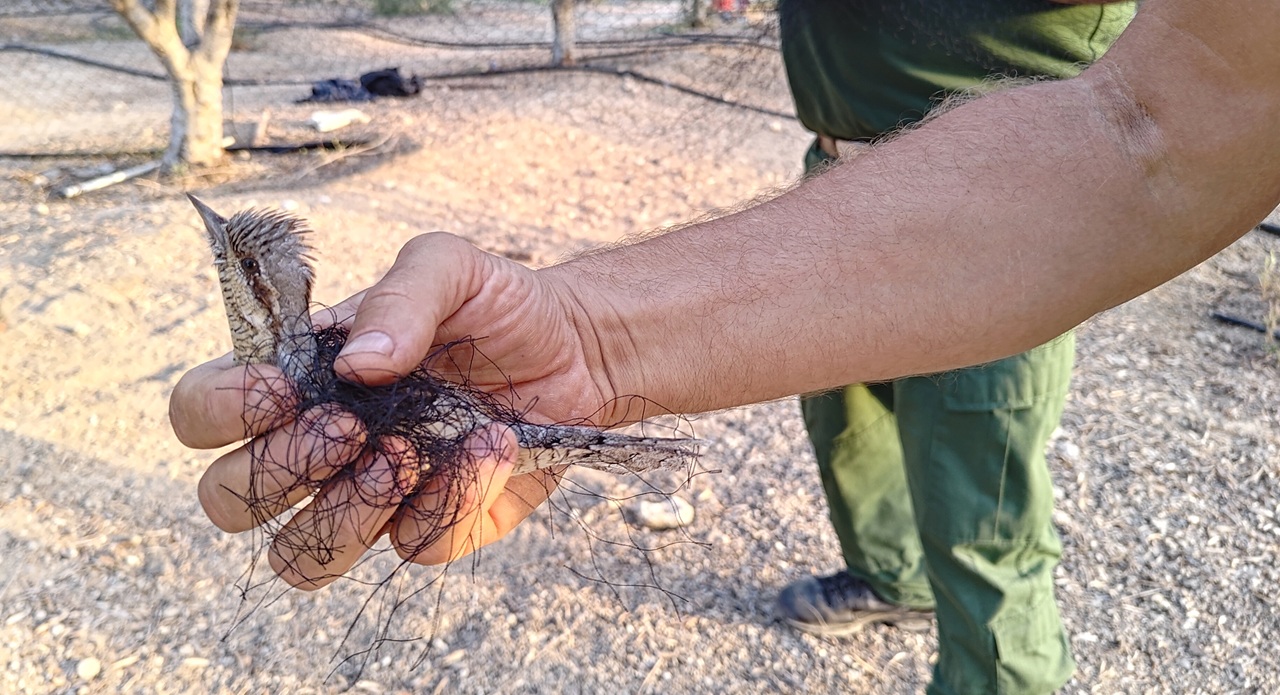
Eurasian Wryneck cut out of a mist net © Committee Against Bird Slaughter (CABS)
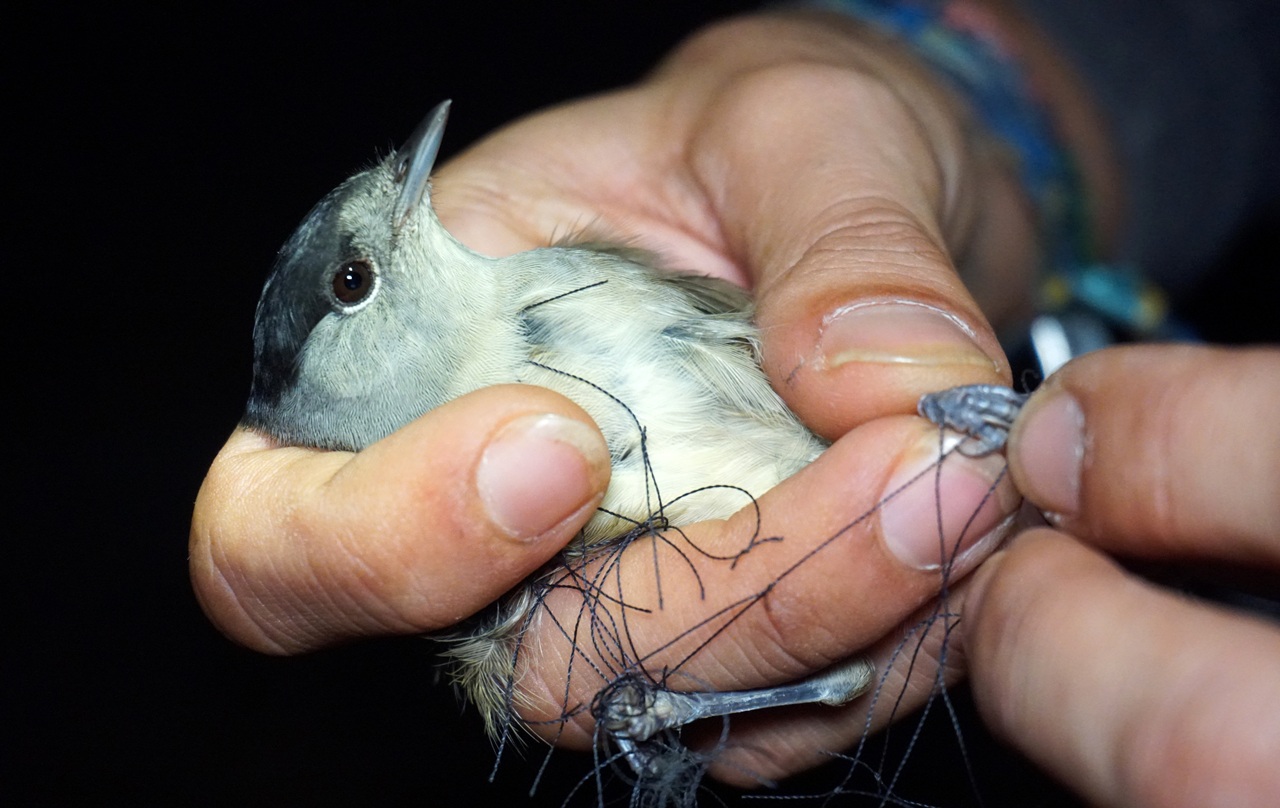
Male Eurasian Blackcap freed from a mist net © Committee Against Bird Slaughter (CABS)
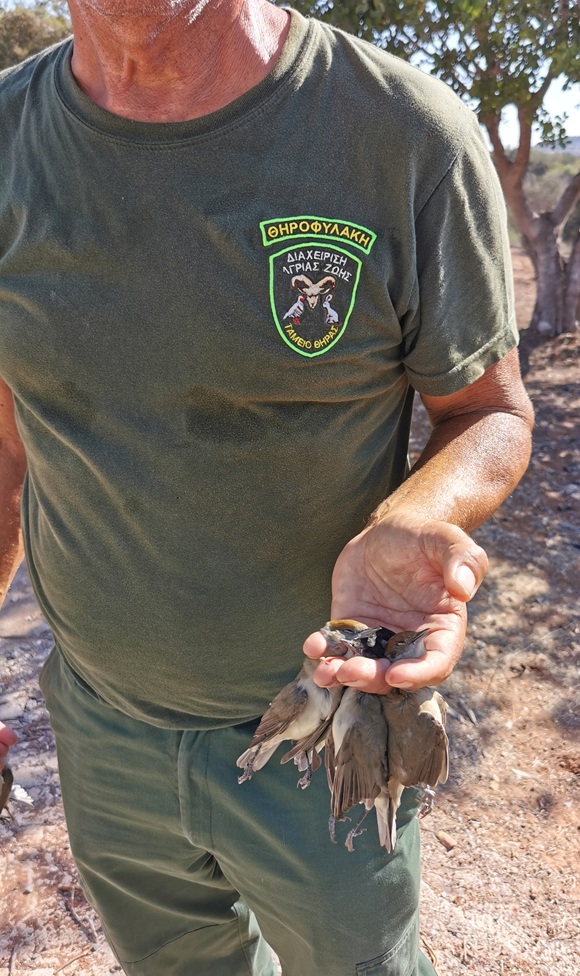
State game warden with confiscated songbird victims © Committee Against Bird Slaughter (CABS)
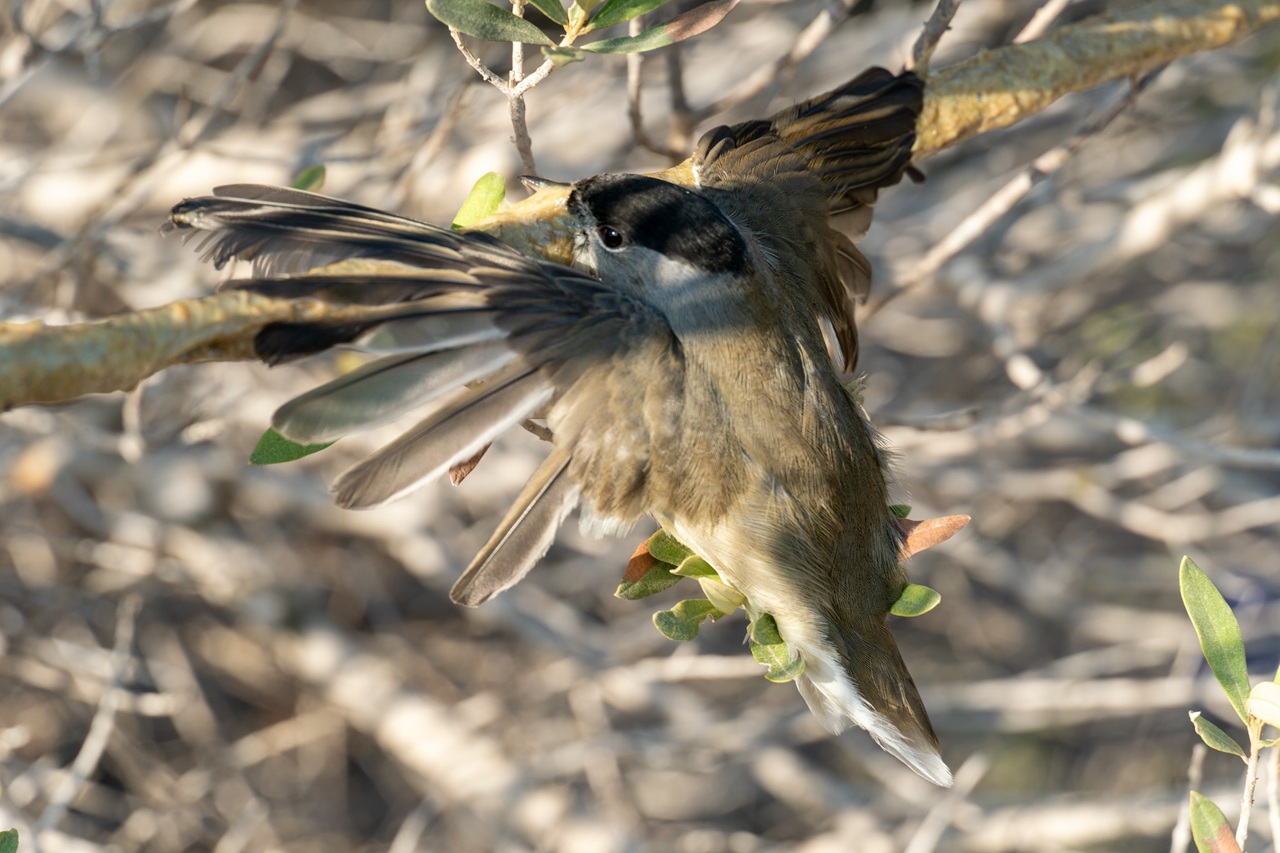
Male Eurasian Blackcap caught on a limestick © Committee Against Bird Slaughter (CABS)
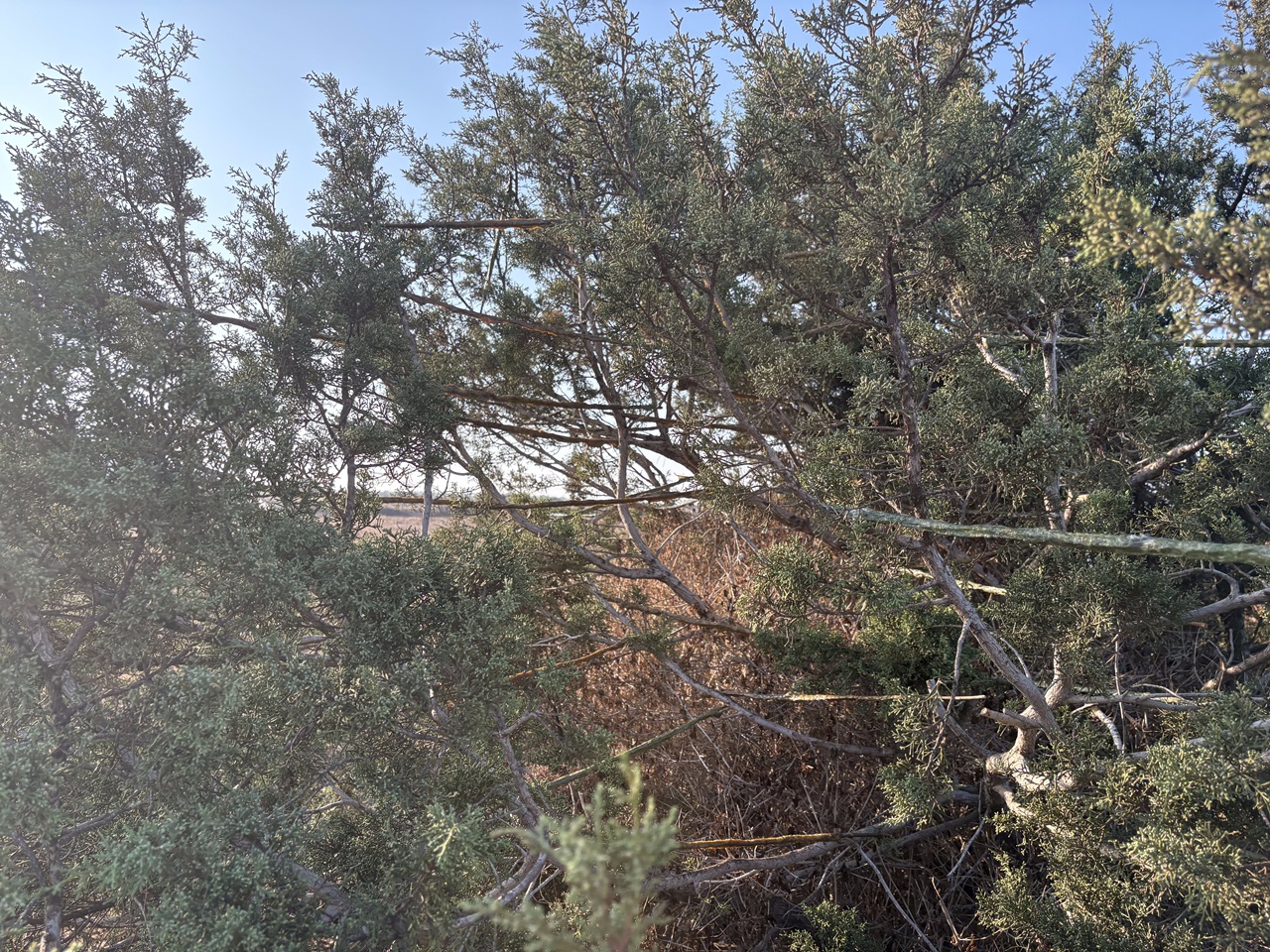
Bush with 15 prohibited limesticks installed © Committee Against Bird Slaughter (CABS)
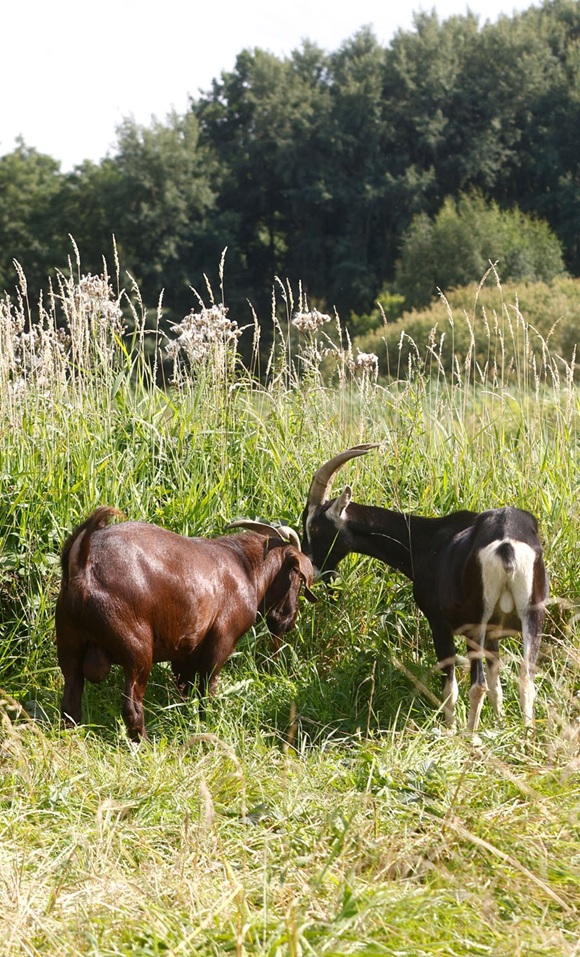
Voracious goats carrying out biotope maintenance work © M. Pfeifer
The preliminary work was lengthy and sometimes very difficult, but a milestone has now been reached at the "Schimmels Teiche" near Limbach-Oberfrohna in Saxony …
After completing approximately one and a half kilometres of sturdy electric pasture fencing, two water buffaloes have now joined the three hungry billy goats in our unique biotope with nine former fish ponds. And with a Scottish Highland cow arriving soon, we will have further reinforcement for biotope maintenance!
With their almost limitless appetite, these animals not only ensure that blackberries, shrubs and invasive Japanese knotweed are kept at bay on the pond banks, but also reduce the excessive growth of bullrushes in the ponds. These still benefit from the mud at the bottom of the ponds, which is heavily fertilised by fish excrement.
Only by reducing the biomass in and around the ponds will the water bodies and pond banks be able to develop in a variety of ways and, following the end of intensive fish farming four years ago, become species-rich biotopes.
Building the pasture fence was not the only challenge on the approximately 12-hectare pond area, which has been owned by our foundation since 2023. The extensive renovation of the pond drains, repairs to the stream inlets and careful reed cutting in an overgrown pond required a lot of work and also cost a considerable amount of donated money. Further biotope work is planned for the coming winter half-year 25/26.
The presence of the semi-wild grazing animals and the sturdy, electrified fence will also ensure that, after years of unauthorised trespassing and recreational use of our property, peace and tranquillity will finally return to this ecologically sensitive pond area.
From now on, the focus here is no longer about human activities, but about protecting the habitat of endangered bird species such as Marsh Harriers, Bluethroats and Reed Warblers, and endangered amphibians such as the Common Spadefoot Toad and the Smooth Newt.
Conservationists from the Limbach-Oberfrohna region, including well-known ornithologists, are already enthusiastic about our pond project, which will certainly bring many positive benefits for biodiversity, which is under threat in many places, over the next few years!
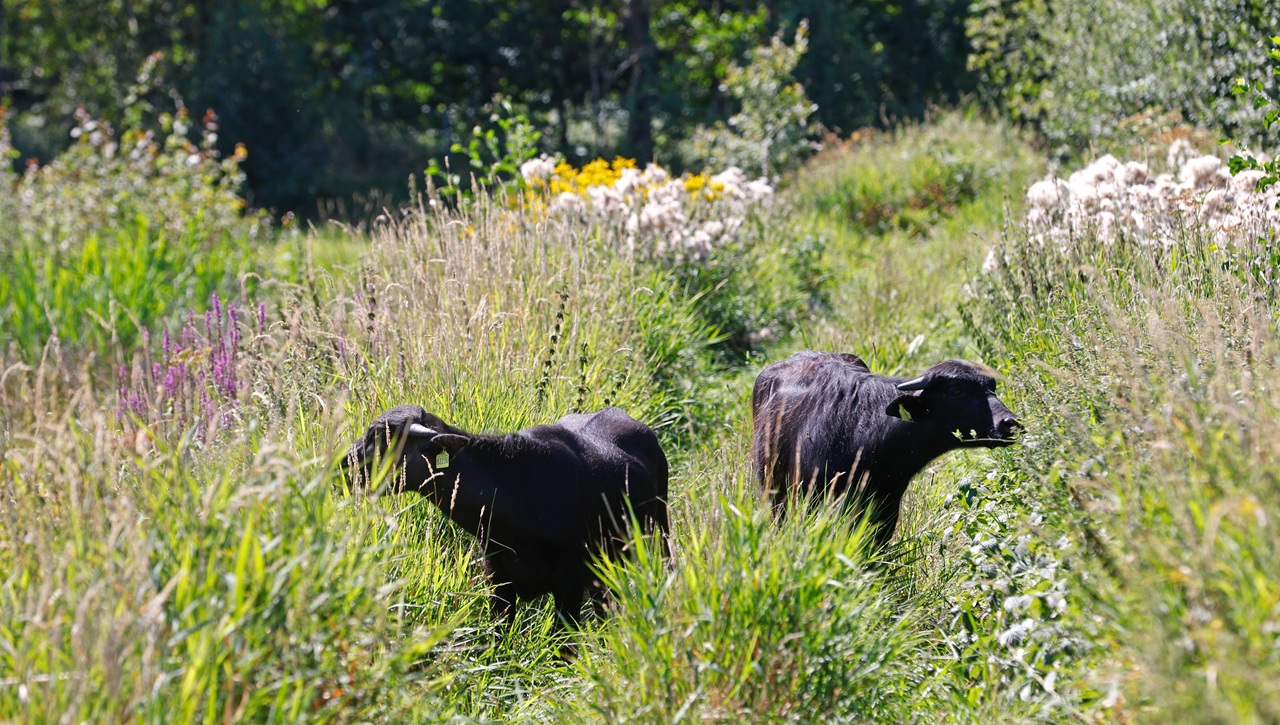
Young water buffaloes are not fussy eaters © M. Pfeifer
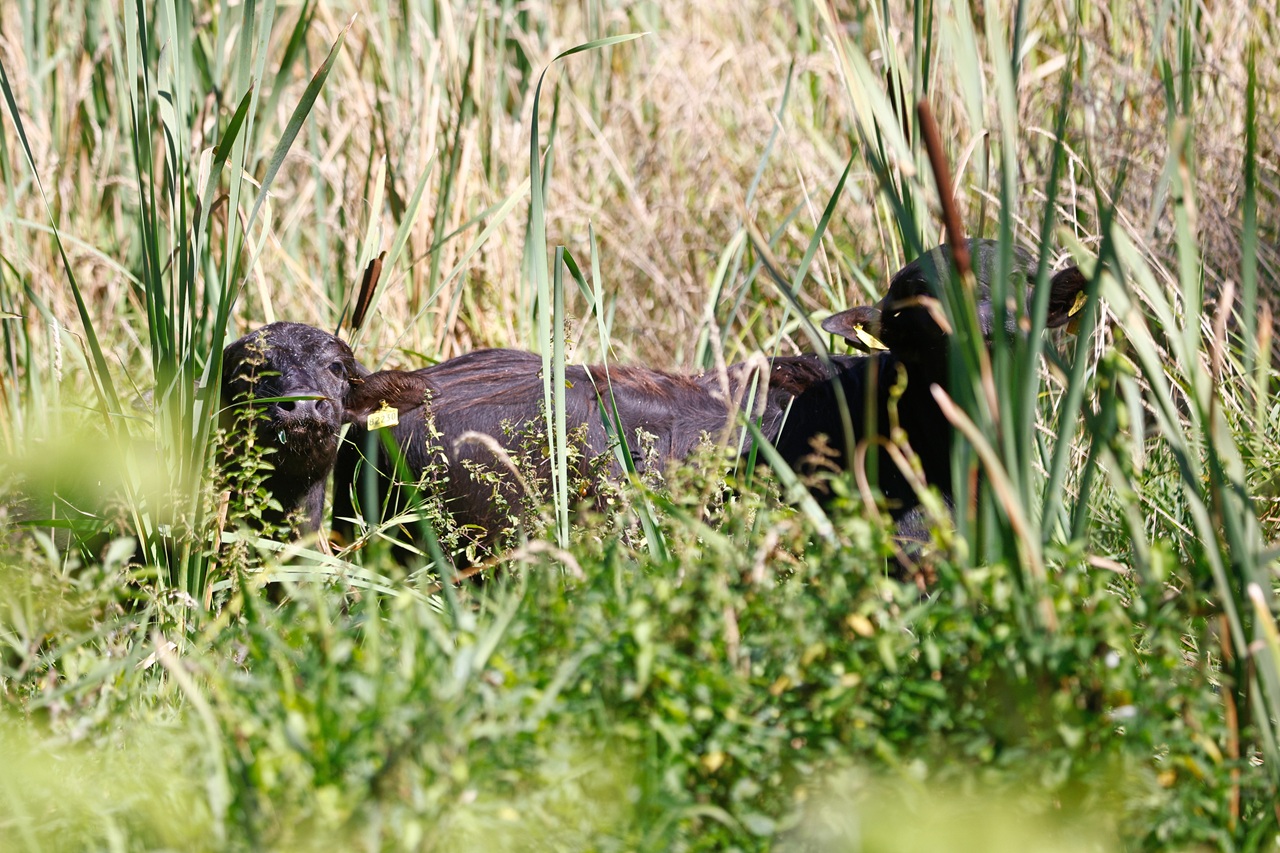
Water buffaloes enjoy the cooling ponds and shelter © M. Pfeifer
Just 30 years ago, Great Egrets were an absolute rarity in Germany. Today, they are a familiar sight in many places. The story of Egret K195 is particularly remarkable: since 2018, it has been turning up time and again in our Frose nature reserve during the summer... more information

Following the successful spring bird conservation camps on Cyprus and the Greek island of Zakynthos, our local bird conservationists in Cyprus are once again standing up to the illegal operations of bird poachers and hunters. Yet again, we need your active support so that we can continue our campaign against the slaughter of migratory birds this autumn ... to the project
Postbank Hannover IBAN: DE47 2501 0030 0905 9063 07 BIC: PBNKDEFF
Stiftung Pro Artenvielfalt Meisenstraße 65 33607 Bielefeld Germany Tel. (0049) 0521 2997-883 / -884 / -889 Fax (0049) 0521 2997-885 Office Mo - Fr. 09.00 to 16.00
Foundation Management team@stiftung-pro-artenvielfalt.org Project Management projekte@stiftung-pro-artenvielfalt.org Donations, Donor Care service@stiftung-pro-artenvielfalt.org
 Donate now